



NTN Antenna Lightweight Design Achieves 47% Reduction Through Innovative Heat Dissipation Device
Revolutionizing NTN Satellite Communication: A Leap in Antenna Design
In an exciting development for satellite communication technology, a collaborative effort between the National Institute of Information and Communications Technology (NICT), Sharp Corporation, Mitsubishi Chemical Corporation, and TECHLAB has resulted in a groundbreaking lightweight design for Non-Terrestrial Network (NTN) flat antennas. By introducing an innovative heat dissipation device, the team successfully reduced the weight of these antennas by an astonishing 47%, from 5.5 kg to just 2.9 kg.
The Challenge of Heat Dissipation in NTN
Satellite communication is essential in remote and challenging environments where traditional terrestrial communication methods fall short, such as mountainous regions, offshore areas, and disaster-stricken locations. NTN satellite user terminals must possess robust tracking capabilities for satellites and High Altitude Platform Systems (HAPS), which generate significant heat, necessitating superior heat dissipation performance.
To effectively incorporate NTN flat antennas into various mobile platforms, these antennas must be both compact and lightweight, a goal that until now posed significant engineering challenges. The combined expertise of NICT, Sharp, Mitsubishi Chemical, and TECHLAB has led to the development of lightweight and thermally conductive composite materials that form the basis of a new heat dissipation solution.
Innovative Material Usage
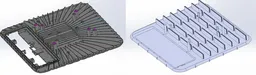
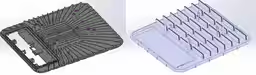
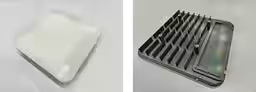
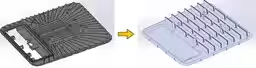
The newly designed heat dissipation device incorporates carbon fiber prepreg and graphite sheets, creating a high-performance composite material known as CFRP (Carbon Fiber Reinforced Polymer). This material not only achieves a dramatic reduction in weight but also enhances thermal conductivity, addressing key challenges faced by previous aluminum-based designs. NICT spearheaded the design efforts, establishing essential guidelines based on weight and thermal conduction issues. They undertook significant research into material composition and device structure to optimize performance.
Mitsubishi Chemical contributed to this advancement by developing the carbon fiber prepreg and graphite sheets, crucial components for the lightweight device. Meanwhile, TECHLAB established the necessary design and molding technologies to manufacture the CFRP heat dissipation device, achieving a remarkable weight of under 1 kg for this component alone.
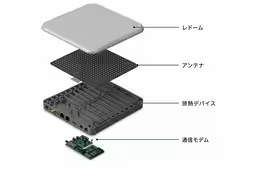
Sharp integrated this new heat dissipation technology into the NTN flat antenna, realizing a performance-enhancing weight reduction that opens the doors for practical satellite communication applications. Testing confirmed that the antenna's performance characteristics fell within acceptable error margins, ensuring reliability in various operational conditions.
Testing and Verification of the User Terminal
The enhanced NTN antenna system has also been tested within an operational satellite communication user terminal, which includes integrated modem functionality. This modular setup demonstrates that the lightweight terminal can easily be deployed on various platforms such as drones and vehicles, significantly broadening the practical applications of NTN technology in real-time data transmission, navigation, and automated driving functionalities.
Future Prospects
Moving forward, the collaboration intends to enhance the evaluation of heat dissipation performance and implementation aspects while exploring optimal design iterations tailored to specific terminal configurations and purposes. Continuous prototyping and validation efforts are planned to develop ultra-lightweight satellite communication user terminals for a range of mobility applications, paving the way for advanced NTN systems.
Roles of the Collaborating Organizations
- - NICT: Responsible for the overall design and simulation of the NTN antenna, including heat dissipation devices and lightweight strategies.
- - Sharp: Developed and evaluated the integrated NTN flat antenna, ensuring functionality within the user terminal framework.
- - Mitsubishi Chemical: Focused on the development of advanced materials for use in heat dissipation devices.
- - TECHLAB: Specialized in the design and molding techniques for the CFRP-based heat dissipation system, facilitating the weight reduction objectives.
In conclusion, this collaborative advancement marks a significant milestone in NTN technology, promising secure and efficient satellite communication solutions that cater to diverse mobility needs, destined to shape the future of mobile communications.
Topics Consumer Technology)
【About Using Articles】
You can freely use the title and article content by linking to the page where the article is posted.
※ Images cannot be used.
【About Links】
Links are free to use.