



Nexthink Report Reveals Millions of Work Hours Lost Annually Due to Digital Disruptions
Nexthink Report Reveals Millions of Work Hours Lost Annually Due to Digital Disruptions
In an alarming revelation, Nexthink, a global leader in Digital Employee Experience (DEX) management software, has released its "Digital Workplace Productivity Report 2025." This report indicates that companies are losing an average of 470,000 hours annually due to digital experience deficiencies, contributing to a staggering indirect loss that extends into the millions. Through a study of 474 large global enterprises, employing a total of over 20 million endpoints, the data exposes significant insights into the productivity crisis faced by many organizations.
According to the analysis, each employee loses approximately 35 hours per year due to various digital disruptions such as application failures, device crashes, and slow loading times. In monetary terms, this loss translates to an estimated $6 million per company when based on an average hourly wage of 1,270 yen in Japan.
Employees are reported to encounter an average of 14 digital experience disruptions each week, which not only hampers productivity but also fosters increased frustration and stress among the workforce. Importantly, the report highlights a strong inverse correlation between DEX scores and productivity declines. A mere increase of 10 points in DEX scores allows employees to reduce wasted time by an average of 22 minutes per week.
Takeshi Hagino, President of Nexthink Japan, emphasized the massive cumulative impact of poor DEX, stating that employees plagued by digital frustrations experience an 80% productivity drop compared to those who enjoy good digital experiences. Consequently, companies collectively lose millions of hours of productivity due to technological discrepancies.
The situation in Japan is particularly dire. The working-age population peaked in 1995 and is projected to plummet to 52.75 million by 2050, a decrease of 29.2% compared to 2021 figures. Additionally, Japan ranks 29th out of 38 OECD countries in hourly labor productivity, showing productivity levels around 60% compared to the United States.
For Japanese businesses grappling with declining labor force numbers and low productivity rates, enhancing DEX is not merely an IT investment but a critical management strategy for survival. Investing in quality DEX is viewed as one of the most effective ways to maximize results with limited personnel.
The findings reveal that continuous interruptions in work do not solely diminish productivity; they also degrade the quality of employee output. An average negative experience lasts just under three minutes, but research from the American Psychological Association indicates that even a break of less than five seconds can triple errors among knowledge workers. Moreover, a study from the University of California found that once a state of flow is disrupted, it can take approximately 23 minutes to regain that engagement, subsequently exacerbating lost time.
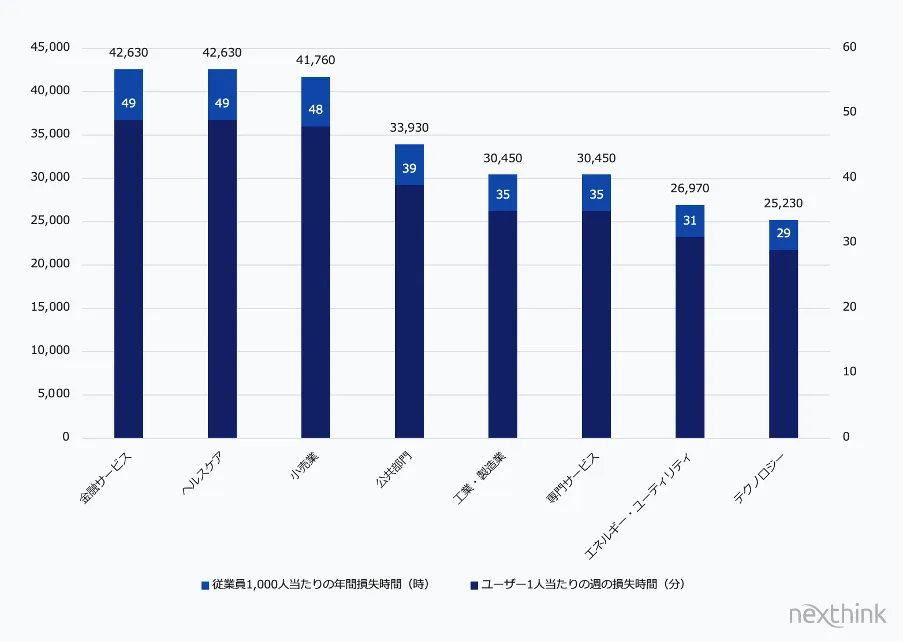
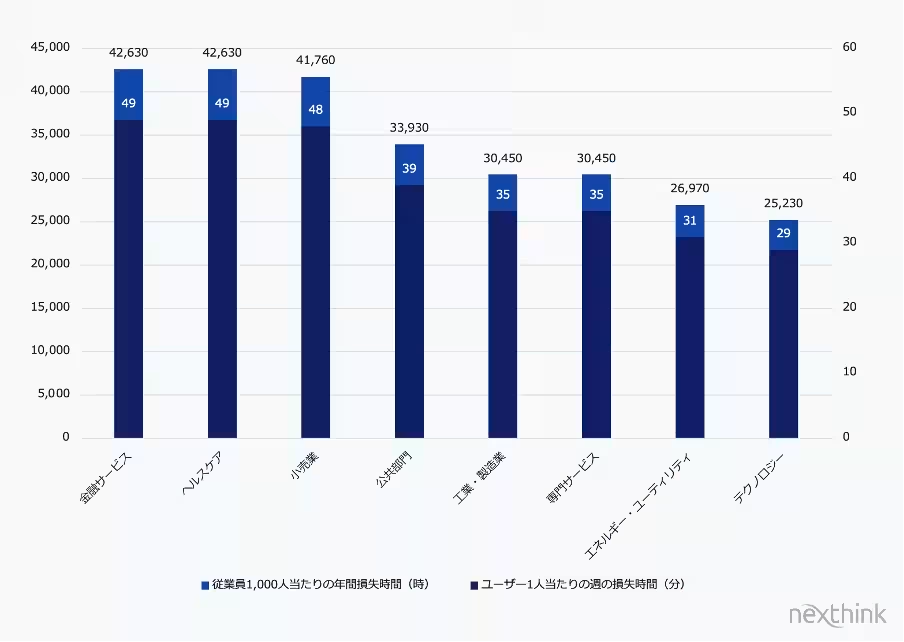
When considering industry averages for downtime, sectors like retail, healthcare, and financial services experience nearly twice the downtime compared to the tech industry. However, it appears that, regardless of the sector, the number of disruption events per week was similar, indicating that variation in downtime is more attributable to the severity of disruptions than their frequency.
Hagino warns, "Even small digital setbacks can lead to hours of lost productivity. Often, these incidents escalate to situations where employees waste an entire day. This isn't merely a problem of company-wide productivity; digital friction can push employees to their limits, making them feel stuck or abandoned. If IT departments do not tackle these underlying issues, firms risk losing talented workers to competitors, diminishing collaboration, and falling behind in the innovation race—all of which inevitably threaten their profitability."
To discover more about how DEX impacts workplace productivity, visit the Nexthink blog.
About Nexthink
Nexthink is a leader in Employee Digital Experience management software. The company provides IT leaders with unprecedented insights, enabling them to proactively grasp, diagnose, and resolve issues that affect employees across applications and networks before they even recognize them. This first-of-its-kind solution allows IT to shift from reactive problem-solving to proactive optimization. Supporting over 1,200 client organizations and impacting more than 15 million employees, Nexthink is headquartered in Lausanne, Switzerland, and Boston, Massachusetts.
Topics Consumer Technology)
【About Using Articles】
You can freely use the title and article content by linking to the page where the article is posted.
※ Images cannot be used.
【About Links】
Links are free to use.