



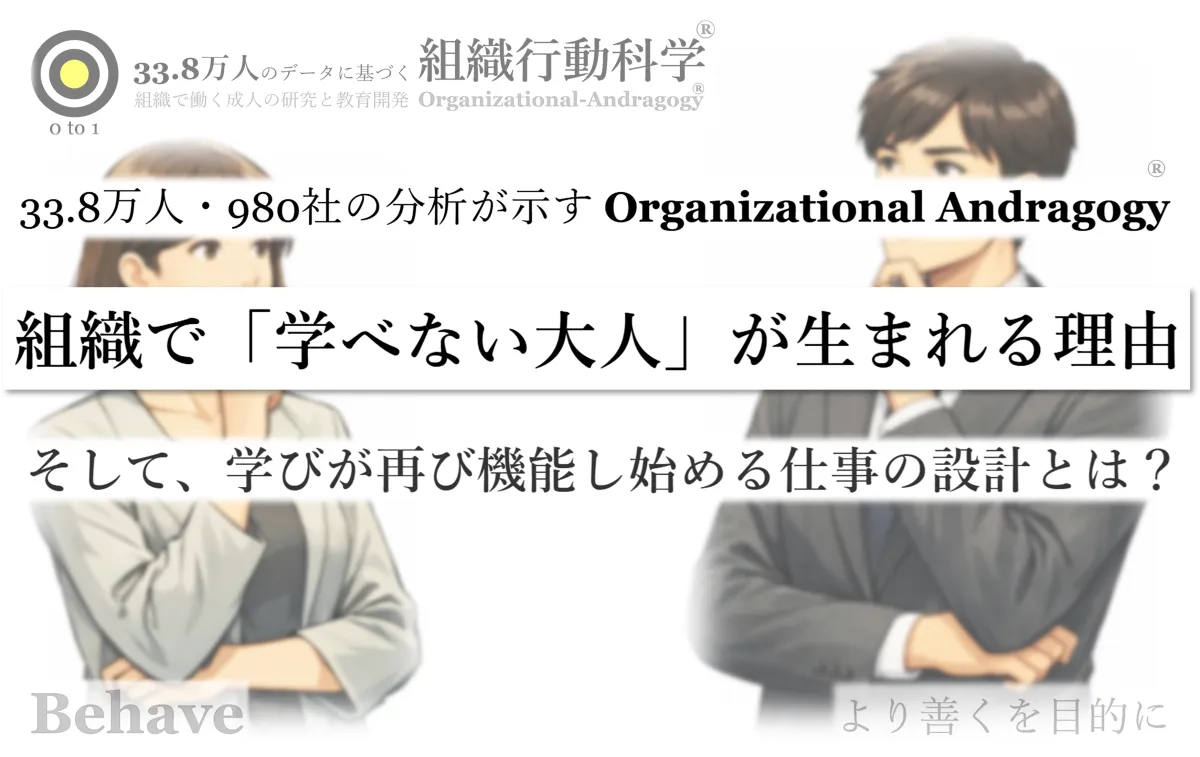
Understanding the Emergence of 'Unlearnable Adults' in Organizations
The Emergence of 'Unlearnable Adults'
In a comprehensive study analyzing behavioral data from 338,000 individuals and 980 companies, Request Inc. has shed light on a pressing issue in many organizations: the rise of "unlearnable adults." Their report, titled "Why are There 'Unlearnable Adults' in Organizations? And What are the Designs That Facilitate Learning Again in Work?" seeks to unravel the structural reasons why learning stalls in workplace environments and offers insights on how to redesign work to reignite learning.
The Core Issue: Designing Work, Not People
Despite increased training sessions and the sophistication of learning materials, many organizations face significant challenges. Observations across industries indicate persistent phenomena such as:
1. Outdated criteria for decision-making in the field.
2. A lack of personnel who can be entrusted with responsibilities.
3. Centralized decision-making under changing environmental conditions.
This report posits that the root causes of these issues do not lie within individual motivation or the inadequacy of training programs. Instead, it suggests that the assumption that work functions without ongoing learning has become embedded in organizational frameworks through a series of rational management decisions.
The Role of Precedents
In its original form, precedents are meant to serve as reference points to assist in decision-making. However, as the optimization for stable operations progresses, the reliance on past precedents transforms them from a guide to a substitute for judgment. This shift can lead to critical judgments and insights becoming lost:
- - The rationale behind choices made.
- - The reflection on outcomes.
Consequently, this cycle of learning—judgment, results, reflection, and subsequent decision-making—quietly erodes from workplace culture.
Moving Beyond Mere Recommendations
The primary aim of this report is not merely to identify the causes behind the stagnation of learning; it is about defining actionable specifications for work that foster a healthy cycle of decision-making and learning. Specific points addressed include:
- - The minimum conditions necessary to ascertain that a judgment has been made.
- - The criteria to evaluate that reflection has taken place.
- - Determining whether judgment criteria are being updated or reused.
The proposal emphasizes measuring the operational cycle of learning in the workplace rather than focusing solely on the frequency of training or participation rates.
Continuous Learning without Additional Measures
The conclusion drawn from this research is unequivocal: It is not the advancement of training content that initiates learning, but rather the design of work that delineates where judgments originate, how results feedback into the system, and how reflections become the new standards. Once this cycle begins to operate effectively within workplace systems, employees can continue learning through their jobs without the need for additional specialized training measures.
Summary of the Report
- - Title: Why are There 'Unlearnable Adults' in Organizations? And What are the Designs That Facilitate Learning Again in Work?
- - Published by: Human Capital Development Planning® Center
- - Key Highlights:
- Insights into the structural substitution of judgment by precedents
- Reconciliation with adult learning theories
- Implementation specifications for environments conducive to continuous learning
- - Publication Date: January 2026
The Human Capital Development Planning® Center is dedicated to bridging the gap between individual development and the structured cultivation of workplace roles, decisions, and environments. By focusing on the holistic design of work, they aim to enhance individual growth without isolating it as solely an individual issue.
For further inquiries, you can reach them at: [email protected]
Learn more about Request Inc. here.
Download the company profile here.
Director: Tomoyasu Kouhata Profile.

Topics Business Technology)

【About Using Articles】
You can freely use the title and article content by linking to the page where the article is posted.
※ Images cannot be used.
【About Links】
Links are free to use.