



New Developments in Organic Electronics: UHF Rectifier Diode Achieved by Japanese Researchers
Introduction
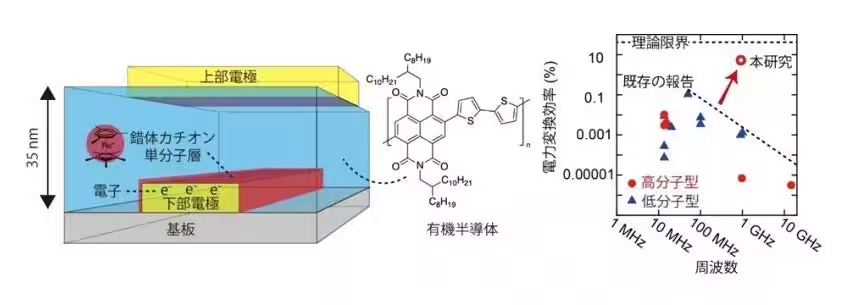
A group of researchers from the University of Tokyo, National Institute for Materials Science (NIMS), Okayama University, and other international partners have achieved a significant advancement in organic electronics. They successfully developed a rectifier diode capable of converting alternating current (AC) power at 920 MHz—classified under the UHF band—into direct current (DC) power with a remarkable efficiency of approximately 5%. This milestone marks the first practical demonstration of such functionality with organic semiconductors, paving the way for innovations in IoT wireless communication technologies.
Research Highlights
The core of this breakthrough lies in the novel technique that introduces locally concentrated electrons to a monolayer of cationic complexes. This process drastically alters the work function of the electrode by over 1 eV, which is crucial for optimizing the performance of the diode. The use of printable organic semiconductors enables the manufacturing of these devices through a cost-effective process, allowing for potential mass production.
The implications of this discovery are profound; the capability to operate at GHz frequencies expands the applications of organic electronics, suggesting that they could be viable for various communication tools in emerging IoT technologies. As wireless connectivity becomes increasingly integral to modern living, these developments hold promise for shaping the future.
Methodology
The researchers utilized ink-like materials to fabricate rectifiers that operate efficiently, demonstrating that organic electronic components can thrive in environments previously thought to be the domain of conventional inorganic systems. Their work involved rigorous experimentation and optimization of materials, leading to the creation of a high-performance diode that stands out in its category.
Innovative approaches included layering techniques that improved charge transport and reduced losses, essential for operating at the UHF band frequencies. The research also highlights the importance of interdisciplinary collaboration, drawing expertise from various fields to achieve this technological advancement.
Publication and Future Directions
The findings were published in the prestigious international journal "Science Advances" on September 19, 2025, under the title "Polymeric microwave rectifiers enabled by monolayer-thick ionized donors". The principal authors of the paper include Nobutaka Osakabe, Jeongeun Her, and Takahiro Kaneta, among others.
The research was supported by various funding agencies, including the Japan Science and Technology Agency (JST) and the Japan Society for the Promotion of Science (JSPS), emphasizing its significance and potential impact.
Conclusion
The successful demonstration of a high-efficiency organic rectifier diode operating in the UHF spectrum opens up new avenues for research and application in the field of organic electronics. With ongoing advancements and a growing interest in sustainable and innovative materials, the future looks promising for organic semiconductors not only in telecommunications but also in a wide array of electronic devices. As researchers continue to push boundaries, this technology could redefine the landscape of wireless communication, emphasizing the role of organic materials in modern electronic applications.
For further inquiries regarding the research or collaboration, interested parties are encouraged to reach out to the respective research teams. This work exemplifies the spirit of innovation and collaboration prevalent within the scientific community, fostering advancements that could benefit society as a whole.

Topics Consumer Technology)
【About Using Articles】
You can freely use the title and article content by linking to the page where the article is posted.
※ Images cannot be used.
【About Links】
Links are free to use.