



New Quantum Material Could Transform High-Speed Electronics
Breakthrough in Quantum Electronics
In a remarkable collaborative effort, researchers from Tohoku University, Okayama University, and Tokyo Institute of Technology have unveiled significant advancements in the field of quantum materials. Their focus is on a specific electronic ferroelectric known as LuFe2O4, which has demonstrated the largest electric polarization change in bulk ferroelectrics to date. This discovery holds the potential for novel applications in high-speed electronic devices.
Key Findings
Recent experiments revealed that when terahertz light is shone on LuFe2O4 at room temperature, the material exhibits unprecedented polarization changes, which are crucial for the development of faster electronics. This substantial alteration in polarization occurs rapidly due to the collaborative effects of numerous electrons within the material, providing a glimpse into the future of super-fast ferroelectric memory and other innovative optoelectronic devices.
The Mechanism Behind the Breakthrough
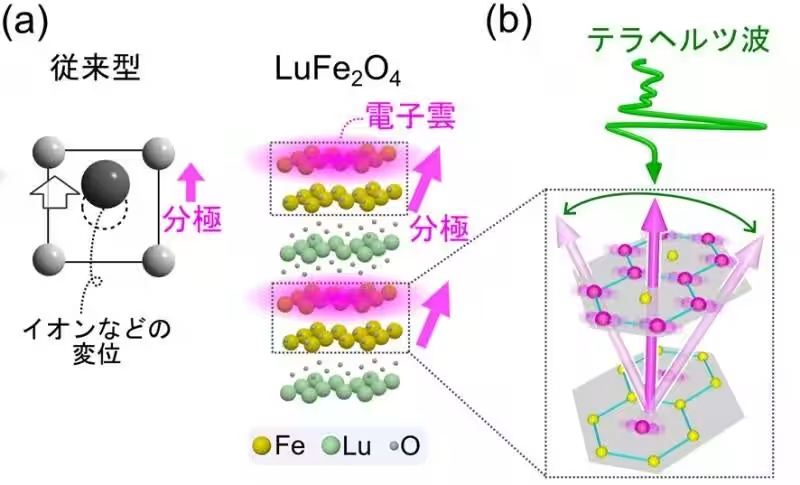
Unlike traditional ferroelectrics that rely on the movement of heavy ions or molecules—causing energy consumption and structural degradation—LuFe2O4 utilizes the deformation of lightweight electron clouds to achieve polarization. This distinction allows for high-speed operations that exceed current technological limits.
The research group, which includes Professor Shinichiro Iwai and Assistant Professor Hirotake Itoh from Tohoku University, as well as several other distinguished scientists from various institutions, has been working diligently to explore the properties of electronic ferroelectrics. Their findings were recently published in the prestigious journal Physical Review Letters, highlighting the collaborative endeavor of multiple universities and research organizations in Japan.
Implications for Future Technologies
The implications of this research are significant in the context of today's digital transformation, as industries strive for electronics capable of operating at terahertz frequencies, which are a thousand times faster than conventional devices. The ability to manipulate polarization in such a manner could revolutionize memory storage and processing speeds, presenting a substantial leap forward in electronic capabilities.
Supporting Research
This study was supported by the Japan Science and Technology Agency (JST) and the Ministry of Education, Culture, Sports, Science and Technology through various research grants. The research team is committed to continuing their exploration into the potential of electronic ferroelectrics, and this work represents just the beginning of what could be a groundbreaking era in materials science and electronics.
Graphical Representation
A schematic provided in the study illustrates the crystal structure and the experimental setup for the research. It highlights the differences in polarization mechanisms between conventional ferroelectrics and the newly studied LuFe2O4. The layers of iron atoms interspersed with rare earth layers allow for the unique polarization effects observed in the experiments.
This breakthrough reflects a new frontier in the field of optoelectronics, driven by advancements in our understanding of quantum materials. Future research will undoubtedly focus on harnessing these properties for practical applications, promising exciting developments in next-generation electronics.





Topics Consumer Technology)
【About Using Articles】
You can freely use the title and article content by linking to the page where the article is posted.
※ Images cannot be used.
【About Links】
Links are free to use.