



Japan Open Chain Unveils Future Development with Tokyo Hardfork Announcement
Japan Open Chain Unveils Future Development with Tokyo Hardfork Announcement
Japan Blockchain Infrastructure Corporation recently announced the long-term development roadmap for its public blockchain, Japan Open Chain, spanning from 2025 to beyond 2030. The company also provided details about the upcoming hard fork dubbed the "Tokyo Hardfork". Additionally, the native token previously known as "Japan Open Chain Token" will now be referred to more commonly as "JOC COIN". This change aims to enhance recognizability and usability for both domestic and international users, facilitating its adoption as a payment and investment medium.
A New Era for Japan Open Chain
According to the announced roadmap, Japan Open Chain plans to evolve into an Ethereum-compatible Layer 1 blockchain with top-tier processing performance, security measures suited for the post-quantum era, and an innovative governance model. The company envisions its platform transforming into a next-generation international financial infrastructure.
Roadmap Overview
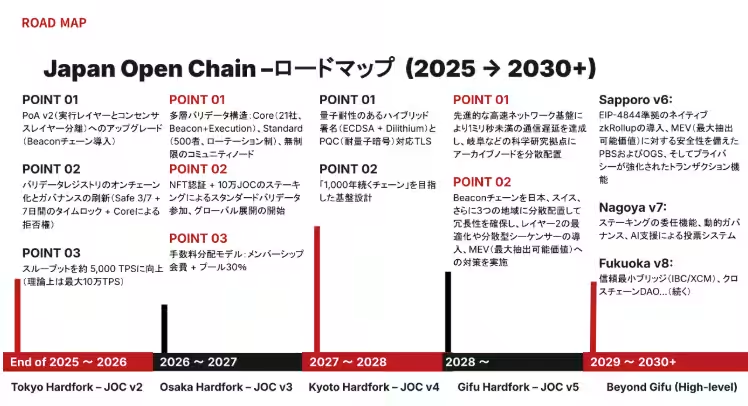
The roadmap is structured around multiple hard forks and new feature integrations, scheduled from 2025 onwards:
1. Tokyo Hardfork (End of 2025 - 2026): Transitioning to PoSA (PoAv2) and synchronizing with Ethereum's Prague/Electra, aiming for a processing capacity of up to 5,000 transactions per second (TPS).
2. Osaka Hardfork (2026 - 2027): Introducing 21 core validators along with 500 standard validators, targeting a staking maximum of 50 million JOC.
3. Kyoto Hardfork (2027 - 2028): Enhancing quantum resistance, validating decentralization, and bolstering disaster resilience.
4. Gifu Hardfork (2028 onwards): Utilizing cutting-edge Japanese technology to reduce delays and enhance decentralized permanent storage layers.
5. Beyond Gifu (2029 - Beyond): Gradually implementing advanced functionality such as zkRollup, dynamic governance, and cross-chain bridges.
These plans aim for Japan Open Chain to establish itself with high-performance capabilities, quantum-resistant security, and innovative governance, ultimately reinforcing its position in international finance.
Details on Tokyo Hardfork
The Tokyo Hardfork is scheduled to take place from late 2025 into 2026. This update will shift from the traditional Clique PoA to a new PoSA mechanism closer to the Ethereum mainnet's Proof of Stake (PoS) system using a beacon chain. Nethermind nodes will be adopted as validator nodes, synchronizing with Ethereum's latest version and enhancing compatibility.
In terms of processing capacity, Japan Open Chain anticipates leveraging Nethermind's expected capability of over 100,000 TPS, with an initial target to stabilize the network's performance to a maximum of 5,000 TPS. This level of throughput would significantly surpass Ethereum's 15-20 TPS or Polygon's several hundred TPS, offering capabilities ideal for high-frequency and high-reliability use cases like stablecoin issues and large-scale on-chain gaming.
The governance model will also see advancements, focusing on transparency and operational stability, critical for long-term project sustainability. Named after the financial hub of Tokyo, the decision to title this hard fork reflects Japan's capital city's role in global finance.
Osaka Hardfork - A Step Towards Diversification
The strategically planned Osaka Hardfork aims to create an inclusive ecosystem by establishing a framework for 21 core validators and an additional 500 standard validators. This move propels Japan Open Chain towards a more decentralized operation while enabling core validators to maintain governance control for security.
The introduction of a multi-tiered validator structure and the allowance for international participants mark a significant step towards scalability and robustness within the network.
Kyoto Hardfork - Ensuring Longevity
With the Kyoto Hardfork set for 2027-2028, Japan Open Chain intends to focus on achieving a blockchain that can sustain operations for over 1,000 years, prioritizing quantum-resistant security critical for long-term asset management.
Gifu Hardfork - Enhancing Network Performance
The Gifu Hardfork, scheduled for 2028 and beyond, plans to utilize advanced Japanese technologies to bolster the network’s capabilities while reducing latency and enhancing the resiliency of the decentralized storage infrastructure.
Future Expectations of Japan Open Chain
Japan Open Chain aims to build a globally competitive next-generation financial infrastructure with a strong foundation in Ethereum compatibility and reliability. By seamlessly integrating cutting-edge technology with a robust operational framework led by trusted Japanese companies, the project anticipates driving a digital financial revolution worldwide.
In summary, the Japan Open Chain continues to progress steadily towards its goal of establishing a secure, efficient, and user-friendly blockchain environment that meets the needs of financial institutions and end-users alike. As the implementation of these upcoming hard forks unfolds, market participants can expect such advancements to drive adoption and usability on a global scale.
For more information and updates on the Japan Open Chain project, visit their official website and follow them on social media platforms.
Topics Consumer Technology)
【About Using Articles】
You can freely use the title and article content by linking to the page where the article is posted.
※ Images cannot be used.
【About Links】
Links are free to use.