



Support for Strengthening University and College Functions for Digital Human Resources in Japan
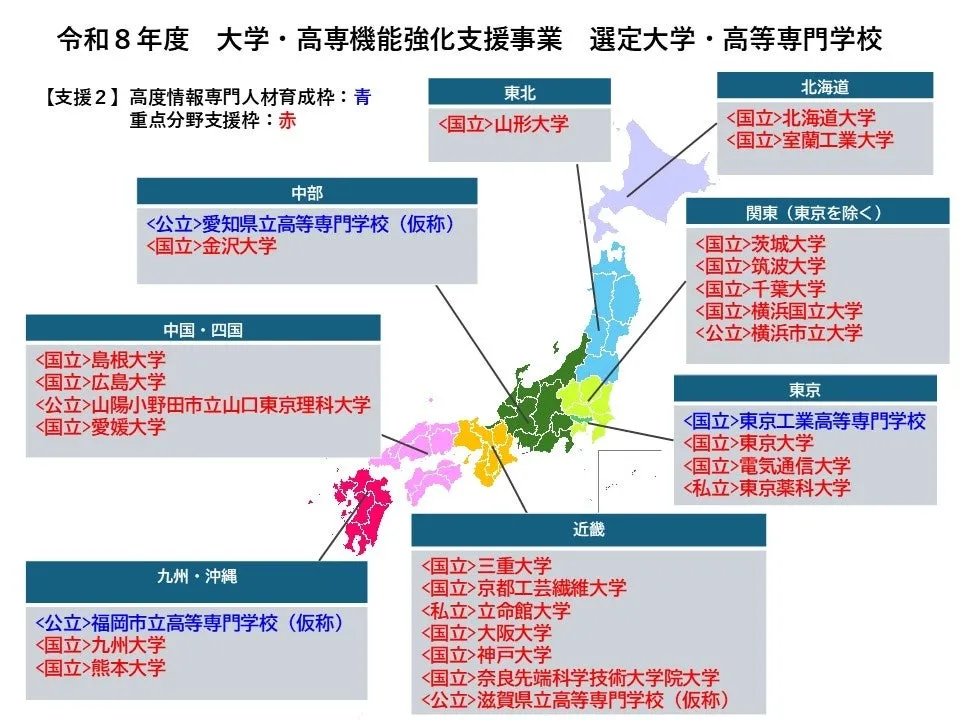
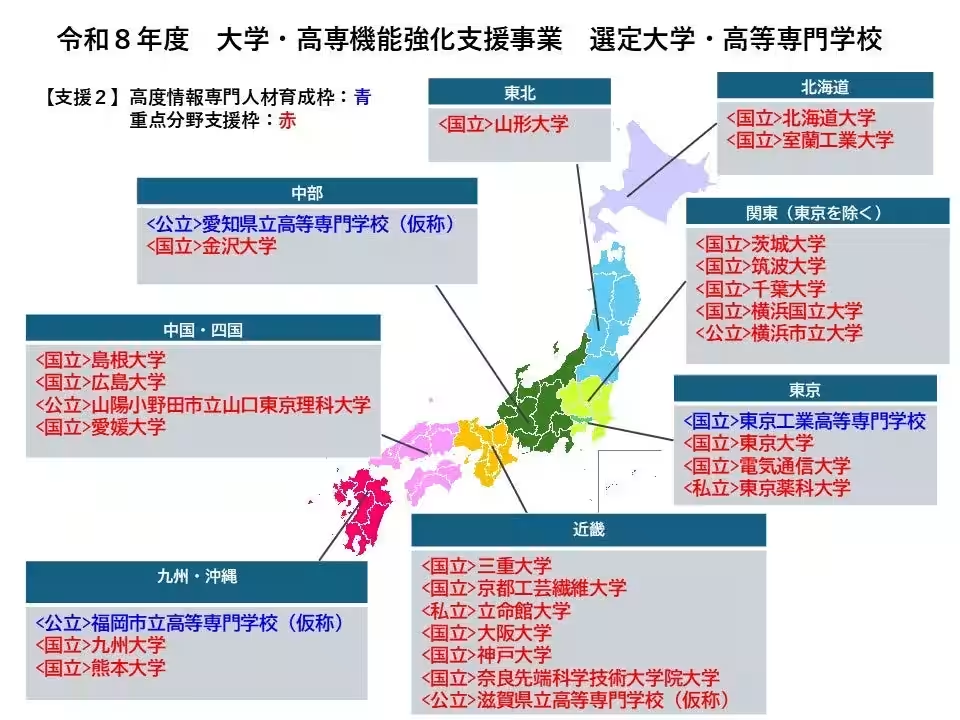
In a significant move aimed at bolstering Japan's digital and scientific educational capabilities, the National Institution for Academic Degrees and Quality Enhancement of Higher Education (NIAD-QE) has initiated the second phase of its university and specialized college support project for the 2028 fiscal year. This initiative, known as the 'Function Enhancement Support for Universities and Colleges,' is essential in training high-level professionals in growth areas such as digital technology and green energy. By expanding the parameters of support, it has notably included recent investments towards AI and semiconductor sectors in January 2026. During this year's inaugural public recruitment, 28 projects have been approved after a thorough review process. This included the 'High-level Information Specialist Human Resource Development Frame' and 'Priority Area Support Frame,' ensuring a diverse geographical representation across selected universities and specialized colleges nationwide.
The Japanese government continues to prioritize the development of talented individuals in the fields of science, technology, and digital innovation, as detailed in the "Basic Plan 2026." NIAD-QE plays a crucial role in this process, offering assistance for restructuring educational departments within institutions to focus on emerging industries. Through continued support of specialized education aimed at developing digital and engineering expertise, Japan aims to enhance its workforce to meet the growing demands of modern industries.
As the demand for specialized talent in urgent growth sectors continues to rise, these educational initiatives represent a vital investment in Japan’s future. By enhancing university and college functions to produce a well-rounded, digitally skilled workforce, Japan positions itself as a leader in innovative educational practices that respond to global challenges. Continued collaboration among institutions will be crucial for maintaining relevance and fostering a proactive approach to education in the digital age.
For more detailed information on the selected projects and the universities involved, please refer to the official NIAD-QE page: NIAD-QE Selection Results
For further inquiries, you may contact the NIAD-QE Grant Division via email: josei-kouhouniad.ac.jp (replace with @).
The Japanese government continues to prioritize the development of talented individuals in the fields of science, technology, and digital innovation, as detailed in the "Basic Plan 2026." NIAD-QE plays a crucial role in this process, offering assistance for restructuring educational departments within institutions to focus on emerging industries. Through continued support of specialized education aimed at developing digital and engineering expertise, Japan aims to enhance its workforce to meet the growing demands of modern industries.
Overview of Selected Universities and Specialized Colleges:
High-Level Information Specialist Human Resource Development Frame:
- - Tokyo Institute of Technology: This initiative aims to train top engineers and innovators who can successfully integrate cyberspace with physical environments, preparing them for future challenges.
- - Aichi Prefectural College of Technology (Provisional Name): The proposed enhancement plan focuses on upgrading the educational structure of this institution.
- - Fukuoka City College of Technology (Provisional Name): This initiative includes plans for the establishment of a new specialized college to address local educational needs.
Priority Area Support Frame:
- - Hokkaido University: The project focuses on developing chemical reaction creation DX personnel through the integration of materials development and information fields.
- - Muroran Institute of Technology: A program designed to develop high-level professionals in the unmanned aerial vehicle sector utilizing aerospace digital technology.
- - Yamagata University: This initiative focuses on enhancing human resources for energy resource circulation and promoting interdisciplinary collaboration.
- - Ibaraki University: Aiming to cultivate the next-generation digital twin talent in the nuclear energy sector, leveraging community collaboration.
- - University of Tsukuba: Establishing a human resource development program that utilizes AI in semiconductor, quantum, and biotechnology fields.
- - Chiba University: Launching an engineering and AI information technology application program.
- - The University of Tokyo: Introducing a quantum information science program to foster future innovators.
- - Yokohama National University: Developing advanced shipbuilding and maritime personnel within digital maritime systems.
- - Kanazawa University: Leading green tech practices to nurture doctoral-level personnel capable of innovation.
- - Kobe University: Establishing a digital bio-lifescience program focusing on biotechnology using AI and data science competencies.
Future Prospects
As the demand for specialized talent in urgent growth sectors continues to rise, these educational initiatives represent a vital investment in Japan’s future. By enhancing university and college functions to produce a well-rounded, digitally skilled workforce, Japan positions itself as a leader in innovative educational practices that respond to global challenges. Continued collaboration among institutions will be crucial for maintaining relevance and fostering a proactive approach to education in the digital age.
For more detailed information on the selected projects and the universities involved, please refer to the official NIAD-QE page: NIAD-QE Selection Results
For further inquiries, you may contact the NIAD-QE Grant Division via email: josei-kouhouniad.ac.jp (replace with @).
Topics Other)







【About Using Articles】
You can freely use the title and article content by linking to the page where the article is posted.
※ Images cannot be used.
【About Links】
Links are free to use.