




AI Search Industry Report: Major Changes in 2026 with EU Fines and Performance Metrics
AI Search Enters a Measurable Era
In July 2026, the landscape of AI search saw significant advancements, primarily through the official publications from tech giants Google and Microsoft. For the first time, companies can access concrete data on how often their sites are referenced in AI-generated responses.
Official Performance Reports: A Game Changer
Microsoft has extended its Bing Webmaster Tools, providing an AI performance report that details how often a site's content is cited by tools like Microsoft Copilot and Bing's AI summary features. The initial preview was launched in February 2026, and by June, additional metrics for search intent, categorization, and citation share had been added. This proactive data disclosure positions Microsoft as a leader in transparency in AI search metrics.
On the other hand, Google has embraced this trend by introducing a performance report for generative AI within its Search Console, as well as updates to the Merchant Center, which now features analytics on AI Mode and Share of Voice.
The implications of these changes mean that businesses can now manage their AI search strategies with quantifiable Key Performance Indicators (KPIs), moving away from subjective estimations and toward data-driven decision-making.
Shift in Search Behavior: Citation Share vs. Ranking
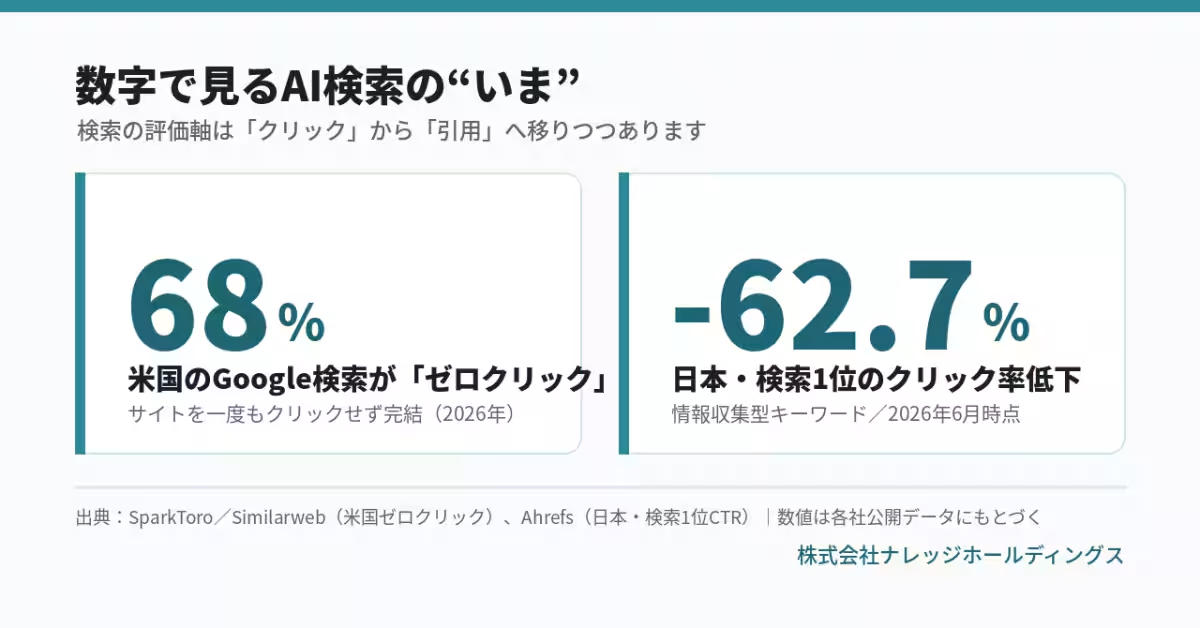
According to research by SparkToro and Similarweb, a startling 68.01% of searches on Google in the U.S. during the first four months of 2026 were completed without clicking on any site links. This figure marks an increase from 60.45% in 2024, illustrating a growing trend in 'zero-click searches' where users obtain information directly from search results. In Japan, data from Ahrefs highlights a sharp decline in click-through rates (CTR), with searches for information-dense keywords seeing a 62.7% reduction in CTR for the top-ranking sites as of June 2026.
The evolving paradigm prompts businesses to rethink their strategies, emphasizing the importance of being referenced in AI responses over traditional ranking metrics.
Evolution from 'Finding Information' to 'Taking Action'
With the launch of Connected Apps in July 2026, Google AI Mode now allows users to manage external services directly through the search interface. Initial partnerships with platforms such as Instacart, Canva, and YouTube Music enable users to complete tasks like shopping and playlist creation seamlessly via search. This evolution reflects a significant shift in how searches are conducted, transforming the search landscape from solely being an information-finding tool to a functional ecosystem for managing daily activities.
YouTube has also expanded its Ask YouTube feature, which allows users to engage with AI to discover videos. This feature saw over 140 million users engage with it by June 2026, signaling a growing acceptance of AI in content discovery.
Regulatory Developments: EU Fines Google
In a significant regulatory move, the European Commission imposed a nearly $1 billion fine (8.9 billion euros) on Google as of July 23, 2026, for violating digital market regulations. The fine addresses Google's preferential treatment of its services in searches and restrictions on directing users outside of the Google Play ecosystem.
Moreover, in a decision by a U.S. district court, Google's DMCA claims against SerpApi regarding scraping search results were rejected, highlighting ongoing legal challenges in the digital space.
Accelerating AI Search Adaptation in Japan
In Japan, businesses are rapidly adapting to the rise of generative AI in search. Established brands like Hachidaime Gihei in Kyoto face challenges in being referenced by AI despite high ranking. They have implemented comprehensive strategies incorporating site improvements, social media engagement, and offline initiatives. Similarly, Fuji Dream Airlines reported a remarkable increase in follower engagement and UGC by 200%, showcasing the effectiveness of a cohesive strategy involving social media and user-generated content.
An upcoming event, the 'Generative AI x Marketing Forum 2026,' set for August 27, 2026, will further explore these critical topics.
Conclusion: Key Points to Consider Moving Forward
As we look ahead to the next month, several important points emerge for businesses:
- - Shift How You Measure Success: Move beyond ranking metrics and start tracking how often your content is cited in AI responses.
- - Embrace Cross-Channel Analytics: Utilize expanded analytics tools to gauge how your brand is perceived across multiple platforms.
- - Design Seamless User Experiences: Ensure that users can not only find your business but also leverage AI to navigate directly to reservations and purchases.
For further insights into how to navigate the complexities of AI search and optimize your strategies, Knowledge Holdings Inc. provides free consultations to help companies aware of the current landscape and implement effective measures.

Topics Consumer Products & Retail)


【About Using Articles】
You can freely use the title and article content by linking to the page where the article is posted.
※ Images cannot be used.
【About Links】
Links are free to use.