




Can Intellectual Property Work be Handed Over to AI? Exploring Patsnap's New Benchmarks
The Role of AI in Intellectual Property
In recent years, the rapid evolution of generative AI and large language models (LLMs) has showcased remarkable capabilities in document generation, summarization, and translation. However, a pressing question remains: can AI genuinely manage critical intellectual property (IP) tasks like novelty searches and claim interpretation? To address these concerns, Patsnap has created a specialized benchmark named "PatentBench" designed specifically for IP practices.
Understanding the True Bottlenecks in IP Work
Imagine a scenario where a manufacturer is developing a next-generation humanoid robot. To ensure the superiority of a technology concept that promises smooth multi-degree movements while maintaining compactness, cost efficiency, and assemblability, the IP department initiates a prior art search. But in the world of IP, a constant challenge looms—the "accuracy barrier." Due to the abstract expressions unique to patent literature and the varying terminologies used by different companies, the risk of missing critical documents is ever-present. A skilled team member might spend days or even weeks sifting through just 100 to 200 published patents.
The Critical Divide Between Conversational and Practical AI
To alleviate this burden, many companies are looking into the adoption of generative AI technologies. Undeniably, recent general-purpose LLMs excel in text generation and summarization. However, LLMs trained primarily on standard web content face a significant challenge: the unique "language" and operational rules of the patent world differ greatly from general text. Trusting a general-purpose LLM with IP responsibilities poses systemic limitations due to its lack of understanding of patent-specific semantics, claim interpretation, and the workflows unique to IP practices. A minor error could escalate into substantial business risks.
The Consequences of Misplaced Trust
The IP domain intersects technology, law, and business in complex ways. Accepting a seemingly plausible AI-generated response without scrutiny is not just an oversight; it can lead to misinterpreting product strategies or even facing severe legal repercussions.
Assessing AI's Role through PatentBench
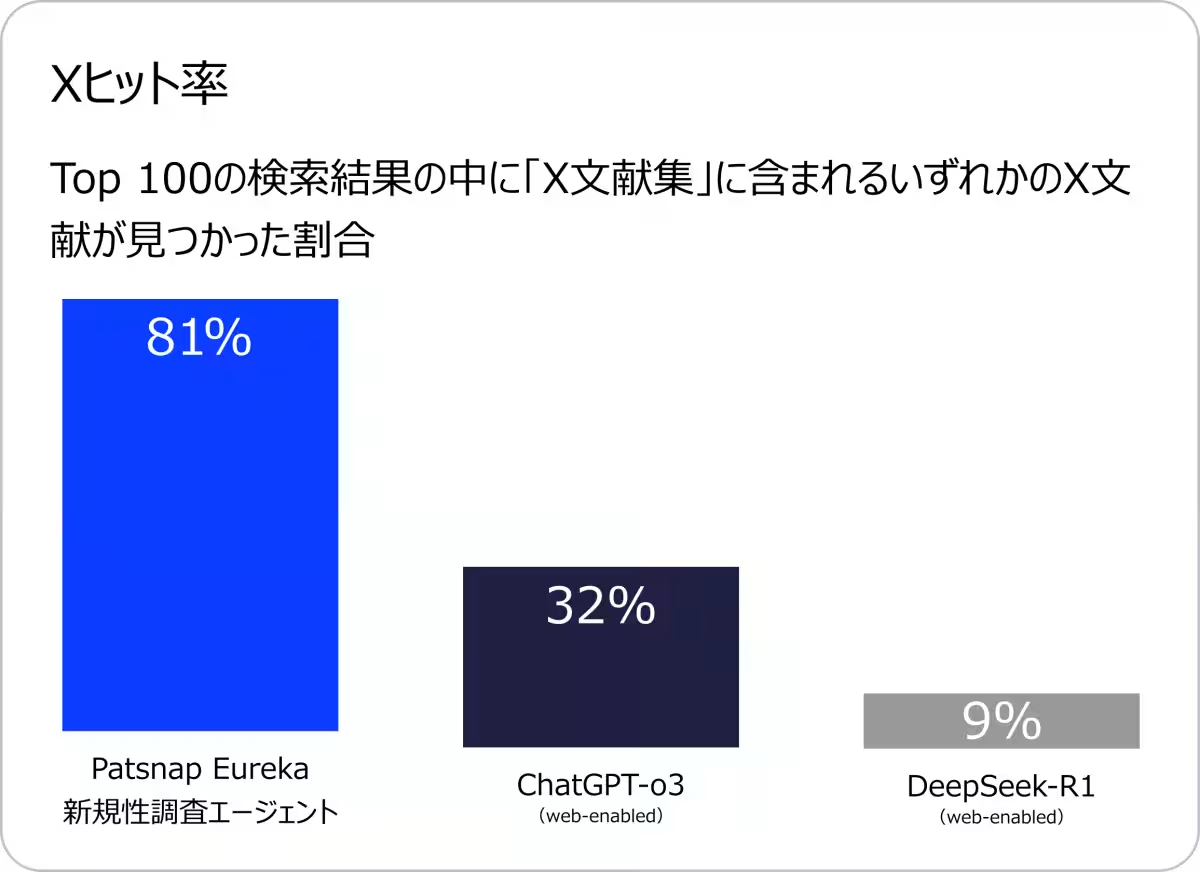
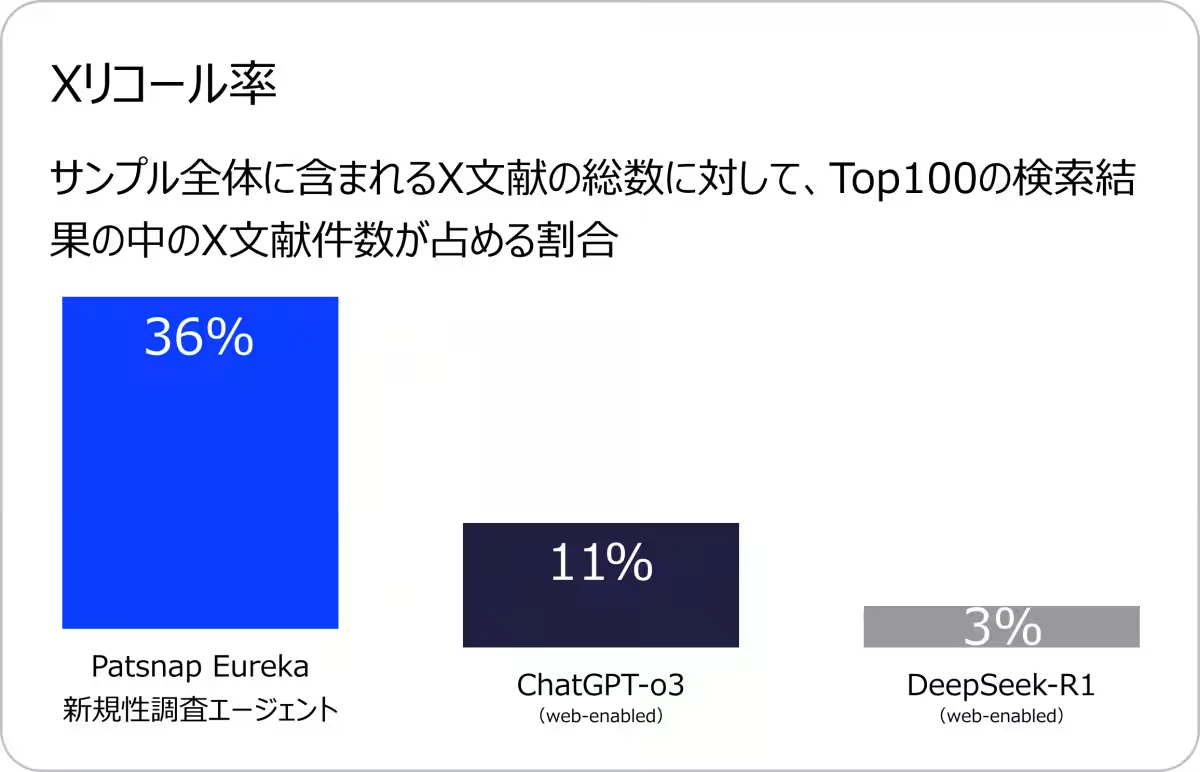
To quantitatively evaluate how much AI can assist in patent practices, Patsnap has established its unique benchmark, "PatentBench." This benchmark compares three models—the Patsnap Eureka novelty search agent, ChatGPT-o3 (web search-enabled), and DeepSeek-R1 (web search-enabled)—under identical conditions. The results revealed that Patsnap Eureka achieved an accuracy detection rate of 81% and a recall rate of 36% in terms of top 100 results. This indicates that Patsnap Eureka identifies relevant documents more accurately and comprehensively compared to general models.
Explore More on PatentBench: PatentBench
Meet Patsnap Eureka: The AI Agent for IP Tasks
While general LLMs face limitations in specialized domains, the spotlight is now on "domain-specific AI agents" like Patsnap Eureka. This isn’t merely a conversational model; it's an active AI that comprehends business contexts and executes tasks in line with existing workflows. …
Patsnap Eureka leads the charge by implementing agents for high-intensity IP tasks, including novelty searching, FTO (freedom to operate) research, drafting specifications, and patent translations.
For instance, the novelty search agent automates functions such as extracting prior arts, element breakdowns, compound query generation, screening, claim mapping, and report/table generation. The resulting data is output in an editable format with supporting evidence, ensuring that industry experts can utilize it directly. This advancement drastically reduces the timeframe for research tasks, from the conventional one to two weeks down to mere minutes or hours.
Unmatched Data Volume and Understanding of Practical Needs
For over a decade, Patsnap has cultivated expertise in technology and patents, currently housing patent data from over 174 countries and more than 200 million patent documents along with an equivalent number of research papers. The data undergoes meticulous processing, including deduplication, structuring, normalization, and labeling under expert supervision. Additionally, while supporting over 15,000 clients, Patsnap systematically extracts the actual workflows and decision-making criteria of patent engineers, agents, and corporate IP departments, which are then implemented into the agents’ operational logic.
Patsnap Eureka aims not merely to introduce a new AI product but to evolve into the next-generation partner collaborating with IP and R&D experts in solving their challenges together.
Demo Request
About Patsnap
Founded in Singapore in 2007 and backed by global investors, Patsnap has grown into a leading global company in the field of AI tools.
Headquarters: Singapore
Patsnap Japan: Minato-ku, Tokyo
Japan Representative: Guan Dian (Co-founder, APAC General Manager)
Corporate site: www.patsnap.jp



Topics Consumer Technology)
【About Using Articles】
You can freely use the title and article content by linking to the page where the article is posted.
※ Images cannot be used.
【About Links】
Links are free to use.