




Development of a Thermal Diode Utilizing Superconductors for Enhanced Thermal Management
Introduction
Thermal management technologies that control heat flow have become essential for the advancement and miniaturization of electronic devices. Recent innovations include materials that enhance or reduce thermal conductivity dramatically. Our research team has developed a novel thermal diode that utilizes the transition in thermal conductivity during superconductivity in specific materials.
Concept and Mechanism
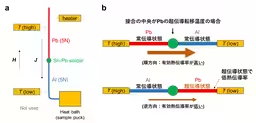
A thermal diode operates by allowing heat to flow more easily in one direction than the other, much like an electronic diode does for electric current. By applying a temperature differential across the materials—a superconductor and a normal conductor—this diode leverages the distinct thermal conductivity changes between these states.
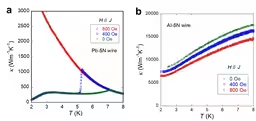
A collaboration involving Yoshikazu Mizuguchi from Tokyo Metropolitan University and several other researchers has successfully demonstrated thermal rectification. They soldered high-purity Lead (Pb) and Aluminum (Al) wires together, observing thermal rectification below the superconducting transition temperature of Pb (7.2 K). The Pb wire's thermal conductivity drops significantly when it becomes superconducting, while the Al wire remains in a normal state and maintains high conductivity.
In this experiment, with the Pb wire positioned at a higher temperature than Al, the enhanced thermal conductivity resulted in a rectification ratio of up to 1.75, validating the effectiveness of this thermal diode configuration.
Future Implications
Optimizing material combinations and geometries could lead to even better performance, making such thermal management systems applicable in low-temperature devices. The results of this research were published on October 20 in Wiley's Advanced Physics Research.
Background
The need for advanced thermal management technologies arises from modern devices requiring significant performance and density improvements. Previous research established that, during superconducting transitions, materials like metals can dramatically drop in thermal conductivity. A theoretical concept of a superconductor-based thermal diode was introduced in 2013 by Giazotto, but no effective experimental demonstrations were achieved—until now.
Research Details
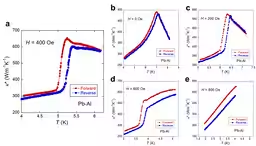
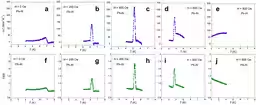
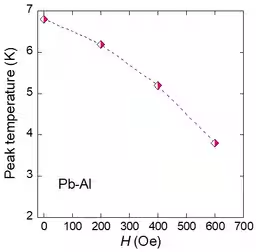
In this study, high-purity Pb (99.999%) and Al were soldered using a Sn-Pb solder joint. The effective thermal conductivity was measured under varying magnetic fields, revealing a maximum thermal rectification at 400 Oe. During measurements, a clear difference in thermal conductivity for forward and reverse directions was confirmed, unlocking the potential for efficient thermal management solutions.
The critical finding was that the magnetic field influences the operational temperature for maximum rectification efficiency, allowing operational flexibility in varying thermal environments with modest magnetic field strengths.
Significance of Findings
This research showcases the first experimental observation of thermal rectification in a superconductor-normal conductor junction, paving the way for enhanced designs in thermal diodes. The ability to operate with minimal magnetic fields signals that this technology could transition into various cold applications, significantly impacting the performance of low-temperature electronic devices.
Conclusion
With the exciting prospects of thermal diode technology powered by superconductivity, the path is laid for innovative solutions in thermal management, anticipated to revolutionize cooling mechanisms in various electronic applications.




Topics Consumer Technology)
【About Using Articles】
You can freely use the title and article content by linking to the page where the article is posted.
※ Images cannot be used.
【About Links】
Links are free to use.