




Revolutionizing Brain-like Computing with New Nano Magnetic Memristors
Mimicking Synapses with Nano Magnetic Memristors
Recent advancements in material science have led to the development of a revolutionary type of nano magnetic memristor capable of imitating synaptic functions in the brain. This innovative technology was spearheaded by Ryuta Yamamoto, a leading researcher at the National Institute of Advanced Industrial Science and Technology, in collaboration with a team from the National Institute for Materials Science. The focus of this research is on ramping up the efficiency and speed of information processing, a critical step toward realizing brain-inspired computing systems.
The Breakthrough in Magnetic Memristor Technology
Under the guidance of notable researchers including Director Takayuki Nozaki, and senior researcher Shinji Yuasa, the team utilized iron-manganese alloy to create ultra-thin magnetic membranes with an atomic-level flatness. The premier structure consists of tiny, circular pillar elements measuring just 200 nanometers in diameter. This successful simulation of synaptic functions highlights the potential of magnetic memristors for incorporation into integrated systems that require rapid operation.
The approach taken by the researchers involved careful thermal treatment of the alloy, which led to the spontaneous formation of a uniquely structured magnetic ultra-thin film. This film exhibits performance capabilities suited for high-speed applications, drawing parallels with how synapses in the brain manage signal transmission between neurons.
What Are Brain-like Systems?
Brain-inspired computing, often referred to as brain-morphic systems, aims to replicate the functional capabilities of biological brains through electronic and engineered circuits. These systems leverage the parallel processing power observed in biological neurons, enabling energy-efficient computation even amidst vast amounts of data, a stark contrast to traditional computing architectures which struggle with increasing demands for data processing.
In biological systems, synapses facilitate communication among neurons, controlling the strength of signal transmission through mechanisms known as long-term potentiation and long-term depression. The incorporation of magnetic memristors allows for a corresponding technological execution of these features, providing a tool for artificial intelligence applications that require sophisticated data handling methodologies at lowered power expenditure levels.
Developmental Context and Challenges
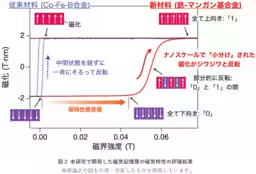
The scientific landscape is rife with challenges as conventional memory technologies struggle with issues such as endurance limits and size scalability. For memristors and resistive random-access memories (ReRAM) to be viable in brain-morphic systems, enhancements in rewrite endurance and integration suitability are paramount. Traditional materials like Co-Fe-B alloys face inherent limitations in their capacity to maintain stable magnetic states necessary for functioning as reliable memristors.
In this research, the team explored the concept of spinodal decomposition within iron-manganese alloys to forge a path towards achieving smaller, more efficient magnetic memory structures. This method allows for the magnetic memory layers to be both structurally sound and configured to maintain stability during operational phases, ensuring precise data retention and retrieval.
Experimental Insights and Outcomes
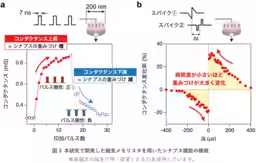
The experimental results demonstrated that the magnetic properties of the newly developed memristors could facilitate nuanced control over resistance states, which play a pivotal role in mimicking synaptic behavior. Specifically, upon application of sequential voltage pulses, the memristors exhibited significant variations in conductance, enabling the reproduction of synaptic plasticity—broadly in terms of long-term potentiation and long-term depression.
Furthermore, the team successfully demonstrated a concept known as spike-timing-dependent plasticity (STDP), which evaluates conductance response based on the timing of electrical signals applied to the memristor. The results indicated that the changes in conductance were contingent on well-defined timing relationships, providing deep insight into how the device could function akin to a biological synapse in terms of learning functions.
Future Directions
With the groundwork laid for this new technology, researchers aim to produce an array of magnetic memristors. This effort will focus on enhancing characteristics such as rewrite resilience, variability among devices, and the intricacies of information processing in systems that model brain-like functions. Initial demonstrations involving handwritten character recognition systems will serve as benchmarks to test the capabilities of these brain-morphic setups.
For further details, the findings will be officially published on January 9, 2026, in the journal 'Advanced Functional Materials.' This represents not just a step forward in computational efficiency but a leap toward merging biological understanding with cutting-edge technology.
Related Resources & References


Topics Consumer Technology)
【About Using Articles】
You can freely use the title and article content by linking to the page where the article is posted.
※ Images cannot be used.
【About Links】
Links are free to use.