




Enhancing Patients' Well-Being: Standardizing Appearance Care After Breast Cancer Treatment
The Importance of Appearance Care After Breast Cancer Treatment
Breast cancer survivors often feel that something is missing even after breast reconstruction is completed. One of the most significant aspects of appearance care is the reconstruction of the nipple-areola complex, which caters to those unmet needs.
This initiative aims to establish a framework for medical art makeup practiced in collaboration with healthcare professionals, ensuring safety and objectivity. It opens up new possibilities for patients to confidently choose this medical option.
Current Status of Post-Surgery Appearance Care
The advancements in breast reconstruction techniques have led to many procedures now being covered by insurance. For many, restoring the breast shape is a crucial milestone in their recovery process.
However, some patients still feel psychologically unbalanced due to the missing or discolored nipple-areola area. The nipple-areola complex is a significant part of self-image and is intricately linked to a patient's sense of normalcy and social reintegration. Currently, medical pigment formation (art makeup) for the nipple-areola complex is not covered by insurance, leaving this essential service outside the realm of standard medical care. Nonetheless, it represents a crucial option for patients to address concerns about their appearance.
Post-cancer appearance care does not merely aim for a standard 'completed image.' It is about understanding what each patient values and providing support that aligns with their unique concerns.
The Role of Medical Art Makeup in Nipple Reconstruction
While surgical reconstruction can replicate the breast shape and protrusion of the nipple, adjusting the color itself through surgical methods remains challenging. The limitations of surgical principles make it hard to achieve natural color tones and shading that harmonize with the unaffected side.
Medical art makeup (paramedical pigmentation) serves this purpose of 'color reconstruction.' By using pigments, professionals can design hues and boundaries for the nipple-areola complex to harmonize beautifully with the surrounding skin. Each patient's desires in breast reconstruction vary; some may feel satisfied with the shape, while others seek comprehensive color adjustments.
Medical art makeup allows patients to choose a cosmetic medical technique tailored to their diverse needs. It targets specific areas of concern, contributing to each individual's sense of satisfaction.
Advanced Design for Natural Reproduction
The ultimate goal in paramedical nipple-areola reconstruction is to reproduce the opposite side in the most natural way possible. Careful observation and analysis of subtle color differences, gradations, edge blurring, and shadow play are essential to minimize asymmetry.
Furthermore, considerations of the reconstruction method, scar conditions, skin texture, and changes following radiation therapy are factored in to determine the most natural-looking balance for each individual. This technique's expertise lies in its ability to adapt to unique conditions rather than applying a one-size-fits-all solution.
Differences in skin condition and constitution lead to personal variations in pigment retention and temporal changes. Over time, color may slightly fade or alter, but adjustments can be made based on evaluations after treatment. By gradually fine-tuning color tones with respect to post-treatment progress, a closer match to natural appearance is achieved.
Systems are in place to address long-term color changes, and as the procedures involve pigments, appropriate information sharing regarding future medical procedures such as MRI scans is crucial. Although no significant complications have been reported, establishing a management system for pigment components and a collaborative atmosphere with medical institutions is vital for patient peace of mind.
The Necessity of Medical Collaboration
To facilitate safe access to medical art makeup, collaboration with medical institutions is essential. Each patient's journey through breast cancer treatment and reconstruction is unique in terms of treatment details and skin condition. Sharing information with primary physicians when determining suitability is a critical process in enhancing safety.
Positioning the pigment formation as an extension of reconstructive medical care within the flow of healthcare creates an environment where patients can choose this option without anxiety.
A New Challenge in Medical Cooperation
PGC Schools is committed to establishing art makeup as a necessary component of medical appearance care beyond cosmetic boundaries through strengthened collaboration with medical institutions.
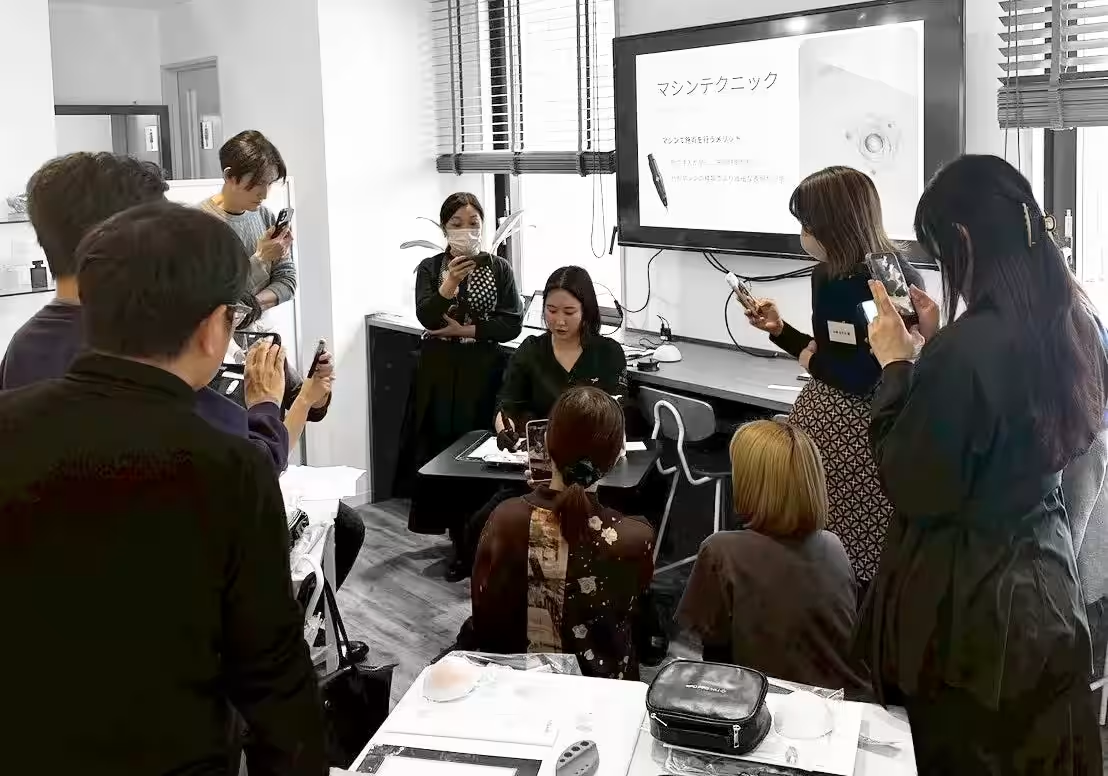
On February 8, 2026, PGC Schools hosted a special seminar for physicians focused on areola-nipple art makeup. The seminar welcomed twelve doctors involved in breast cancer treatment and reconstruction, with both newcomers and returning attendees interested in refreshers.
The seminar's essence goes beyond skill acquisition. It aims to educate physicians deeply involved with patients on the realities and importance of medical art makeup and hospital collaboration. By fostering accurate recognition of art makeup, the goal is to strengthen collaboration in practice.
The training began with theoretical instruction followed by an emphasis on design and practical applications. Notably, participants observed procedures with the cooperation of two patients, allowing them to appreciate the intricacies of treatment and the compassionate approach necessary.
Transforming Subjectivity into Objectivity
Traditionally, nipple-areola art makeup has relied heavily on subjective measures such as the practitioner’s experience and the patient’s satisfaction level. This over-reliance on subjectivity has hindered adequate discussions regarding its classification within healthcare.
Currently, efforts to quantify changes in color and accumulate longitudinal data aim for a more objective assessment. Visualizing pre- and post-treatment changes will be crucial for ensuring reproducibility and safety, leading to trust from patients.
Even if it isn't currently classified as standard treatment, the objective is clear: to develop a medical technique that patients can confidently choose through consistent safety assurances, information sharing, and objective evaluations.
The goal is to transform appearance care after breast cancer into something that patients can consider naturally, without viewing it as special or extravagant. The commitment to achieving this objective will continue unwaveringly in the future.




Topics Health)
【About Using Articles】
You can freely use the title and article content by linking to the page where the article is posted.
※ Images cannot be used.
【About Links】
Links are free to use.