



Breakthrough in Low Dielectric Materials for Next-Generation 6G Communications
Breakthrough in Low Dielectric Materials for Next-Generation 6G Communications
In a significant development, a research group from Waseda University, led by Professor Kenichi Oyaizu and Associate Researcher Seigo Watanabe, has successfully established a low dielectric material with a dissipation factor of less than 0.001. This creation is poised to play a vital role in the advancement of 6G communication technologies, enabling high-speed, high-capacity, and low-latency connectivity crucial for the future.
The Path to Discovery
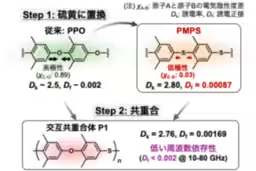
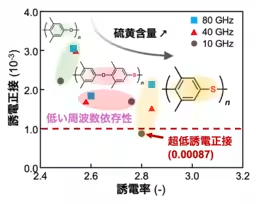
The early findings highlight a novel approach to achieving these remarkable low dielectric properties. The research team focused on a polymer structure known as Poly(phenylene sulfide) (PPS) derivatives and incorporated sulfur into the molecular design. This innovative molecular arrangement notably reduces the material’s responsiveness to high-frequency electrical signals, resulting in superior dielectric characteristics that meet world-class standards.
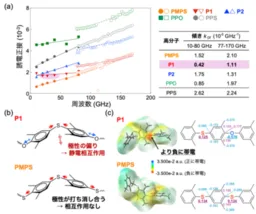
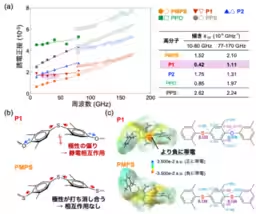
The research also demonstrated that by alternating oxygen and sulfur atoms in the molecular structure, the material maintains its low dielectric properties even at millimeter wave frequencies up to 170 GHz, critical for the anticipated 6G technology expected to roll out around 2030.
Significance for 6G Communication
As data transmission demands increase fundamentally due to the rapid advancements in IoT (Internet of Things) and AI (Artificial Intelligence), the need for effective low dielectric materials has become essential. Traditional dielectric materials face challenges with energy loss as frequencies rise, causing heat generation and quality degradation during communication. This is where the newly developed low dielectric PPS derivatives show potential, enabling less energy loss and more efficient data transmission.
Previous attempts to combine low dielectric rate and loss in polymer materials had limited success. The new approach introduces sulfide bonds, which mitigate the energy loss typical in conventional polymers. The effort diversifies electronic communication capabilities, raising prospects for superior quality in data processing, IoT expansion, and advanced performance in wearable devices.
Research Underpinning
The team took a step beyond the previously difficult-to-achieve dielectric loss of less than 0.001. High dielectric materials like Polyimide and Poly(phenylene oxide) faced limitations due to their polar structures, which contributed to higher loss rates. However, by selectively removing polar functional groups and adopting a molecular design strategy that leverages the properties of sulfur, this research provides a distinctive breakthrough in low-loss dielectric materials.
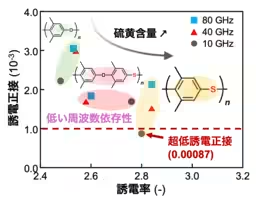
Upon measuring the dielectric properties, the researchers found that the incorporation of a higher percentage of PPS skeletons directly correlates with lower dielectric loss, with PMPS showcasing a loss factor below 0.001 at 10 GHz. Despite an increment in dielectricity from sulfur's high polarizability, it proved sufficient for maintaining low dielectric functionality, presenting an opportunity for progressive advancements in 6G communication materials.
Future Implications
This progress not only marks a milestone in materials science but also signals potential ramifications for future technologies. As the demand for efficient data transmission escalates, especially with 6G on the horizon, the development of better dielectric materials becomes crucial. The application of these findings is not merely limited to communications; they could lead to innovations that extend to various fields requiring efficient electronic transmission.
Conclusion
In conclusion, the successful development of low dielectric materials by Waseda University and Daicel Corporation sets a precedent for future innovations in communication technologies. The promise of 6G connectivity hinges on these breakthroughs, which aim to deliver faster, higher quality data transfers. This research opens new avenues, demonstrating how molecular engineering can facilitate revolutionary advancements in communication infrastructure well into the future.
Topics Consumer Technology)

【About Using Articles】
You can freely use the title and article content by linking to the page where the article is posted.
※ Images cannot be used.
【About Links】
Links are free to use.