



Connecting Climate and Business: Key Challenges in Asia-Pacific Explored at the Carbon Economics Salon
Understanding the Climate and Trade Connection
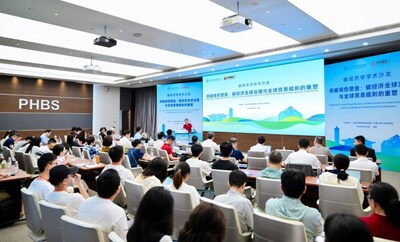
On June 16, the HSBC Business School at Peking University in Shenzhen hosted the Carbon Economics Salon, drawing nearly 100 participants from academia, policy making, and industry. This event focused on the critical intersection of climate change and trade, a growing concern in the Asia-Pacific region.
Significance of the Event
The discussions led by experts highlighted the urgency of developing an inclusive global carbon management system. Piao Shilong, vice president of Peking University and dean of the Institute for Carbon Neutrality, emphasized the need for collaborative efforts to address climate-related trade barriers. As the region gears up for the upcoming APEC ministerial meeting on forestry, scheduled for late July, the topics discussed at the salon are expected to align with the agenda focused on green transformation.
Key Themes of Discussion
The salon's theme, "Breaking Green Barriers: Managing the Carbon Economy and Reshaping International Trade Rules," was jointly organized by the HSBC Business School and the Institute for Carbon Neutrality at Peking University. Concerns regarding unilateral trade measures related to climate, the uneven development of carbon markets, and the emerging role of artificial intelligence in carbon governance were at the forefront. These discussions are pivotal as they set the stage for APEC's main agenda in November.
Insights from Renowned Experts
Thomas J. Sargent, a Nobel Laureate in Economics, delivered a keynote address emphasizing the importance of early investments in eco-friendly R&D, emission reductions, and forest conservation. His insights underline the role of uncertainty in propelling businesses towards sustainable practices. Meanwhile, Jiang Kejun from Hong Kong University of Science and Technology identified 2030 to 2035 as a critical window for China's energy transformation, fueled by rapid advancements in renewable energy and electric vehicles.
Addressing Trade Fairness
Two roundtable sessions addressed the impact of unilateral climate measures on the equity of global trading practices and collaboration on carbon markets with countries in the global South. Through these discussions, Zhang Haibin, also a Boya professor, reasserted the necessity for ongoing dialogue across various scientific disciplines.
Moving Forward: The Path to Carbon Management
As the salon wrapped up, the conversations reiterated that carbon emission governance is increasingly being shaped by trade rules, technologies, and international coordination. This presents an opportunity for continued information exchange between the HSBC Business School and the Institute for Carbon Neutrality regarding global climate governance and China's dual carbon targets.
Attendees expressed optimism that these discussions are only the beginning of deeper cooperation among APEC economies in tackling climate challenges. In this era of rapid change, the integration of sustainable practices into trade policies is not merely a choice, but a requirement for future success across the Asia-Pacific region.
Topics Policy & Public Interest)
【About Using Articles】
You can freely use the title and article content by linking to the page where the article is posted.
※ Images cannot be used.
【About Links】
Links are free to use.