




Revolutionizing Voting: Real-Time Congestion Visualizations for Japan's Elections
Real-Time Congestion Visualization for Japan's Elections
As Japan prepares for its 51st House of Representatives election, an innovative approach is set to transform the voting experience. VACAN, a company based in Tokyo, is deploying a state-of-the-art platform to visualize real-time congestion at polling stations. This initiative is aimed at connecting people with their spatial environments through technology, ensuring that voters can navigate the voting process more smoothly than ever before.
Overview of the Initiative
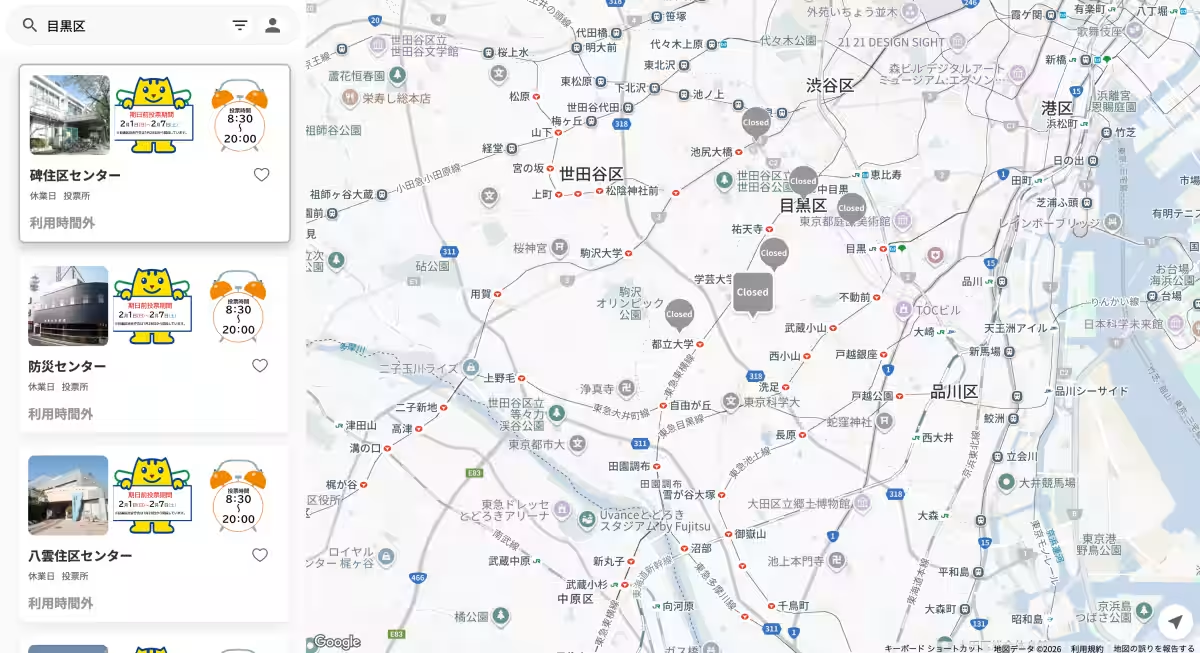
Under this initiative, a total of 61 polling stations will be monitored for congestion during both advance and same-day voting periods. Specifically, 48 of these stations are designated for early voting and 13 for election day voting. VACAN’s platform will provide real-time updates on crowd density, categorized into three levels: "Available," "Moderately Crowded," and "Crowded." This information can be accessed via the VACAN Maps online service, which allows voters to view available and congested areas effortlessly.
Voters can easily consult the platform through their computers or smartphones from the comfort of their homes, making it convenient to decide when to cast their votes. Not only will this system enhance the voting experience, but it is also expected to alleviate burdens on polling station operations by enabling voters to plan their visits effectively.
The Polling Locations
The initiative encompasses numerous locations across Tokyo and other municipalities:
- - Tokyo's 23 Wards: 19 locations, including 6 in Meguro, 6 in Kita, and 7 in Nerima.
- - Other Municipalities: 42 locations, including 11 in Yokohama, 4 in Koshigaya, 7 in Yokkaichi, and 7 newly introduced in Nara City.
- - On Election Day: 13 polling stations in Yokkaichi will also be monitored.
In addition to the central platform, Yokohama’s polling stations will have a dedicated portal, known as "VACAN Pages," providing specific crowd information for wards like Tsurumi, Konan, Asahi, Kohoku, and Totsuka.
Background and Rationale
Japan hosts countless elections each year in its 1,724 municipalities. Efficient election operations have become increasingly vital, particularly as the public demands improved convenience through digital technology. VACAN’s initiative aligns with these demands, encouraging voters to avoid long lines while also minimizing operational strain on polling stations through better crowd distribution.
This initiative marks a leap toward establishing a new standard in election experience. VACAN aims to continue collaborating with local governments to enhance public service infrastructure while ensuring that residents benefit from a more user-friendly voting process.
Highlighting the VACAN System
The VACAN system has already proven its effectiveness, with successful implementations across 300 municipalities. The platform’s visual mapping capability allows users to view congestion levels not just at polling stations but also in other areas such as evacuation centers, restaurants, and public transport facilities. The VACAN Maps feature offers a comprehensive overview of nearby facilities, aiding in both everyday activities and emergency situations.
About VACAN
Founded in June 2016 by CEO Goshin Kono, VACAN's mission is to connect people and spaces with innovative technology. The company has been recognized as a J-Startup 2019 by Japan’s Ministry of Economy, Trade, and Industry, showcasing its potential to transform urban living and management through smart solutions, including congestion and human flow management, and the operation of restroom media services such as "Unveil."
In conclusion, as Japan gears up for its elections, the introduction of real-time congestion visualization by VACAN stands poised to enhance the voter experience significantly, proving that technology can indeed foster a more democratic and accessible process.

Topics Policy & Public Interest)
【About Using Articles】
You can freely use the title and article content by linking to the page where the article is posted.
※ Images cannot be used.
【About Links】
Links are free to use.