



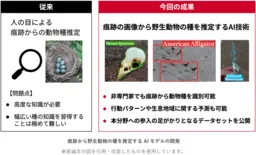
AI Model to Identify Animal Species from Diverse Wildlife Traces
AI Model Revolutionizes Animal Species Identification
In a groundbreaking development for wildlife research, a new AI model has been created that can accurately identify animal species based on diverse traces left in the environment. This innovation comes from a collaborative effort between Hirokatsu Kataoka, a senior researcher at the National Institute of Advanced Industrial Science and Technology (AIST), and Risa Shinoda, a specially appointed assistant professor at Osaka University’s Graduate School of Information Science and Technology.
The AnimalClue Dataset
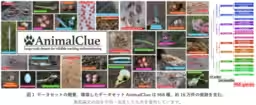
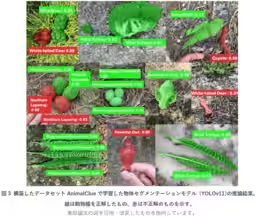
The newly developed AI model leverages a comprehensive dataset known as "AnimalClue," which comprises images of animal traces, including footprints, feces, eggs, bones, and feathers. This dataset addresses a significant challenge in wildlife studies where identifying animal species from these traces traditionally required extensive expertise and experience. By using this dataset, the AI model was trained to recognize and classify different animal species efficiently.
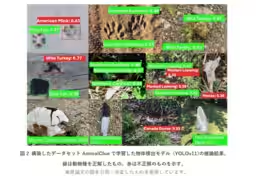
One of the notable achievements of the AI model is its ability to reach over 65% Top-1 accuracy in identifying species from feather images, successfully distinguishing among 555 potential animal candidates. This level of precision means that researchers and conservationists can now derive insights about wildlife populations without the need for invasive or specialized equipment.
Importance for Biodiversity Conservation
Understanding wildlife populations is critical for assessing ecosystem health and advancing conservation efforts. The model's ability to analyze traces non-invasively provides a tool for efficient monitoring of animal habitats, particularly as human activities and climate change impact these environments. By accurately identifying rare and elusive species before development projects take place, proactive conservation measures can be implemented.
While direct observation of all wildlife species, especially nocturnal or rare ones, remains a daunting task, automated tracking methods like the one based on animal traces offer a viable alternative. Previous methods for animal tracking have often relied on sensor cameras and were sometimes invasive, putting animals under stress. However, with this AI technology, experts hope to streamline the assessment process and enhance public engagement in wildlife conservation.
Technical Background
The foundation of this AI model is rooted in large-scale pre-training on extensive datasets. AIST has focused its resources on integrating vision and language models, enhancing image recognition capabilities for real-world robot intelligence. This research enables the identification of both human movement and environmental factors, crucial for building adaptable models.
Using about 160,000 traces annotated with behavioral patterns and species habitat information, the AnimalClue dataset provides the necessary groundwork for training sophisticated AI image recognition models capable of discerning intricate details often overlooked by casual observers.
Developers structured the project to automate the animal tracking process without requiring expert knowledge, making it accessible to a broader audience. This agenda stems from AIST's policy budget project, aiming at utilizing AI within the physical domain.
Future Directions
Looking ahead, researchers plan to enhance the model's capabilities by gathering additional data on rare animal species, whose images are currently scarce. This effort will not only improve identification accuracy but also foster the development of specialized models capable of processing different types and characteristics of animal traces.
Ultimately, the goal is to create an application that allows real-time analysis and identification of species from photographs taken in the field—potentially revolutionizing how biologists and environmental scientists interact with the ecosystem.
Upcoming Presentations
The research outcomes will be showcased at two significant conferences:
- - MIRU2025 Image Recognition Understanding Symposium (July 29 - August 1, 2025, Kyoto)
- - IEEE/CVF International Conference on Computer Vision (ICCV) (October 19-23, 2025, Hawaii, USA)
Moreover, the AnimalClue dataset is available for download through its GitHub page, fostering further research and exploration in wildlife tracking methods worldwide.
This novel approach to wildlife study promises to not only ease the burden of species identification but also empower more individuals and organizations to participate in biodiversity conservation efforts, ultimately aiding in the protection of our planet's diverse ecosystems.
Topics Environment)
【About Using Articles】
You can freely use the title and article content by linking to the page where the article is posted.
※ Images cannot be used.
【About Links】
Links are free to use.