



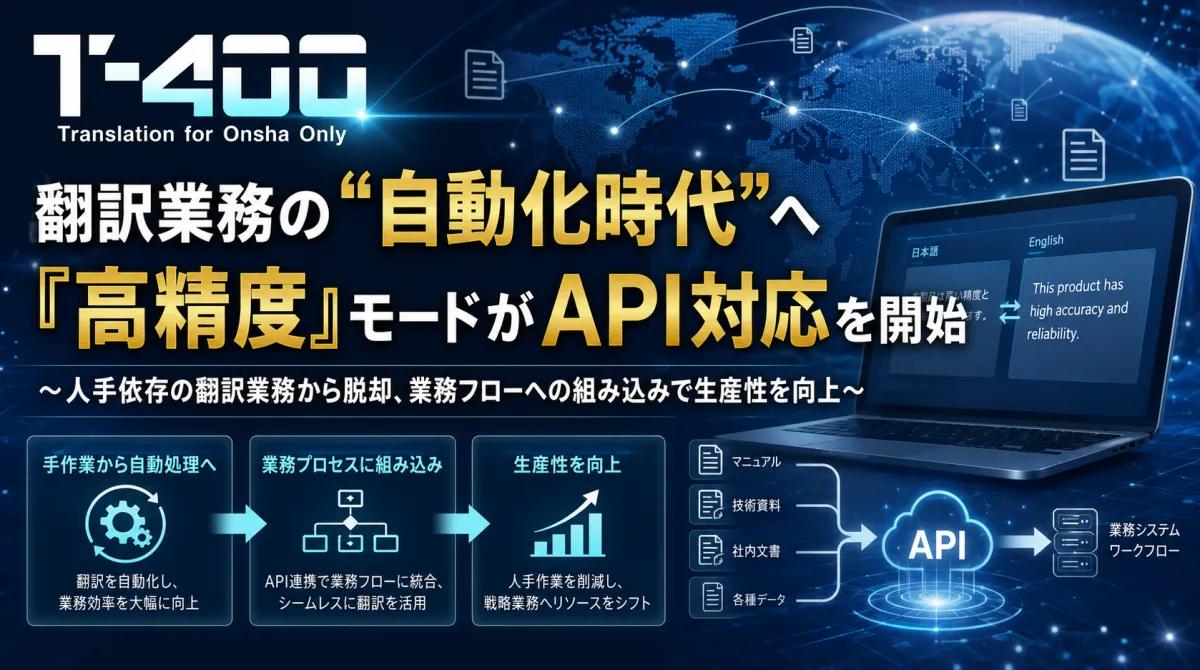
High-Precision AI Translation Tool T-400 Introduces API Support for Businesses
Rosetta's T-400: Revolutionizing Translation Services with API Support
On July 30, 2026, Rosetta, a leading provider of AI translation services, introduced API support for its high-precision industrial translation AI known as T-400. This significant update marks a new era in automation for translation tasks, enabling businesses to seamlessly integrate translation processes into their existing systems and workflows.
The Current Landscape of Translation Work
Despite the growing demand for translations as companies expand globally, many organizations continue to rely heavily on manual methods. Common issues include labor-intensive copy-pasting, significant resources spent on post-translation revisions, and inefficient operations due to fragmented workflows among departments. As a result, the digital transformation (DX) in translation services has been progressing at a slow pace, hampering overall efficiency.
Transitioning to Automated Translation Processes
With the recent API support for T-400's high-precision mode, businesses can now call the translation function directly from external systems. This transformation elevates translation from a mere task to an integral part of business operations, facilitating a smoother transition from manual processes to automated ones.
Key Use Cases of API Integration:
- - Automatic Generation of Translations: Linking with internal systems or content management systems (CMS) to generate translations automatically.
- - Bulk Translation for Reduced Work Hours: Translating large volumes of text at once, significantly decreasing the time required for workflow completion.
- - Optimization of Human Resources: Automating standard operations allows for better allocation of human resources to critical tasks.
Changing the Structure of Translation Work
The API support will bring three significant changes to the translation landscape:
1. Shift from Manual to Automated: Moving away from manual labor towards automated processing.
2. Standardization of Work: Transitioning from individual-dependent tasks to standardized and reproducible workflows.
3. Resource Allocation to Strategic Tasks: Freeing up time from repetitive tasks to focus on strategic business objectives.
Particularly in sectors such as manufacturing, IT, and pharmaceuticals that handle specialized documents, the combination of efficiency and quality is now more achievable than ever.
The Advantages of High-Precision Translation Integrated into Business Operations
T-400’s high-precision mode not only allows for the integration of specialized and internal terminology but also significantly reduces translation errors compared to traditional translation engines. Its high accuracy ensures that automated translations maintain the necessary quality for practical use, especially when integrated through APIs.
Insights from Atsunori Shinoda, Chief Developer of T-400
Atsunori Shinoda stated, “With this API integration, translation in the high-precision mode evolves from tasks performed by humans into automated processes. We believe it will have a transformative impact on the organizational structure of companies. Moving forward, we aim to facilitate an environment where more businesses can automate their translation operations and focus their resources on core activities.”
Future Developments
Rosetta plans to continue evolving T-400, not just as a translation tool but as a foundational platform for business operations.
About T-400
T-400 is a high-precision industrial translation AI that merges the ability to customize for specialized documents and internal terms with fluent translations generated by AI. Unlike traditional translation services, users can efficiently leverage their internal translation assets without the need for high-cost proprietary engines. It features a high-precision mode that accurately reflects the user's style and requirements, alongside a groundbreaking ultra-high precision mode with agentic AI that has greatly enhanced translation accuracy.
For more information on T-400, visit Rosetta’s website. You can also sign up for a free trial here.
About Metarial Group
Metarial Group operates with the mission of liberating people from constraints of location, time, and language. As market leader in the translation sector, they are committed to providing solutions across over 2,000 domains including law, pharmaceuticals, finance, and IT. They have a solid foundation built on over 6,000 clients, developing customized AI solutions to solve individual client challenges efficiently.
For inquiries, reach out at [email protected].
Topics Consumer Technology)
【About Using Articles】
You can freely use the title and article content by linking to the page where the article is posted.
※ Images cannot be used.
【About Links】
Links are free to use.