



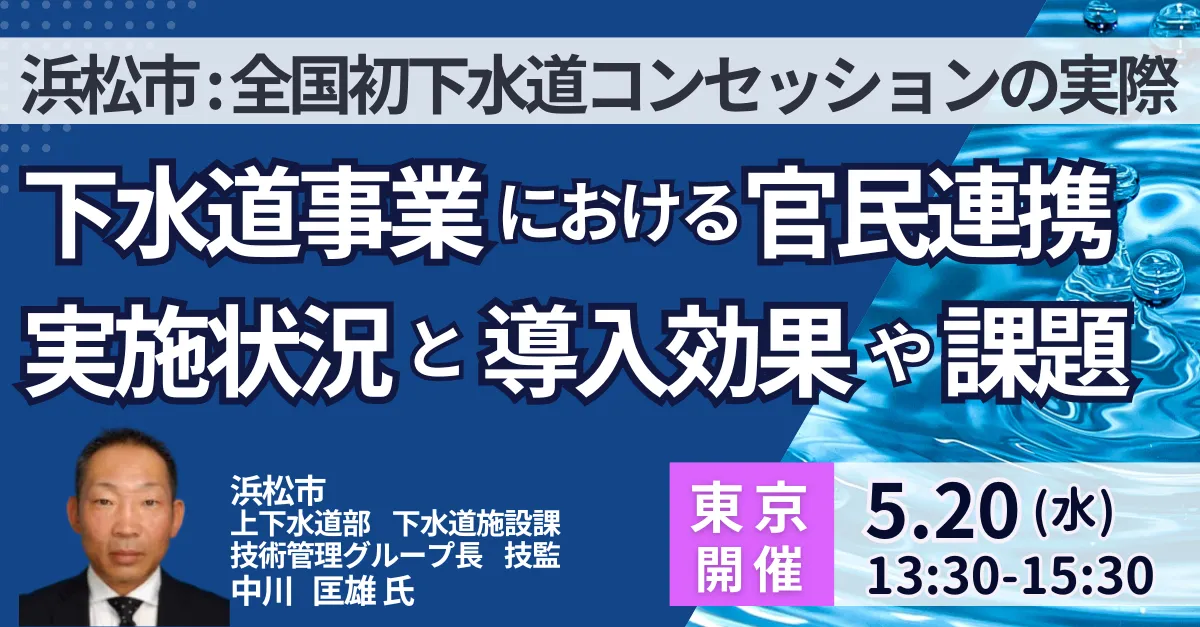
Exploring Public-Private Partnerships in Hamamatsu City's Sewerage Management: A Seminar on the First Nationwide Sewerage Concession
JPI Seminar on Hamamatsu City's Sewerage Management
On May 20, 2026, the Japan Planning Institute (JPI) is hosting a seminar in Tokyo focused on the current state and effects of public-private partnerships in sewerage projects, highlighting Hamamatsu City’s groundbreaking initiatives. This event is a unique opportunity to gain insights into the practical implementation of Japan's first sewerage concession.
Seminar Details
The seminar will occur from 1:30 PM to 3:30 PM, featuring Takao Nakagawa, the Technical Manager of the Hamamatsu City Sewerage Department, as the keynote speaker. The session will delve into Hamamatsu's proactive steps taken since the introduction of the concession model in 2018, which applies to major sewerage facilities within the city.
Background on Hamamatsu's Initiative
Hamamatsu City was a pioneer in implementing the Public-Private Partnership (PPP) model using the Private Finance Initiative (PFI) act. This approach, specifically within the sewerage sector, was the first of its kind in the nation, centered on the Nishien Treatment Area, a key operational zone for sewerage management.
The session will outline the motivations that led Hamamatsu to adopt this model, including oversight on contractor selection and management. Now, nearly a decade into the concession agreement, attendees will hear about the current status, monitoring practices, realized benefits, and challenges that have arisen.
Agenda Overview
The seminar agenda is extensive and designed to demystify the implementation and operational processes involved in the sewerage concession:
1. Overview of Hamamatsu City
- City demographics and profile
- Current status of sewerage management and outsourcing in Hamamatsu
- Challenges faced in the sewerage sector
2. Introduction of Concession Model
- How the concession model was implemented
- Financial realities of sewerage management
- Outcomes of the evaluation process prior to implementation
3. Project Description
- Challenges in formulating a reliable operational scheme
- Characteristics and overview of the construction process
4. Contractor Selection and Expected Benefits
- Key points in selecting contractors for effective partnership
- Review of selection outcomes and proposal details
- Innovative techniques for attracting quality proposals
- Anticipated benefits from the concession approach
5. Current Operations and Outcomes
- Insights on operational monitoring practices
- Benefits realized so far and issues encountered
- Future outlook and potential strategies for addressing existing challenges
6. Q&A Session
7. Networking Opportunity - An invaluable chance to connect with industry peers and the seminar presenter.
Following the seminar, participants can engage in discussion with Nakagawa, allowing for a deeper understanding of the implications of the concession model in terms of policy and practice.
Registration Information
Participants can join the seminar either on-site or via a live stream, with options for post-event access to recorded sessions. The registration fee is set at ¥37,650 per individual, which includes a special offer for sending an additional attendee from the same organization at no extra cost.
This JPI seminar not only provides a wealth of knowledge but also fosters networking opportunities across various sectors, promoting collaborative efforts towards shared goals in public services.
For registration and more details, visit the JPI seminar page: JPI Seminar Registration.
Company Information
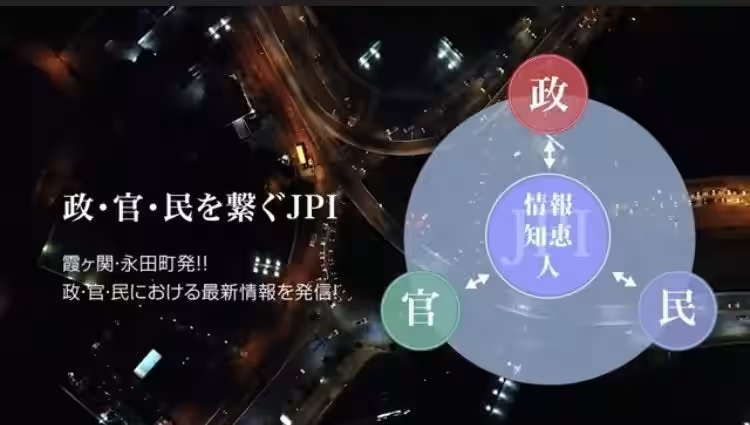
The Japan Planning Institute, located at 5-2-32 Minami-Azabu, Minato-ku, Tokyo, has been a key player in bridging the knowledge gap between government and the private sector for over fifty years, providing valuable insights and training for senior executives engaged in public policy and national projects.
For inquiries, contact:
- - Phone: 03-5793-9761
- - Fax: 03-5793-9767
- - Website: JPI Official Site

Topics Business Technology)
【About Using Articles】
You can freely use the title and article content by linking to the page where the article is posted.
※ Images cannot be used.
【About Links】
Links are free to use.