



New Discoveries in Filler Particle Cohesion Conditions for Coatings and Adhesives
Groundbreaking Insights into Filler Particle Cohesion in Coatings
In recent years, the significance of filler particles in coatings, adhesives, and inks has gained immense attention owing to their impact on material properties such as conductivity, antibacterial performance, and durability. Despite this, the underlying mechanisms that determine how these filler particles aggregate during the curing process have remained poorly understood until now. Researchers from the Graduate School of Science at Tokyo Metropolitan University have tackled this issue, shedding light on critical factors that influence particle cohesion during the curing of epoxy-amine systems.
The research team, led by Yujiro Furuta and Professor Rei Kurita, employed a cutting-edge technique using confocal fluorescence microscopy to conduct direct three-dimensional observations of the distribution of fluorescent polystyrene particles before and after the curing process. Their findings reveal a notable enhancement in particle aggregation due to the curing reaction itself, emphasizing the need to re-evaluate traditional views that mainly consider the volume fraction of filler particles as indicators of aggregation likelihood.
Study Methodology
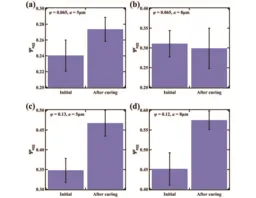
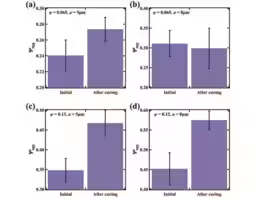
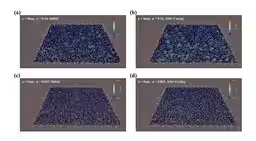
The researchers meticulously altered variables such as particle size and volume fraction to quantify the extent of particle aggregation. Initially, particles were individually indexed to observe their arrangement in a liquid state. Figure 1 in their paper illustrates a striking transformation: before curing, samples showcase sparse and isolated particles contrasted against clusters that form after curing. This deliberate observation enabled a deeper understanding of how the curing process modifies particle interactions.
To define the cohesion quantitatively, the team introduced a new metric termed the 'aggregation ratio,' representing the proportion of particles in contact with at least one other particle. Results confirmed that curing significantly elevated the aggregation ratio, underscoring that considerations beyond simply the volume fraction of filler particles were necessary to comprehend the phenomena accurately.
Key Discoveries
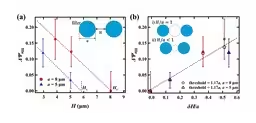
Through their research, the team determined that traditional methods of assessing cohesion solely by particle concentration do not adequately explain how particles tend to aggregate. A pivotal parameter identified was the average particle spacing, denoted as "H." Notably, when normalized by particle size, the newly introduced parameter, δH/a, showed a direct correlation with the likelihood of aggregation. Larger values of δH/a indicated a greater propensity for aggregation upon curing.
This innovative approach to understanding filler cohesion serves as a critical advancement for the formulation of high-performance coatings, inks, and adhesives. The research concludes that utilizing this parameter allows for better predictions on how to design materials with desired dispersal characteristics.
Broader Implications
The implications of these findings extend beyond the immediate scope of coating materials, as they pave the way for enhanced design protocols across various polymer-based composites. Industries such as automotive, electronics, and construction, which rely heavily on coating materials with specific properties, can benefit significantly from insights into particle dispersion and cohesion. With continued exploration of different resins and curing agents, these principles could be applied across a broader range of applications, leading to improved performance and sustainability in material utilization.
Ultimately, this research not only yields practical tools for material scientists aiming to optimize the design of high-performance coatings but also challenges existing paradigms surrounding particle interactions during the curing process. By revealing how fundamental particle dynamics govern material performance, researchers are set to redefine the landscape of material science in coatings.
The research was published on June 5 in the journal Progress in Organic Coatings and was partially supported by the Japan Society for the Promotion of Science under Grant No. 26K00676.
Topics Consumer Products & Retail)
【About Using Articles】
You can freely use the title and article content by linking to the page where the article is posted.
※ Images cannot be used.
【About Links】
Links are free to use.