



Tokyo Launches King Salmon Project for Global Startups at Brooklyn Army Terminal
King Salmon Project: An Opportunity for Global Startups
Tokyo is making strides in fostering innovation and business development by collaborating with the New York City Economic Development Corporation (NYCEDC) and the Los Angeles Cleantech Incubator (LACI). In November 2023, a significant memorandum was signed that aims to transform both cities into robust global hubs of business and innovation.
As part of this collaboration, the King Salmon Project has been initiated to support startups aspiring for global expansion. This testbed program, aptly named the "Pilots at BAT Program," will provide a unique opportunity for startups, particularly those focused on climate tech, to demonstrate their solutions at the Brooklyn Army Terminal (BAT).
Program Overview
The Pilots at BAT Program offers innovative startups access to infrastructure at BAT, crucial for conducting demonstrations of their technologies. Participants will receive various types of support facilitated by the NYCEDC, LACI, and the Tokyo Metropolitan Government, ensuring that startups have the tools they need for success in a competitive global market.
Target Participants
The program is open to one selected company, which will be chosen through a stringent application process that includes document and interview evaluations. Detailed eligibility criteria can be found in the program guidelines.
Support Framework
The support for this program encompasses a broad array of resources provided over a maximum duration of approximately 12 months. Through the collaboration with NYCEDC and LACI, participants will gain:
- - Access to the necessary infrastructure at BAT for demonstrations.
- - Technical support for obtaining permits and handling local equipment and facilities.
- - Regular mentoring sessions to guide startups through their progress.
- - Publication of case studies demonstrating the results of their demonstrations.
Additionally, the Tokyo Metropolitan Government will offer comprehensive assistance focused on enabling local demonstrations and providing financial support for international travel related to the program.
Schedule of Events
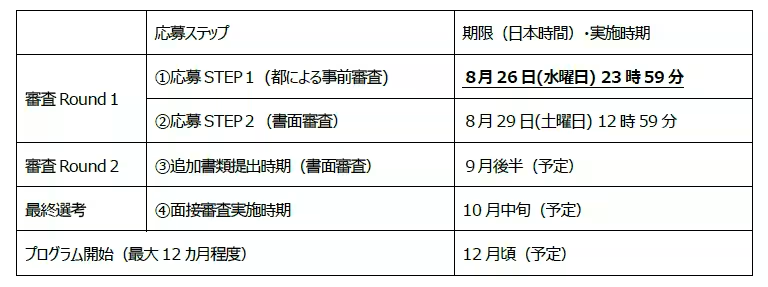
All interested parties are encouraged to apply before the first deadline. An information session for the program will take place online on August 6, 2024, from 19:00 to 20:00 JST. Potential applicants can find more details and register via the program's web page.
For further information, please visit the King Salmon Project's official website: King Salmon Project
Understanding Brooklyn Army Terminal (BAT)
The Brooklyn Army Terminal (BAT) is situated in Sunset Park, Brooklyn, New York. Spanning approximately 4 million square feet, it serves as a modern industrial hub hosting over 100 companies that collectively create more than 3,500 jobs. Originally built in 1918 as the largest military logistics base in the United States, BAT transitioned in 1966 when military operations ceased. The city acquired it in 1981, and it has since undergone a transformation into a vibrant space for the next generation of innovators and manufacturing firms.
BAT now features the climate-tech innovation hub "BATWorks," which supports emerging market innovators, small enterprises, and those at various stages of business development. Equipped with specialized labs, co-working spaces, and event areas, BATWorks facilitates product development and rapid prototyping.
Los Angeles Cleantech Incubator (LACI)
LACI operates the climate programs at BATWorks, leveraging the strengths of New York City and Los Angeles, the two largest cities in the U.S., to spearhead climate innovation. Established in 2011 as part of an economic development initiative by the City of Los Angeles and L.A. Department of Water and Power, LACI has supported 537 portfolio companies, resulting in over $1.5 billion in total fundraising, $477 million in revenue generation, and the creation of over 3,000 jobs. Moreover, it has produced an economic ripple effect exceeding $733 million.
This initiative ties into the broader '2050 Tokyo Strategy,' specifically aiming to nurture startups that can thrive on a global scale. The focus is on cultivating an ecosystem where local companies can gain prominence and influence beyond their borders, especially in high-growth sectors like climate technology.
In conclusion, the King Salmon Project represents a unique venture for startups poised to make an impact on a global scale. As Tokyo continues to establish itself as a player in international business innovation, programs like this pave the way for the future generation of transformative companies.

Topics Consumer Technology)
【About Using Articles】
You can freely use the title and article content by linking to the page where the article is posted.
※ Images cannot be used.
【About Links】
Links are free to use.