



Advanced Visualization Technique for Detecting Plate Boundary Coupling Dynamics for Earthquake Evaluation
Advanced Visualization Technique for Detecting Plate Boundary Coupling Dynamics for Earthquake Evaluation
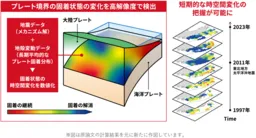
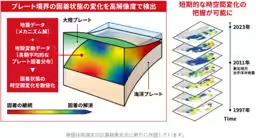
A new method for visualizing the changes in the coupling state of plate boundaries has been developed by the National Institute of Advanced Industrial Science and Technology (AIST) in Japan. This innovative approach enables high-resolution observations of the coupling variations at plate boundaries over time, significantly enhancing the understanding of earthquake probabilities and magnitudes, especially in relation to the Tohoku earthquake of 2011.
Key Insights
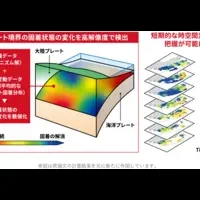
The method integrates earthquake data and crustal deformation data to visualize the changes in the coupling state at plate boundaries with exceptional spatial and temporal resolution. By applying this method to the Tohoku-Oki plate boundary, researchers successfully detected year-scale variations and identified changes in coupling state leading up to the 2011 Tohoku earthquake. It is crucial for assessing areas with a high likelihood of seismic activity.
In regions where the oceanic plate is subducting beneath the continental plate, different areas exhibit strong coupling, with minimal movement, and others where movement is relatively free. Areas of strong coupling accumulate strain, which is released in the form of earthquakes. Thus, accurately monitoring these changes can offer predictions of earthquake occurrences and their scales. Historically, coupling states have been inferred from crustal deformation data, but limitations existed in terms of spatial and temporal resolution.
The Technique’s Development
To overcome these limitations, the researchers utilized a combination of high-resolution earthquake data and long-term stable crustal deformation data. In their examination of the Tohoku-Oki plate boundary, they effectively discovered shifts in coupling states that were previously undetectable by crustal deformation data alone. The findings revealed crucial insights into the process of large earthquake preparedness and will aid in improving the estimation of earthquake occurrence probabilities and magnitudes.
This research highlights the historical context of earthquake activities in the Japan region, where large earthquakes have repeatedly occurred. Between strongly and weakly coupled regions at plate boundaries, the accumulation of strain in strongly coupled areas leads to sudden releases, resulting in seismic activities. The dynamic changes of coupling states signify changing stress fields that drive these seismic events.
Methodology
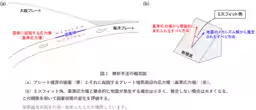
The developed method was constructed using the following processes to visualize changes from the baseline state:
- - Estimating the long-term average plate coupling distribution (baseline state) from GNSS data.
- - Calculating the surrounding stress field caused by the derived coupling (baseline stress field).
- - Quantifying how well earthquakes aligned with the baseline stress field using a misfit angle as the indicator.
- - Evaluating the changes in the spatial and temporal distribution of the misfit angle to visualize deviations from the baseline state.
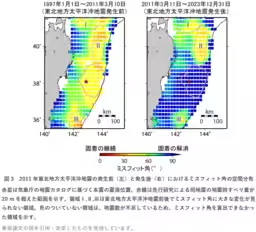
A small misfit angle indicates a generally stable coupling state, whereas a large angle suggests a resolution of the coupling state possibly due to earthquakes or slow slips. By using this method, the research team was able to capture shifts in subsurface conditions with high temporal resolution while also taking advantage of the stable long-term variations provided by crustal deformation data.
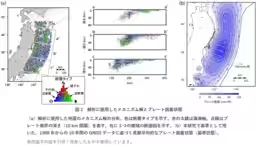
In exploring the Tohoku-Oki region's plate boundary with about 25 years of earthquake data (1997-2023), the researchers identified that prior to the 2011 Tohoku earthquake, small misfit angles were maintained over expansive areas, signifying long-term coupling stability. Conversely, post-earthquake analysis revealed increased misfit angles across a wide area, indicating a resolution of coupling.
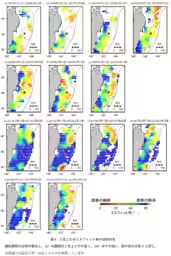
Additionally, analyses with improved temporal resolution uncovered that the coupling states change not only over the years but also exhibit complex and heterogeneous spatial structures.
Implications for Earthquake Preparedness
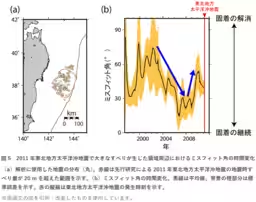
Interestingly, this study also hints at the possibility that partial uncoupling processes have been occurring for years leading up to major seismic events. This vital information could play a crucial role in assessing the likelihood and intensity of earthquake occurrences, thereby contributing significantly to disaster prevention and mitigation efforts. The researchers emphasize that thorough inspection of coupling state variations is pivotal in enhancing earthquake triggering process understandings.
Future Directions
Moving forward, the researchers plan to apply this technique to other regions, including the Nankai Trough and the Kuril Trench. By employing machine learning for larger-scale estimates, they aim to enhance both the versatility and accuracy of this groundbreaking technique.
Publication Details
This research is documented in the September 1, 2026 edition of the Journal of Geophysical Research: Solid Earth with the title, "Detection of Interannual and Fine-Scale Plate Coupling Variations Using Intraplate Earthquakes and Geodetic Data: Application to the Tohoku-Oki Plate Boundary" by Kazutoshi Imanishi and Akemi Noda.
For further details, refer to the publication here.
Topics Other)







【About Using Articles】
You can freely use the title and article content by linking to the page where the article is posted.
※ Images cannot be used.
【About Links】
Links are free to use.