



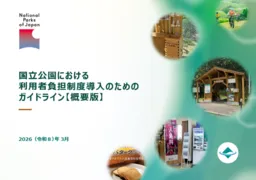
EY Supports Guideline for User Fee System in Japan's National Parks
EY Supports Guideline for User Fee System in Japan's National Parks
EY Strategy and Consulting (EYSC) based in Chiyoda, Tokyo, has announced its support in the development of guidelines for a user fee system in national parks, as set forth by Japan's Ministry of the Environment. These guidelines aim to provide a structured approach for government officials and local stakeholders to sustainably advance the conservation and appropriate use of natural environments within national parks. The guidelines outline practical steps from the introduction to implementation and improvement of the user fee system, supported by numerous real-world examples.
Rising Visitor Numbers
In recent years, Japan has seen a significant increase in inbound tourists, with many visitors drawn to the majestic landscapes of national parks. It is estimated that by 2025, the number of foreign visitors utilizing national parks will reach approximately 9.88 million, which is 1.48 times more than the pre-pandemic figures in 2019. However, this surge in visitation has brought common challenges to national parks, such as increased visitor numbers, aging facilities, and heightened environmental impacts, resulting in a noticeable shortage of maintenance funds. To continue providing safe and high-quality natural experiences, a stable financial foundation and a system for user participation in conservation efforts are essential.
Comprehensive Approaches to User Fee Implementation
In response to these pressing issues, EYSC has leveraged its expertise in regional management utilizing natural capital to support the "National Park Enjoyment Project" aimed at promoting the use of national parks across Japan. This initiative has included thorough research on advanced practices from various regions, leading to the organization and compilation of case studies for the user fee system's introduction.
The guidelines distill the implementation process into five structured steps, which include:
1. Purpose Clarification: Establishing clear objectives for the user fee system.
2. System Design: Creating an appropriate framework for the user fee system.
3. Trial Implementation: Conducting pilot tests to assess effectiveness.
4. Evaluation: Analyzing the outcomes of the implemented system.
5. Improvement: Making necessary adjustments based on feedback and findings.
Additionally, the guidelines dissect various system types, including entry fees, usage fees, and optional donations, clearly outlining their advantages, disadvantages, and considerations for implementation.
Enhancing Operations and Collaborations
The guidelines also detail methods for consensus building among local stakeholders, capacity for managing funds, and processing payments. It emphasizes the importance of engaging community members in the decision-making process and constructing an effective operational structure.
Numerous case studies are included, featuring pioneering practices from national parks such as Fuji-Hakone-Izu National Park, Myoko-Togakushi Renzan National Park, and Aso-Kuju National Park. These examples are categorized and organized to be practical for various stakeholders.
A Step Towards Sustainable Tourism
According to Keiichi Hasegawa, Director of the Social Agenda Team at EYSC, and Tatsuhiro Suzuki, Manager, “These guidelines represent a systematic framework for the effective introduction and operation of user fee systems in national parks based on best practices nationwide. The efficient management of national parks is crucial for expanding Japan's inbound tourism policy, yet many regions struggle to maintain the status quo under challenging circumstances. This document details a clear flow from purpose clarification and consensus building to system design and improvement, allowing regions to establish sustainable models for conservation and use. As visitor awareness about environmental issues grows alongside the demand for sustainable tourism, the user fee system becomes not just a revenue source but a chance for visitors to participate actively in nature conservation, enhancing the experience and value of the natural environment.”
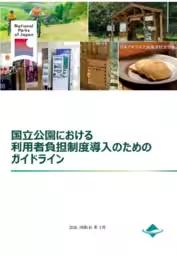
For further insights, you can find the user fee system introduction guidelines and exemplary case studies on the Ministry of the Environment's website.
- - Summary of User Fee System Guidelines
- - Complete User Fee System Guidelines
- - National Park Enjoyment Project
About EY
EY aims to create new value for clients, members, society, and the planet, building a better working world through trust in capital markets. By harnessing data, AI, and advanced technologies, EY teams support clients in shaping the future confidently, addressing pressing challenges today and for the future. EY’s reach spans over 150 countries and regions, delivering integrated services across assurance, consulting, tax, strategy, and transactions.
EY's Consulting Services
EY’s consulting services transform business through people, technology, and innovation, aiming to become leading consultants in the transformation space. With more than 70,000 EY consultants applying diverse skills for rapid technological implementation and large-scale innovation, they support clients in their transformations, creating long-term value for people, clients, and society.
Topics Environment)
【About Using Articles】
You can freely use the title and article content by linking to the page where the article is posted.
※ Images cannot be used.
【About Links】
Links are free to use.