



Revealing Ecological Connectivity Between Seamounts in the Deep Sea
Understanding Seamounts and Their Ecological Importance
Introduction
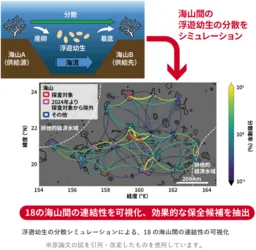
As humanity explores the deep seas, it’s essential to grasp the delicate ecosystems that thrive in these remote locations. Recently, a team led by Naoki Saito from the National Institute of Advanced Industrial Science and Technology (AIST) investigated the ecological connectivity between eighteen seamounts in the Northwest Pacific using advanced larval dispersal simulations.
Background
Seamounts are underwater mountains that rise more than 1,000 meters above the surrounding ocean floor. They serve as crucial habitats for various marine species, fostering biodiversity. Among the notable discoveries in these regions are cobalt-rich crusts, which are considered potential sources of rare metals. These metals, sought after for their applications in technology, are prompting interest in commercial exploration of seamounts. However, large-scale mining hasn’t been conducted yet, leaving questions regarding its ecological impact unanswered.
The Research Study
The research involved carrying out simulations to observe how larval dispersal occurs among the eighteen studied seamounts. The aim was to reveal the connectivity of these ecosystems and identify key seamounts that contribute to maintaining overall ecological linkages. The results indicated that some seamounts are critical pathways for dispersal and could significantly influence the genetic connectivity of marine populations.
Methodology
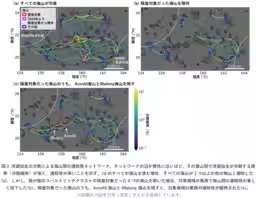
Utilizing a high-resolution ocean current model capable of distinguishing over two hundred thousand cells over a 1,000 km by 1,000 km area, the researchers quantified the probability of larval dispersal between seamounts. This quantitative analysis allowed them to visualize the connectivity as a network, where the seamounts served as nodes regarding larval dispersal.
Findings
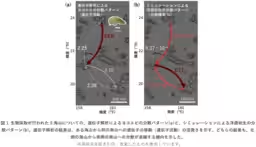
The results highlighted a robust connectivity amongst all eighteen seamounts through larval dispersal. However, the modeling also indicated that should specific seamounts—including those targeted for cobalt exploration—be removed from the network, connectivity significantly declines in certain areas. Conversely, other seamounts, such as Arnold and Malony, emerge as critical nodes that facilitate connectivity within the region. Maintaining these seamounts within the conservation framework could be key to preserving ecological linkages.
Ecological Ramifications
Ecosystems on seamounts are interconnected through larval dispersal. Many marine species, including shrimp and corals, release larvae that drift via ocean currents to establish new populations on distant seamounts. Preserving these connections is vital not only for the genetic health of marine populations but also for preventing local extinctions.
The Need for Conservation
Given the imminent potential for deep-sea mining, this research underscores the importance of establishing effective conservation areas. By fostering an understanding of ecological connections, the study advocates for an integrated approach to resource management that respects and preserves the delicate balance of deep-sea ecosystems.
Implications for Future Policy
As international talks continue regarding the management of marine mineral resources, integrating these findings into conservation policy is crucial. The insights gained from the larval dispersal simulations can inform the design of marine protected areas that maintain ecological connectivity, thus supporting sustainable development of deep-sea mining activities.
Conclusion
The recent research sheds light on the often-overlooked ecological dynamics of seamounts, highlighting crucial areas for conservation. As exploration and extraction activities ramp up, safeguarding the intricate web of connections among these underwater mountains becomes not just necessary but imperative to ensure the longevity of marine biodiversity in the deep seas. The study was published in the journal Ecological Applications, signaling an important step towards responsible and informed ocean resource management.
Future Directions
Future investigations will aim to encompass more seamounts and synthesize genetic analysis with dispersal modeling, striving for a deeper understanding of ecological connectivity in the deep sea. It’s a vital endeavor toward balancing resource extraction with environmental stewardship.
References
- - Saito, N., et al. (2025). Seamount larval dispersal networks: a potential strategy for conserving ecological connectivity from deep-sea mining. Ecological Applications. DOI: 10.1002/eap.70086
Topics Environment)
【About Using Articles】
You can freely use the title and article content by linking to the page where the article is posted.
※ Images cannot be used.
【About Links】
Links are free to use.