



Next-Generation Alloy Catalyst Surpass Platinum Through Mesoporous Single Crystal Innovation
Revolutionary Advances in Catalysts
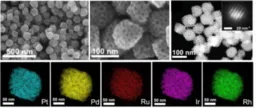
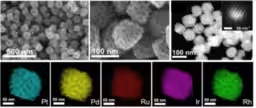
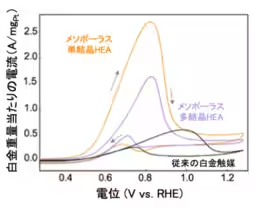
Researchers from Nagoya University and Waseda University have made a groundbreaking advancement in the field of catalysis by successfully synthesizing a mesoporous single-crystal high-entropy alloy (HEA). This innovative material demonstrates remarkable performance, surpassing traditional platinum catalysts by an impressive factor of 2.9 in methanol decomposition efficiency. The development of this alloy is significant not only for reducing the environmental burden associated with expensive platinum use but also for its applications in next-generation energy devices such as electric vehicles and portable generators.
Key Features of the Innovation
- - Mesoporous Structure: The team has achieved the unprecedented mesoporous structure with a single crystal that consists of five types of metals, marking a significant step forward in alloy synthesis.
- - Improved Catalytic Activity: The new HEA exhibits a catalytic activity 2.9 times higher than standard platinum catalysts, making it a highly efficient alternative for methanol fuel cells.
- - Exceptional Durability: The alloy maintains 93% of its peak performance even after undergoing approximately 2,500 charge-discharge cycles, showcasing its resilience and longevity compared to traditional platinum materials that exhibit lower retention of performance.
The synthesis technique utilized a novel soft chemical process that combines surfactants to create a micelle template for forming nanoparticles with uniform mesopores. This groundbreaking method resolved the long-standing challenges of synthesizing single-crystal HEAs with high surface area and a porous nature.
Implications for Energy Devices
The implications of this research are vast, as the newly developed mesoporous single-crystal HEA satisfies the crucial need for cost-effective catalysts without sacrificing performance. As the world pushes towards a decarbonized society, this innovative material is poised to significantly contribute to the efficiency of clean energy technologies. In particular, it holds promise for enhancing the capabilities of methanol fuel cells, which are often sought after for their lightweight and compact designs, making them ideal for portable electronic devices and other applications.
Furthermore, the synthetic method developed by the research team has the potential to be applied to other metal-based materials. This could extend beyond catalysis to benefit sensors, electronic materials, and environmental purification technologies. Consequently, the societal impact of this project is expected to be far-reaching in promoting sustainability through advanced materials science.
Challenges Ahead
While the findings are promising, the research team faces the challenge of exploring multielement systems that include more affordable metals for broader application. Moreover, they acknowledge the necessity for durability testing under larger-scale operational conditions, which is part of the next steps in their ongoing research. Future efforts aim to address applications related to hydrogen generation and carbon dioxide reduction to contribute to breakthroughs in energy and environmental domains.
Commitment to Sustainable Solutions
In conclusion, the successful integration of high-entropy alloy, single-crystal structure, and mesoporous design heralds a new era in material science. The research team expressed that this work bridges fundamental science with practical applications, pledging to continue their contributions towards creating a sustainable future.

Topics Consumer Technology)
【About Using Articles】
You can freely use the title and article content by linking to the page where the article is posted.
※ Images cannot be used.
【About Links】
Links are free to use.