



Hitachi Launches Knowledge-Based System to Improve Design Efficiency and Quality in Manufacturing
Hitachi's Innovative Design Knowledge System: Boosting Manufacturing Efficiency
Hitachi has unveiled its latest innovation, the Design Knowledge System, intended specifically for the manufacturing sector. This new system aims to streamline design tasks while improving the quality of product designs, marking a significant milestone in the adoption of AI within the industry.
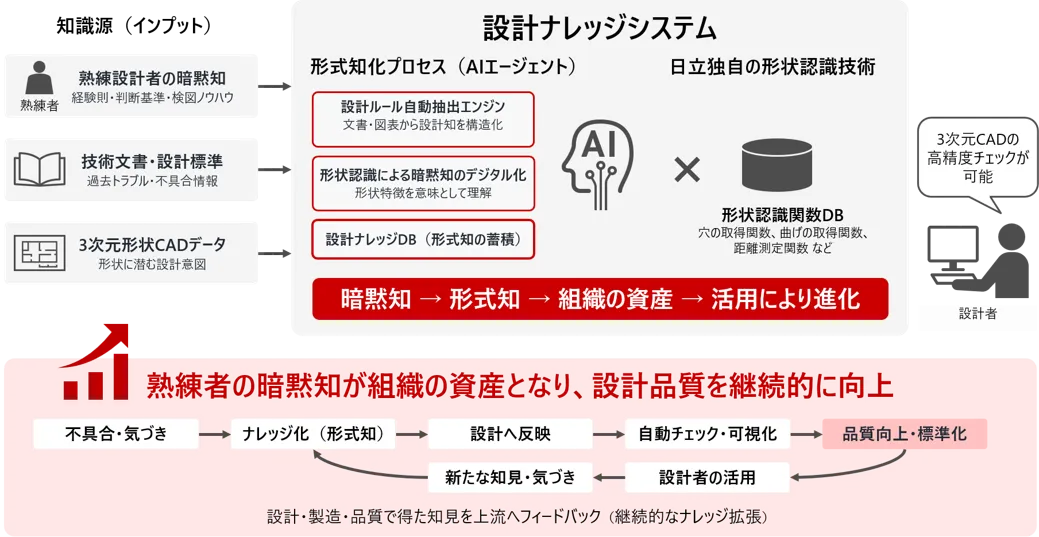
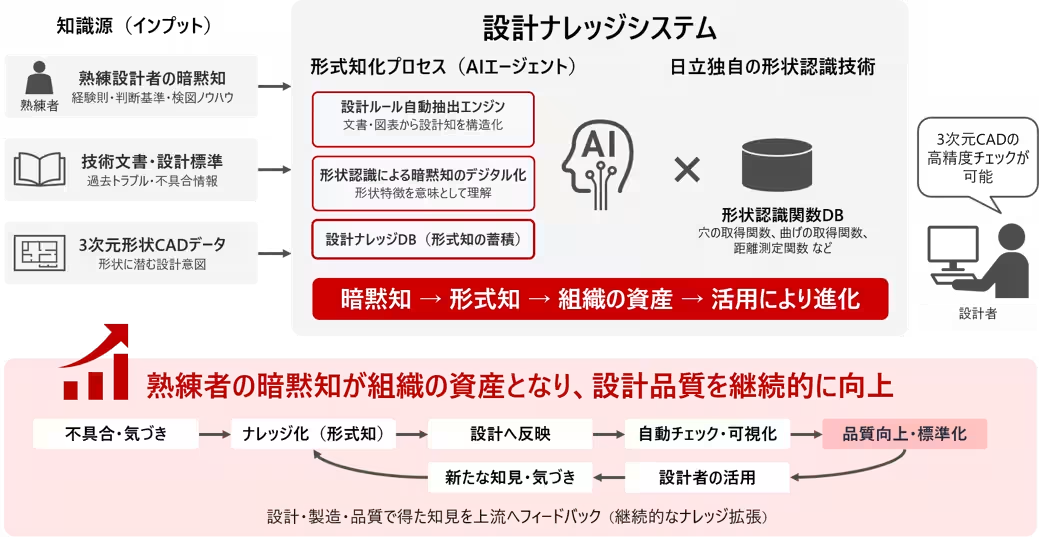
With the manufacturing sector facing challenges such as a shortage of skilled technicians and the need for effective knowledge transfer, the importance of capturing and utilizing knowledge from experienced workers is more critical than ever. The Design Knowledge System seeks to address these issues by transforming implicit knowledge from seasoned professionals into explicit knowledge that can be shared across organizations. By combining an AI agent with Hitachi's proprietary shape recognition technology, the system creates a cycle where tacit knowledge is converted into formal knowledge, ultimately contributing to organizational assets.
The Design Knowledge System is part of Hitachi's broader strategy to support efficient operations in design work. According to market predictions, the global AI market for manufacturing is anticipated to grow significantly, reaching approximately $12.81 billion by 2034, driven by innovations such as this one. This data underscores the global trend towards adopting AI to enhance efficiency and quality in manufacturing processes, with 2026 expected to see a significant market expansion.
Key Features of the Design Knowledge System
The new Design Knowledge System employs an AI agent that gathers expertise from seasoned professionals, including technical documentation, past issues, and CAD data, to convert nuanced knowledge into formal knowledge that can be utilized organization-wide.
Notable features include:
- - Automatic Extraction of Design Rules: The system can autonomously extract design rules from text and diagrams without the need for prompts. This knowledge is then centralized for easy access.
- - Natural Language Search: Stakeholders can query and reference accumulated design knowledge via a chatbot interface, enhancing user experience and accessibility.
- - High-Precision CAD Data Validation: By integrating design rules with Hitachi's unique shape recognition database, the system performs precise checks on 3D shape CAD data, visualizing violations of established design rules. This feature aids in preventing quality issues and backtracking due to missed discrepancies.
By streamlining the design process, the system significantly reduces the labor intensive tasks associated with verification, allowing designers to focus on more complex and essential responsibilities. With the capability of providing continuous feedback to enhance design knowledge, the system promotes a culture of learning and improvement within the organization. This empowers design teams to gradually evolve their knowledge assets through operational insights.
Future Prospects and Goals
Hitachi foresees an evolution of the Design Knowledge System that will encompass broader aspects of design, manufacturing, maintenance, and quality assurance. The company aims to seamlessly integrate these services to facilitate a comprehensive framework that supports the entire design-to-manufacturing process. This will be achieved through a phased enhancement of the system, leading to automatic generation of BOMs and BOPs from design data and enabling virtual prototype evaluations based on rapid similarity searches.
Looking ahead, Hitachi is poised to leverage their extensive product installation base and domain knowledge, combined with advanced AI, to provide next-generation solutions under the HMAX Industry banner. This initiative will not only enhance customer lifetime value but also contribute to global industrial transformation for a more prosperous society.
For more information about Hitachi's innovations and their impact on various industries, please visit their official website.
Topics Consumer Technology)

【About Using Articles】
You can freely use the title and article content by linking to the page where the article is posted.
※ Images cannot be used.
【About Links】
Links are free to use.