



Unlocking the Secrets of Electronic Components with LTspice: A Comprehensive Seminar
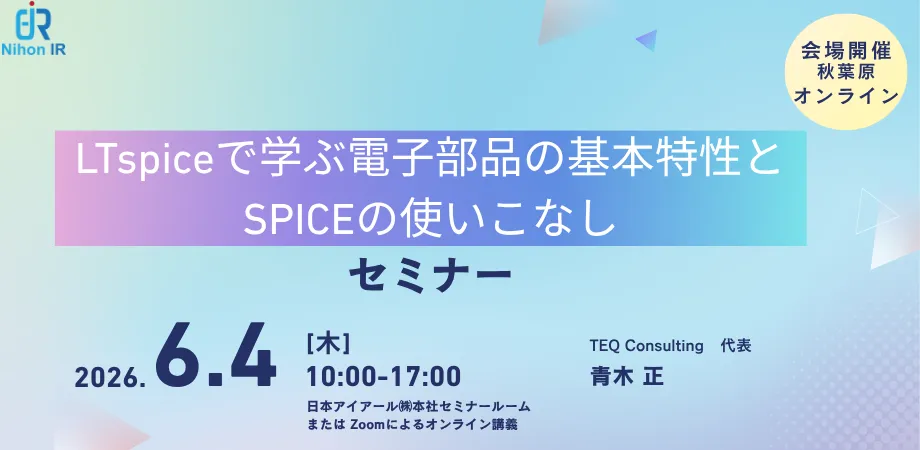
Seminar on Understanding Electronic Component Characteristics with LTspice
The Institute for Engineer Education at Nihon IR is set to host a seminar focusing on how to utilize LTspice to understand the intrinsic characteristics of electronic components such as inductors, capacitors, MOSFETs, and CMOS ICs. This open seminar aims to blend theoretical knowledge with practical simulation, making the learning process relatable to real-world applications.
In the fields of circuit design, layout planning, and evaluation, understanding the characteristics of components is crucial. It transcends mere empirical knowledge; participants will learn the necessity of quantifiable comprehension based on equations and repeatable verification through simulation. However, diving into SPICE (Simulation Program with Integrated Circuit Emphasis) can often present challenges, including managing different model types, library integration, and various measurement and calculation commands. The seminar is structured to tackle these common hurdles by educating participants on the fundamental characteristics of electronic components while simultaneously mastering the practical use of LTspice.
Seminar Overview
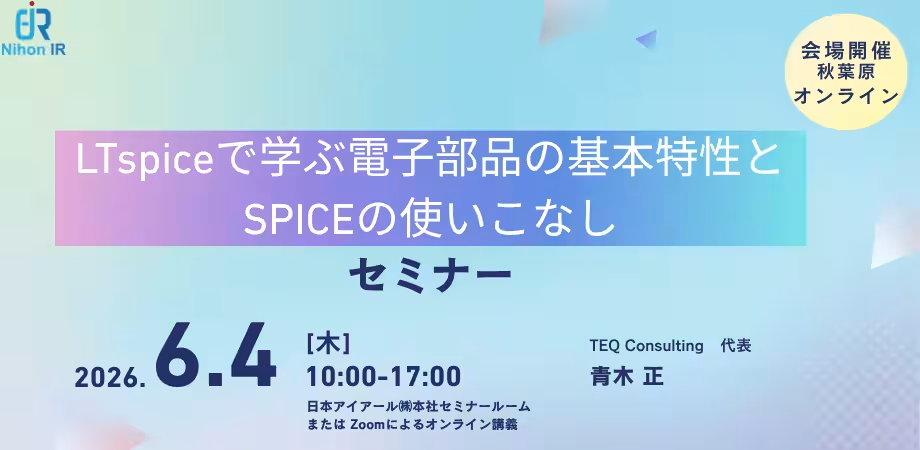
- - Title: Understanding the Fundamental Characteristics of Electronic Components with LTspice and Mastering SPICE
- - Date and Time: June 4, 2026, from 10:00 AM to 5:00 PM
- - Format: Held at the Nihon IR headquarters seminar room, with an option for online participation via Zoom
- - Capacity: 7 attendees for on-site participation (No limit for online participation)
- - Fee: 49,500 yen (tax included)
- - Instructor: Masashi Aoki, Representative of TEQ Consulting
Course Details
This course features LTspice, which is a free SPICE simulator distributed by Analog Devices. Participants will learn about the essential characteristics of electronic components and key points regarding SPICE utilization in a systematic manner. To deepen the understanding required for practical work such as design and evaluation, the characteristics of inductors, capacitors, and MOSFETs will be explained using equations, coupled with simulations including transient analysis, AC analysis, and FFT analysis to validate results.
Furthermore, by addressing an essential aspect of SPICE analysis—model management—this course will provide insight into the characteristics and limitations of compact models, behavioral models, S-parameter models, and IBIS models. Participants will learn about model integration and library organization (.lib/.sym/.mod), how to utilize the .measure command for data reading and calculations, processing steps using raw files, and exporting results, all while analyzing actual outcomes.
Seminar Program
1. Overview: Objectives, goals, and seminar contents
2. Introduction to SPICE: What it can and cannot do; key considerations for business use
3. Obtaining and Installing LTspice: Sample circuits, library structures, and acquiring related information
4. Hands-On LTspice: Creating circuits, running transient, AC analysis, and scale adjustments
5. Inductor Characteristics: Equivalent circuits, frequency characteristics, parasitic inductance
6. Capacitor Characteristics: Equivalent circuits, DC bias dependence, Dynamic Capacitor Model
7. MOSFET and CMOS IC: Static and dynamic characteristics, temperature dependency, process corners
8. Effective Use of Voltage and Current Sources
9. Model Differences in SPICE: Distinction among compact, behavioral, S-parameter, and IBIS models
10. Library Management for Models: How to integrate and related file knowledge
11. Additional Features: .measure utilization, handling raw files, and exporting results. The appendix includes oscilloscope measurement, LC resonance, and S-parameter supplements.
Target Audience
This seminar is aimed at:
- - Circuit designers and layout personnel
- - Those involved in EMC-related tasks
- - Individuals looking to practically master LTspice
- - Participants wanting to quantitatively learn about the fundamental characteristics of inductors, capacitors, MOSFETs, and CMOS ICs
- - Professionals aiming to use transient, AC, and FFT analysis in their work applications.
For more details on this seminar, visit our website.
The Institute for Engineer Education at Nihon IR continues to provide valuable knowledge and know-how through technical education services, seminars, e-learning, training, and publishing targeted at the manufacturing sector.
About Nihon IR Co., Ltd.
With over 50 years of experience, Nihon IR provides specialized services including patent and intellectual property solutions, technical information research and analysis, technical education for manufacturing, and creation of technical content, all grounded in expertise-driven practical services. More information can be found on our website: Nihon IR | Institute for Engineer Education. Address: 15-1 Kanda Iwamoto-cho, Chiyoda-ku, Tokyo 101-0033, Japan. Telephone: 03-6206-4966.
Topics Consumer Technology)
【About Using Articles】
You can freely use the title and article content by linking to the page where the article is posted.
※ Images cannot be used.
【About Links】
Links are free to use.