



Unraveling the Origins of Japan's Intense Volcanic Activity During the Late Cretaceous
Exploring the Origins of Japan's Volcanic Activity
Recent research by a team from the National Institute of Advanced Industrial Science and Technology and the University of Tokyo has shed light on the origins of Japan's notable volcanic activity during the Late Cretaceous to early Paleocene period. This phenomenon, termed the Ignimbrite flare-up, is marked by a series of large caldera-forming eruptions occurring in a concentrated timeframe. Spanning approximately 90 million to 60 million years ago, this period has been pivotal in shaping not only Japan's geological landscape but also its ecosystems.
Understanding the Ignimbrite Flare-Up
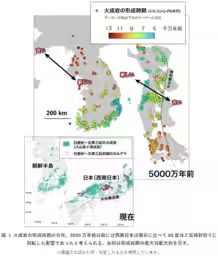
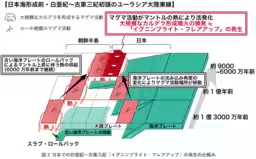
Ignimbrite flare-ups are associated with massive caldera eruptions that occur in relatively short geological timescales. Despite being documented worldwide, the exact causes of such intense geological events remain a subject of investigation. During this research, scientists compiled isotopic data of elements from igneous rocks found across the Japanese archipelago and the Korean Peninsula, creating a comprehensive database.
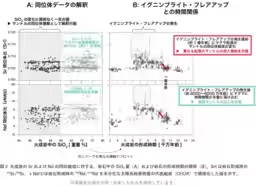
The results indicated a significant shift in the isotopic composition of strontium (Sr) and neodymium (Nd) roughly 100 million years ago, suggesting that the magma sources feeding these volcanic eruptions were dramatically altered prior to the onset of the Ignimbrite flare-up.
The Role of Hot Mantle Inflow
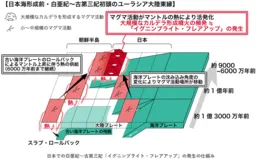
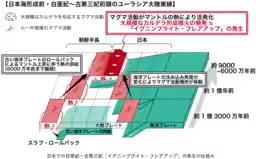
A major breakthrough in the study was the revelation that prior to the Ignimbrite flare-up, hot mantle material was injected beneath the Japanese archipelago. This influx is believed to have been triggered by a geological process known as 'slab rollback,' where the trailing edge of an old oceanic plate folded under the continental crust, allowing hot mantle to flow upward. This interaction likely provided the necessary heat and material to ignite the extensive volcanic activity witnessed during this epoch.
The researchers argue this inflow of heat was instrumental in transitioning the magma system beneath Japan from a stable state to one characterized by explosive volcanic activity. Analysis of the rock compositions confirmed that eruptions were closely linked to geological changes, supporting the theory that the volcanic events were not a regular occurrence but influenced by dynamic subsurface processes.
Implications for Understanding Volcanic Activity
This research not only unravels the origins of Japan's volcanic history but also contributes to our understanding of how similar flare-ups might occur in other subduction zones around the world. Given the potential impact of explosive volcanic eruptions on climate and human societies, deciphering the conditions that lead to such phenomena is crucial for disaster preparedness.
The findings have been published in the journal Progress in Earth and Planetary Science, illustrating a collaborative effort to bridge geological history with contemporary volcanic risk assessment techniques.
Conclusion
As we consider the implications of this study, it highlights the intricate relationships between tectonic movements and volcanic eruptions. Understanding these relationships is not merely an academic pursuit; it holds significant relevance for risk mitigation in seismically active regions. Improved predictive models for volcanic activity can better prepare societies for potential natural disasters originating from these geological phenomena.
The study’s lead author, Ken Yamaoka, emphasizes that uncovering the links between mantle dynamics and volcanic activity can help predict future occurrences, safeguarding populations living in vulnerable areas.
Further Reading
For those interested in diving deeper into this subject, the full paper titled Ignimbrite flare-up in Late Cretaceous–Paleocene Japan empowered by hot mantle inflow can be accessed through its DOI: 10.1186/s40645-025-00755-x.
By advancing our geological knowledge of volcanic activities, researchers aim to offer valuable insights into the ever-evolving nature of Earth's geology and its potential threats to human life.
Topics Environment)
【About Using Articles】
You can freely use the title and article content by linking to the page where the article is posted.
※ Images cannot be used.
【About Links】
Links are free to use.