



Revolutionizing Medical Imaging with Novel Dual ICG Fluorescence Technology for Real-Time Bioinformation Capture
Introduction
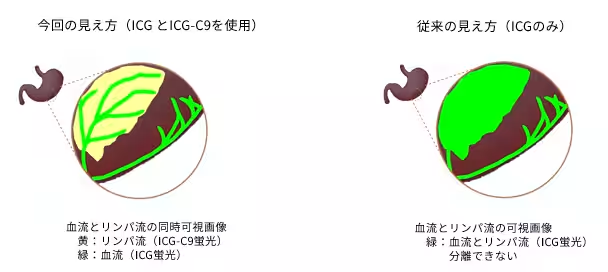
The healthcare technology landscape is witnessing a significant transformation, thanks to i-PRO Inc., which has developed a pioneering medical imaging camera that employs dual types of indocyanine green (ICG) fluorescence. This advancement has been achieved through a collaboration with Hokkaido University, which introduced a novel fluorescein reagent named "ICG-C9." In a remarkable academic and clinical partnership, this dual-fluorescence technology allows for the simultaneous visualization of blood and lymphatic flow, a feat never before accomplished at this level of effectiveness.
The Significance of Dual Fluorescence Imaging
The cutting-edge multi-fluorescence imaging camera can obtain multiple biological signals concurrently, effectively separating and visualizing each in real time. This new platform enhances the precision of medical procedures by providing detailed insights into anatomical structures based on visual images, combined with functional data relating to blood flow and lymphatic dynamics.
Background of Collaborative Research
Fluorescence-guided surgery has become a widely adopted method for making blood and lymphatic flow visible during surgical interventions. Traditionally, only one type of fluorescein could be visualized in a single procedure, posing challenges in achieving a comprehensive understanding of multiple biological signals simultaneously. Advancements in this area have spurred the need for techniques that can improve intraoperative decision-making capabilities.
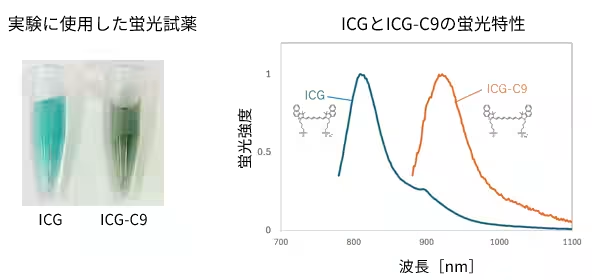
In response to these challenges, a team led by Professor Kenji Kadokuro of Hokkaido University’s Graduate School of Advanced Life Science developed the innovative ICG-C9 fluorescein. This new agent, featuring a different wavelength range from traditional ICG, allows the clear distinction between blood and lymphatic flow, facilitating a new era of imaging capabilities.
Technical Overview of the Multi-Fluorescence Imaging Camera
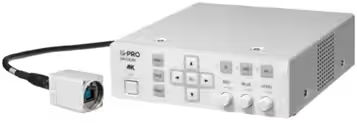
The architecture of the multi-fluorescence imaging camera harnesses a multi-channel structure that collects two fluorescent images in the infrared wavelength range alongside visible imaging. The camera utilizes the distinctive fluorescence characteristics of both ICG and ICG-C9 for optimal results in separate evaluations of blood and lymphatic flow. Notably, the camera minimizes cross-talk between the signals, enabling high-sensitivity imaging of both fluorescent signals while maintaining clarity across biological data.
Experimental Validation
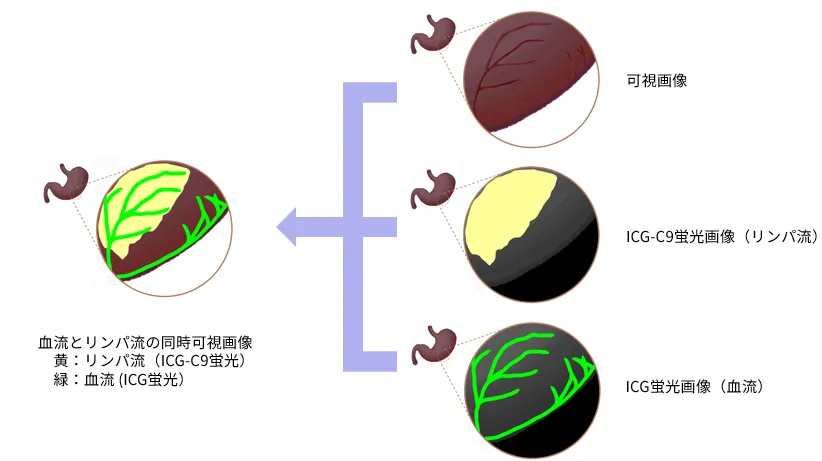
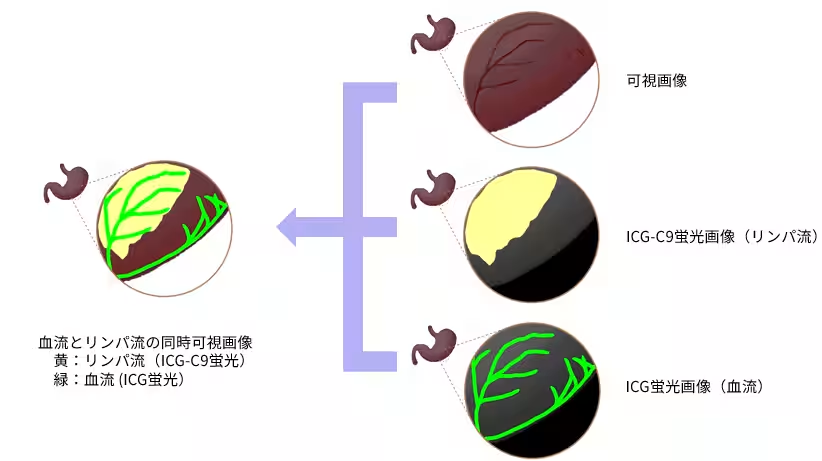
The collaborative research has demonstrated the effectiveness of this technology through clinical imaging experiments conducted by Dr. Yusuke Watanabe, a specialist in gastrointestinal surgery at Hokkaido University Hospital's Medical and Health Science Research Development Institute. By employing this innovative camera, researchers successfully visualized blood flow through venous ICG administration and lymphatic flow via localized ICG-C9 injection in real time.
The research validated that the camera's unique ability to overlay both visible and fluorescent images rendered a comprehensive view of anatomical structures and vital functional information related to blood and lymphatic flow. This groundbreaking verification affirms the camera’s role as an essential tool for real-time visualization of diverse biological signals.
Implications and Future Developments
The essence of the multi-fluorescence imaging technology extends beyond isolated observations; it enables the simultaneous acquisition and identification of multiple biological signals. This versatility opens pathways for new methods to visualize complex biological information by combining various fluorescein agents to meet specific clinical needs.
i-PRO envisions its multi-fluorescence imaging camera as a pivotal visualization platform capable of integrating various biological data, pushing forward the application of this technology in diverse medical contexts. The findings from this collaborative research were highlighted at the International Society for Fluorescence Guided Surgery (ISFGS) conference held in the U.S. on June 20.
Conclusion
The establishment of this innovative imaging technology not only represents a leap forward in medical visuals but also promises to substantially enhance the quality of surgical interventions. In a world increasingly reliant on precise imaging, i-PRO's dual ICG camera could redefine standards of care for patients undergoing complex surgical procedures with the potential for improved outcomes.
For more information about Hokkaido University, visit here.
For i-PRO Inc.'s latest technologies, check their website here where they are leading advancements in security, safety, and medical imaging sectors.

Topics Health)
【About Using Articles】
You can freely use the title and article content by linking to the page where the article is posted.
※ Images cannot be used.
【About Links】
Links are free to use.