



New Discovery of Asymmetric Diffusion Phenomenon in Magnetic Skyrmions with Potential AI Applications
Discovery of Asymmetric Diffusion Phenomenon in Magnetic Skyrmions
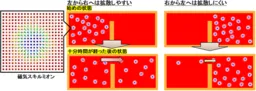
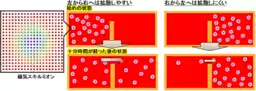
Recent research by a team from Waseda University has produced exciting findings regarding magnetic skyrmions, which are nano-sized magnetic structures exhibiting unique transport behaviors. The study reveals that these skyrmions can demonstrate an unprecedented asymmetric diffusion phenomenon driven by thermal fluctuations, diverging from conventional diffusion processes typically observed in particles.
Understanding Magnetic Skyrmions
Magnetic skyrmions consist of a cluster of localized magnetic moments, intrinsic to the atoms forming ferromagnetic materials. Despite being fixed in place on their atomic lattice, these magnetic moments collectively adjust their orientations in a manner akin to the random motion of particles, thereby mimicking the dynamics usually associated with thermal fluctuations.
Diffusion is a fundamental physical phenomenon where individual particles disperse throughout a space due to random thermal motion. However, the recent discovery highlights that skyrmions, when subjected to heat fluctuations, preferentially spread in one direction rather than isotropically, a pattern that can be referred to as asymmetric diffusion.
The Asymmetric Diffusion Encountered in Skyrmions
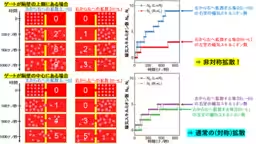
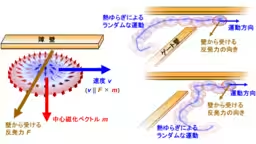
Professor Masahito Mochizuki and Associate Professor Xichao Zhang, alongside their research group, have explored the mechanisms behind this novel diffusion. They constructed a theoretical model in which the space housing skyrmions was bordered by barriers with asymmetrical gate openings to facilitate movement. Through extensive microscale simulations, they unveiled that under asymmetric conditions, magnetic skyrmions preferentially diffused in one specific direction, unlike the symmetrical diffusion seen in other conventional particles that occur with equal probability in both directions.
This phenomenon is attributed to the unique topological properties of skyrmions interacting with the structured environment, marking a significant finding in the realm of thermal statistical mechanics and non-equilibrium statistical mechanics. The results of this theoretical understanding provide a deeper insight into the physical principles governing skyrmion behavior and imply potential technology applications in fields such as AI hardware and reservoir computing.
Implications for AI Hardware and Computing
The implications of this research extend beyond fundamental physics; it opens avenues for novel information processing technologies. The asymmetric diffusion discovered by the researchers suggests that what was once regarded as chaotic random behavior influenced by thermal fluctuations could be harnessed through the tuning of magnetic textures and spatial parameters. This finding holds substantial promise for future applications in next-generation computing architectures, particularly in harnessing the rich dynamics of many-particle systems.
Furthermore, the study signifies that skyrmions could be key players in the development of spintronic devices and AI hardware, wherein the dynamics induced by thermal fluctuations could be utilized resourcefully. The controlled manipulation of such phenomena is expected to benefit reservoir computing systems, which thrive on complex temporal changes in physical systems.
Future Directions and Challenges
As promising as this research may be, there exists a pivotal step towards realizing these findings practically. Experimental validation of the asymmetric diffusion in real-world magnetic films and nano-structured materials is paramount for future exploration. Understanding the specific conditions that enable this phenomenon and devising methods for its control remain essential objectives for researchers.
Moreover, while this study focuses on magnetic skyrmions, it also raises the question of whether similar behaviors can be observed in other types of magnetic textures and different material systems. Addressing these inquiries will be crucial in deepening our comprehension of thermal and non-equilibrium dynamics within magnetic textures and their potential practical applications.
In summary, the emerging insights into the asymmetric diffusion of magnetic skyrmions signify a promising leap forward in both the basic physics of magnetic textures and their prospective utility in cutting-edge technologies. As research continues to evolve, the integration of these phenomena into practical applications may pave the way for advancements in the fields of spintronics and AI hardware, ultimately shaping the future of information processing.
Topics General Business)
【About Using Articles】
You can freely use the title and article content by linking to the page where the article is posted.
※ Images cannot be used.
【About Links】
Links are free to use.