



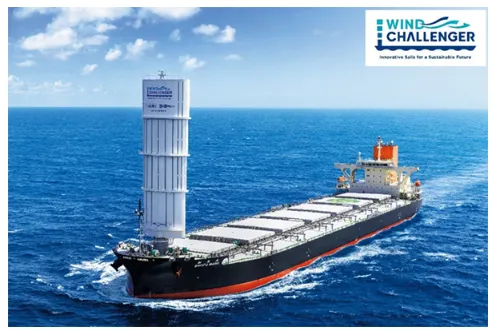
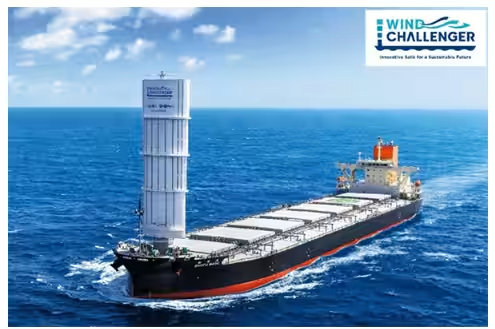
MOL's Innovative Retractable Rigid Wing Sail Wins WIPO Award in 2023
MOL's Revolutionary Wind-Driven Ship Technology
Mitsui O.S.K. Lines (MOL), under the leadership of President Takeshi Hashimoto, has achieved a significant milestone in maritime innovation by receiving the prestigious "WIPO Award" at the National Invention Awards for their groundbreaking invention: a sail with adjustable height using a rigid wing (Patent No. 5318008), recognized for its potential in sustainable shipping. This invention, developed in collaboration with notable industry experts, highlights MOL's commitment to eco-friendly transportation solutions.
The Vision Behind the Invention
The primary focus of MOL's recent invention is to utilize wind power as a sustainable energy source for marine propulsion, replacing traditional fossil fuels. By incorporating adjustable rigid wings, the sail can be extended or retracted to optimize performance based on wind conditions. This adjustment not only enhances the efficiency of the vessel but also significantly reduces greenhouse gas emissions associated with fuel consumption.
Currently, MOL has integrated this innovative technology into two of its vessels, the Matsukaze Maru and Green Winds, with plans to deploy the technology across an additional 25 ships by 2030 and 80 ships by 2035 as part of their "Environmental Vision 2.2" initiative.
Noteworthy Achievements
The rigid wing sail technology has already demonstrated its effectiveness. For instance, on board the Matsukaze Maru, a coal transport vessel with a carrying capacity of approximately 100,000 tons, the retractable sail has achieved an impressive fuel reduction of 5 to 8 percent on average per voyage, and up to 17 percent in a single day. These results underscore the potential of wind-powered vessels in significantly cutting costs while contributing to the global endeavor of carbon neutrality.
Ceremony Details
The awarding ceremony, attended by Her Imperial Highness Sayako, is scheduled for July 1, marking a celebratory acknowledgment of MOL's contributions towards sustainable shipping technologies. The recognition comes at a crucial time when the maritime industry is under pressure to innovate and reduce carbon footprints amid growing environmental concerns.
Collaborative Efforts
MOL's commitment to reducing greenhouse gas emissions does not stop at the development of the rigid wing sail. The company plans to further integrate this technology through its Wind Challenger project, showcasing their dedication not only to their corporate sustainability goals but also to the broader objective of promoting environmental stewardship within the maritime industry. With industry leaders such as MOL pushing boundaries, the future of green shipping looks promising.
Innovation and Recognition
The recognition of this sail technology serves not only as a testament to MOL’s innovative capabilities but also sheds light on the collaborative efforts of various stakeholders, including the Kanazawa Institute of Technology's Advanced Composite Materials Research and Development Center, where experts like Takashi Ouchi are pivotal in advancing maritime innovations.
In conclusion, MOL's recent accolade at the WIPO awards reinforces the importance of innovation in promoting sustainable practices in shipping. With their retractable rigid wing sails making waves in the industry, the path towards a cleaner, greener maritime future is indeed within reach.
Topics Consumer Products & Retail)
【About Using Articles】
You can freely use the title and article content by linking to the page where the article is posted.
※ Images cannot be used.
【About Links】
Links are free to use.