



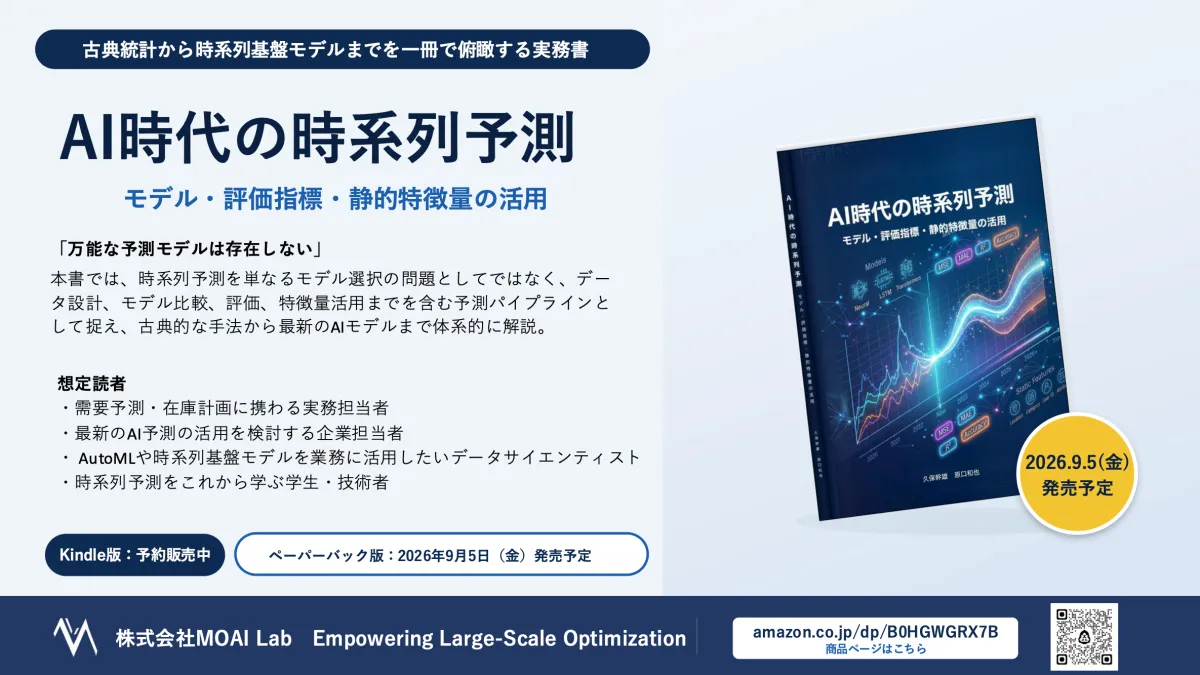
Exploring the Comprehensive Guide to Time Series Forecasting in the AI Era
Introduction
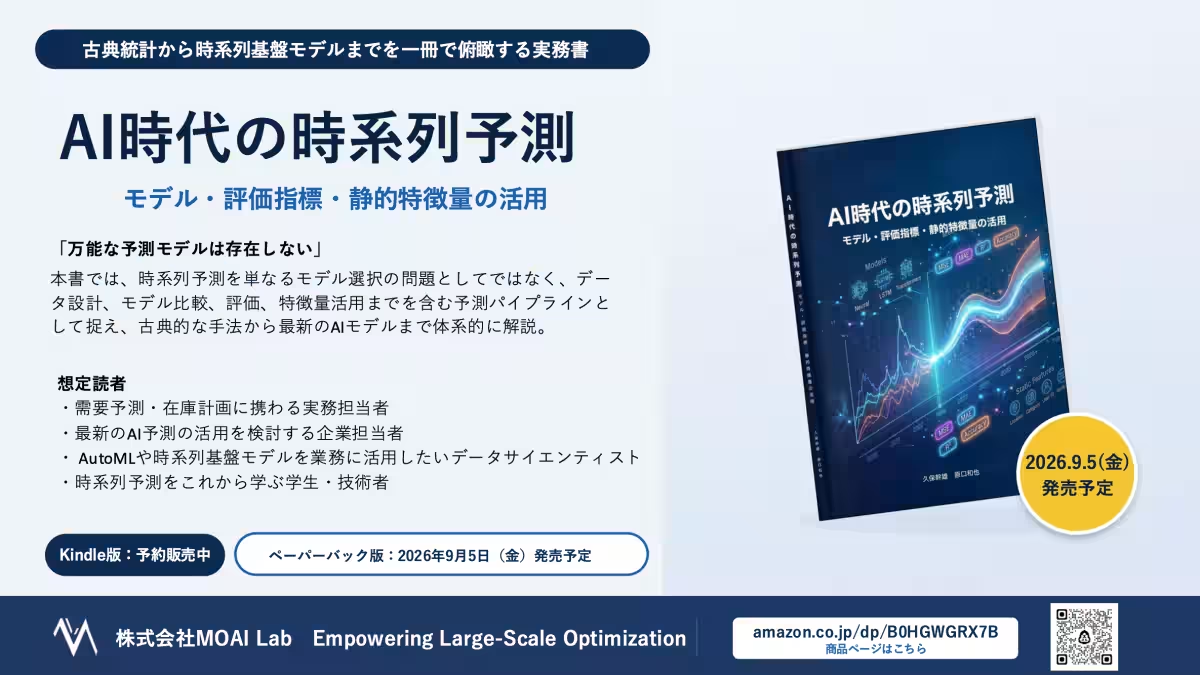
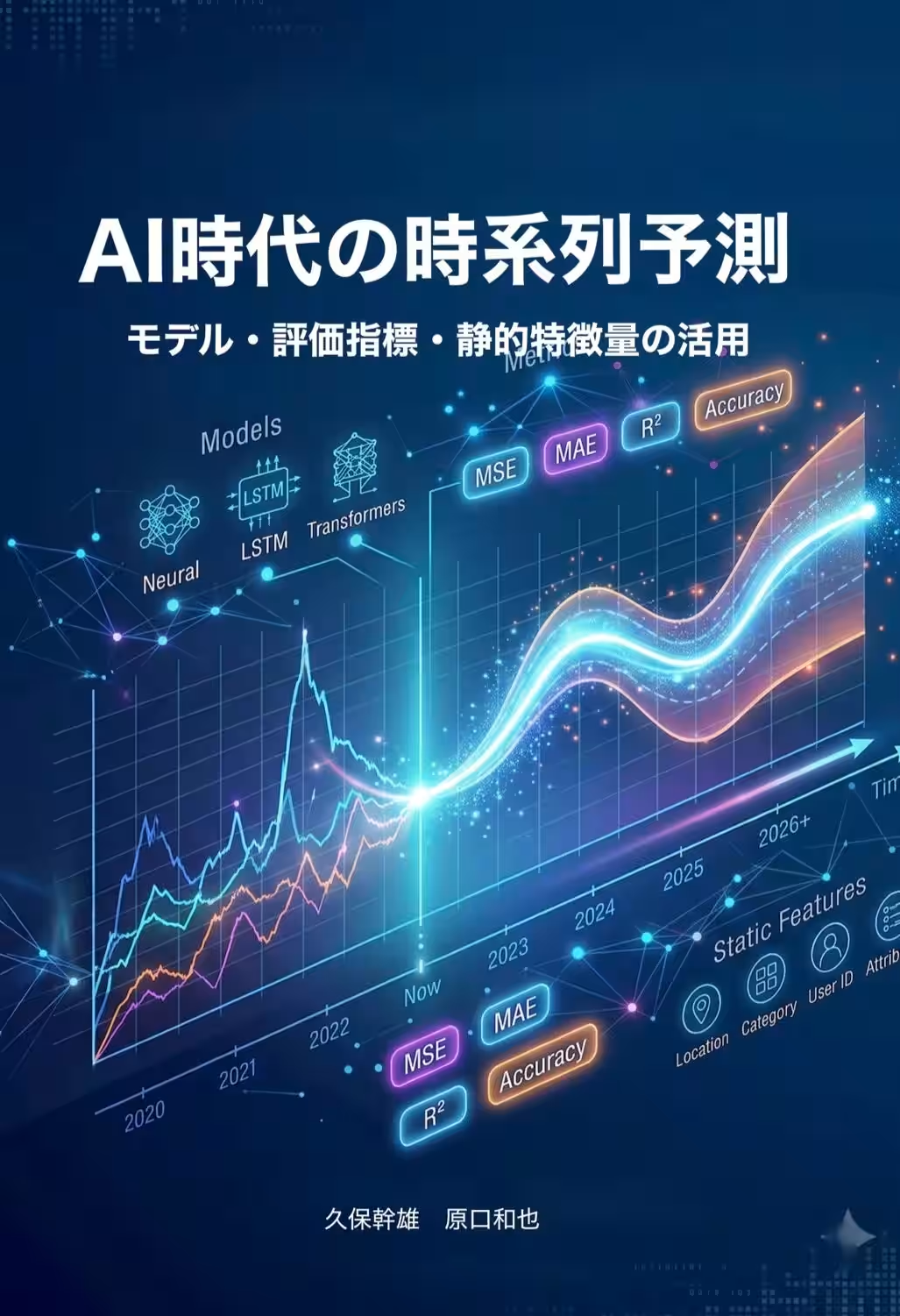
In the rapidly evolving landscape of business decision-making, effective demand forecasting is crucial for operations such as inventory management, staffing, and sales planning. The release of the practical guide 'Time Series Forecasting in the AI Era: Models, Evaluation Metrics, and Utilization of Static Features' by MOAI Lab provides a comprehensive framework for understanding time series forecasting methodologies. This book will be available in paperback and Kindle formats on Amazon starting September 5, 2026.
The Growing Need for Forecasting
As enterprises increasingly rely on accurate predictions for their operational strategies, the complexity of choosing the right forecasting model has intensified. Companies must consider numerous methods ranging from traditional statistical approaches to advanced machine learning and deep learning models. This influx of options has made it challenging to determine which model to select, what evaluation metrics to use, and how to utilize data available at the time of forecasting.
A New Perspective on Forecasting
This book emphasizes that forecasting is not simply about selecting the best model. Instead, it advocates for a pipeline approach that encompasses data design, model comparison, evaluation, and feature utilization. It systematically explains both classical methods and the latest AI models, equipping readers with the insights needed to navigate the complexities of forecasting.
What You Can Expect from the Book
The guide covers a wide array of statistical models like the Naive Seasonal Method, Exponential Smoothing, ARIMA, and Prophet, as well as machine learning models like LightGBM, XGBoost, and CatBoost. Additionally, it dives deep into deep learning models such as DeepAR and Temporal Fusion Transformer, along with foundational time series models like Chronos. Each method is explained in detail to ensure that readers can choose the most suitable for their needs.
Evaluation Metrics and Business Losses
The book does not just present various models; it also clarifies how to evaluate forecasting accuracy using metrics like MAE, RMSE, and MAPE. It highlights the importance of associating predictive accuracy with real-world business losses and decision-making processes, offering valuable insights for practical implementation.
Understanding Data Roles
A significant focus of the book lies in dissecting the roles of different data elements used in time series forecasting, including targets, series keys, static features, and future/past covariates. Attention is specifically directed towards the common pitfall of data leakage, which can occur when inaccessible information is mistakenly used during forecasting, providing practical guidelines to avoid such errors.
Who Should Read This Book?
The book is tailored for a wide range of professionals:
- - Practitioners involved in demand forecasting, sales projections, and inventory planning
- - Corporate personnel exploring the adoption and application of the latest AI forecasting technologies
- - Decision-makers looking to link predictive results to business planning
- - Data scientists aiming to implement AutoML and time series models in their work
- - Students and engineers aspiring to learn about time series forecasting
Looking Ahead
MOAI Lab aims to optimize decision-making across various business environments. By addressing practical challenges in forecasting model selection and evaluation, this publication seeks to bolster businesses' DX (Digital Transformation) and decision-making processes, providing not only software and solutions but also critical knowledge and technologies.
There are future plans to publish a book regarding the AMPL modeling language, which has been widely adopted for over 40 years. This language allows users to express business objectives and constraints in mathematical models, facilitating optimal decision-making. As we move into the era of Agentic AI, utilizing modeling languages like AMPL to clearly convey complicated business rules will become increasingly essential.
Final Note
Stay informed about all upcoming publications and insights related to AI and mathematical optimization by signing up for MOAI Lab’s mailing list here. For further inquiries regarding the book, please visit our official website or contact us through the designated form.
Topics Business Technology)
【About Using Articles】
You can freely use the title and article content by linking to the page where the article is posted.
※ Images cannot be used.
【About Links】
Links are free to use.