



Online Thermodynamics Course for Working Professionals - Enhance Your Engineering Skills
Online Thermodynamics Course for Professionals
The IR Institute of Engineering Education is launching an online seminar tailored for working engineers and facility managers, aimed at refreshing their knowledge of thermodynamics from a practical perspective. This course is ideal for those who have been away from academic studies for a while or are newly assigned to technical roles.
Thermodynamics can be a challenging topic within mechanical engineering due to the difficulty in visually comprehending systems that involve calculations. However, understanding thermodynamics is crucial across various practical applications such as vacuum processes, heat exchangers, air conditioning systems, refrigeration machines, and the design and operation of various mechanical devices. The knowledge gained in this seminar is valuable for examining heat storage, heat transfer, and overall system optimization.
Seminar Overview
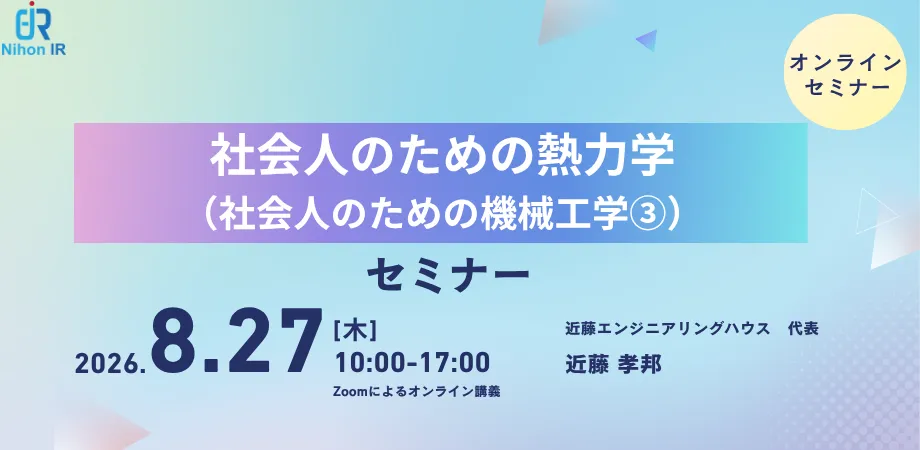
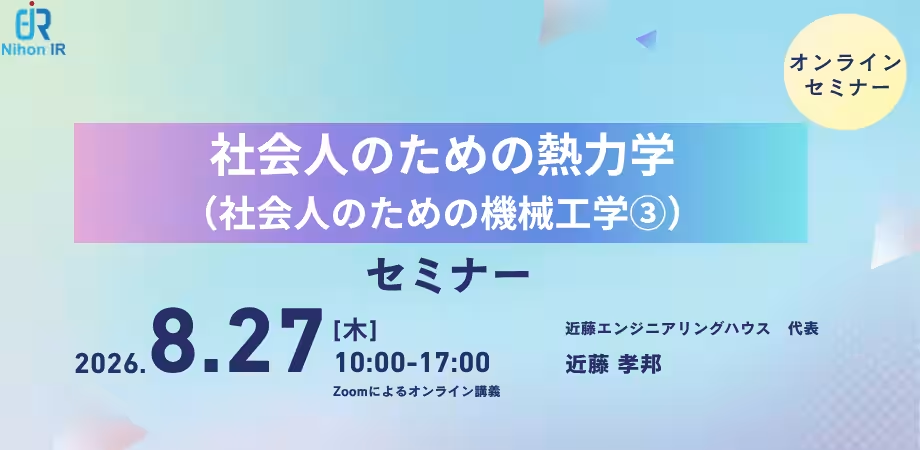
The seminar titled "Thermodynamics for Professionals" is the third installment in a series focusing on mechanical engineering for the workforce.
Details:
- - Format: Online via Zoom
- - Date and Time: August 27, 2026 (Thursday) from 10:00 AM to 5:00 PM
- - Registration Fee: 39,600 JPY (including tax) per participant
- - Instructor: Takakuni Kondo, Representative of Kondo Engineering House
Course Content
In this course, participants will cover fundamental concepts such as Boyle's Law and the First Law of Thermodynamics, progressing to the Second Law of Thermodynamics, Carnot cycles, heat conduction, heat transfer, heat exchangers, refrigeration cycles, and refrigerant solutions.
Seminar Program
1. Today's Training Goals
2. Unit Measurements
3. Properties of Gases
4. Mathematical Review of Logarithms
5. Boyle's Law and the First Law of Thermodynamics
- 5.1 Reversible Isochoric Processes
- 5.2 Reversible Isobaric Processes
- 5.3 Reversible Isothermal Processes
- 5.4 Reversible Adiabatic Processes
- 5.5 Practice Problems (1-4)
6. The Second Law of Thermodynamics
- Overview and Practice Problems
7. Heat Conduction and Transfer
8. Heat Exchangers
- Including Practice Problems
9. Refrigeration Cycles
- Performance Assessment of Refrigeration Machines
10. Refrigerant Solutions
- Next-Generation Refrigerants
Target Audience
This seminar is designed for:
- - Engineers and facility managers who have completed high school or college-level mechanical engineering and want to bridge the gap between academic theory and industrial applications.
- - Employees needing a refresher on mechanical engineering due to workplace requirements after a significant hiatus.
- - Individuals who haven’t studied mechanical engineering formally but are required to understand its principles in their jobs.
- - New hires or recently assigned facility managers seeking essential training in mechanical engineering.
- - Those interested in learning how mechanical engineering differs in a corporate context compared to academic settings.
- - Professionals seeking to organize foundational knowledge in areas relating to air conditioning systems, heat exchangers, refrigeration machines, and vacuum processes.
For more information, please visit: IR Institute of Engineering Education
The IR Institute of Engineering Education continues to provide valuable knowledge and expertise through technical training services tailored for the manufacturing industry, including seminars, e-learning, and publications.
Company Background
Nihon IR Co., Ltd. has over 50 years of expertise in patent and intellectual property solutions. We specialize in technology information research, analysis, technical training for manufacturing engineers, and the creation of engineering-focused content. Visit our website for more details: Nihon IR
Address: 15-1 Kanda-Iwamotocho, Chiyoda-ku, Tokyo 101-0033, Japan
Tel: +81-3-6206-4966
Topics Other)
【About Using Articles】
You can freely use the title and article content by linking to the page where the article is posted.
※ Images cannot be used.
【About Links】
Links are free to use.