



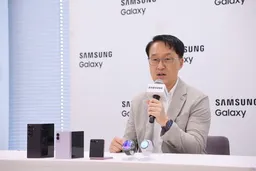
Samsung's Byung-Duk Yang Discusses Innovations in Foldable Technology
Highlights from Byung-Duk Yang's Visit to Japan
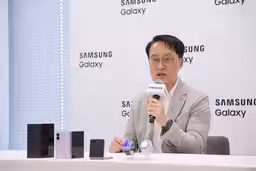
Samsung Japan hosted an exclusive press event to celebrate the domestic launch of the latest Samsung Galaxy Z series, which includes the Galaxy Z Fold8 Ultra, Fold8, and Flip8. The event featured an in-depth interview with Byung-Duk Yang, the Vice President and Vice Team Leader of the Core Component Technology Team at Samsung Electronics. Yang shared invaluable insights into Samsung's long-standing commitment to developing foldable smartphones, focusing on the innovative "Flex Titanium" technology introduced in the latest models.
Evolution through User Insights
Since the launch of the original Galaxy Fold in 2019, Samsung has persistently advanced its foldable smartphone technology across seven generations. The goal has been to create devices that are thinner, lighter, more durable, and practical. This evolution encompasses everything from displays and hinges to batteries and heat dissipation designs, ultimately enhancing the overall user experience. Samsung takes pride in leading the charge for the entire foldable smartphone market with this evolution.
Defining the Ideal Foldable Experience
Through the insights gathered over seven generations, Samsung has concluded that the idea of an "ideal foldable" cannot be limited to a single form. Whether it's enhancing productivity on a larger screen, immersing oneself deeply in content, or expressing individuality through a compact device, user experiences vary widely. To achieve this ideal foldable, Samsung pursued three core technological innovations: a more expansive and immersive display experience, a thinner and lighter design with unmatched durability, and uncompromising Ultra-level performance. As a result, three distinct models have been developed to satisfy diverse user needs.
Three Models to Match Diverse Needs
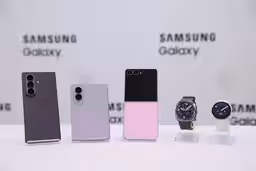
The Galaxy Z Fold8 Ultra is the most powerful model, combining a large screen with AI functionality to maximize usability and productivity. The Galaxy Z Fold8, on the other hand, is designed for enjoying various types of content and entertainment with higher immersion. Lastly, the Galaxy Z Flip8 presents a compact and stylish option, allowing users to express their individuality as an AI-native model. This lineup represents the pinnacle of Samsung Galaxy's foldable series to date, tailored to various lifestyles and scenarios for utilizing Galaxy AI.
End-to-End Innovation for Optimal User Experience
To enhance the unique experiences offered by these foldables, simple changes to size, shape, or design are insufficient. Multiple components—including display structures, hinges, batteries, and heat dissipation systems—are interdependent and significantly impact each other. For instance, the display can affect the thickness and internal space of the device, while the hinge not only contributes to durability but also influences the feel when opening and closing the device.
Instead of just making individual components thinner and more efficient, Samsung has adopted an inclusive approach, revisiting the entire system level—from materials and display structures to hinges, batteries, and internal architectures—to emphasize end-to-end technological innovation.
Introducing the Groundbreaking Flex Titanium Technology
The introduction of Flex Titanium in the latest Galaxy Z series has been pivotal. To achieve a thinner device, Samsung needed to ensure that the display could be protected and supported while retaining the necessary flexibility for folding, as well as the strength and durability required for long-term use.
After years of development, including analysis of user data, impact testing, service data, and verification results, Samsung re-evaluated the materials and structures needed to create a thinner foldable smartphone. They also looked into methods to reduce long-term deformation at the crease while enhancing resilience.
The key material that emerged was titanium, known for its strength, structural stability, and resistance to deformation, even after repeated use. It has proven performance in extreme environments, such as aerospace applications. However, merely selecting titanium was not sufficient; the challenge lay in processing it to retain its strength while maintaining thinness and bendability.
The Flex Titanium technology resolved this by combining two components: titanium plates and titanium alloy films, facilitating an innovative solution for the development challenges.
- - Titanium Plates: These provide primary structural support beneath the display, absorbing pressure and shock. The use of Grade 4 titanium's detailed structure maintains strength while providing the flexibility needed for folding. A hybrid manufacturing process combines wet etching to form large holes with laser cutting to create fine patterns, resulting in a precisely crafted reinforcing lattice structure for the bending area.
- - Titanium Alloy Films: A balanced selection of titanium alloys, including vanadium, aluminum, and chromium, was employed with ultra-thin processing and heat treatment, achieving a thickness about one-third that of human hair while ensuring long-term durability.
In developing this technology, attention was given to user feedback, specifically the opening mechanism. Adjustments to the hinge, magnetic structure, and display tension, along with minute grooves at the crease, were made to help users open the device naturally. This balance of thinness with a smooth opening experience was crucial.
Enhancing User Experience with Flex Titanium
This innovation allows for several key user experiences:
- - Intensified Immersion: The new display features a flat screen, improved crease design, and reflective coating for an augmented viewing experience.
- - Slim and Light Design: The Galaxy Z Fold8 Ultra reaches a thickness of approximately 4.1mm, making it the world's thinnest foldable, while the Fold8 weighs around 201g, making it the lightest foldable available.
- - Ultra Performance: Reductions in module thickness by 10% have resulted in efficient internal space utilization, accommodating larger batteries and improved heat dissipation design for uncompromised performance.
Collaborating with Japanese Companies for Innovation
Byung-Duk Yang referred to the project as the most challenging and innovative he has ever worked on, having been involved in developing foldable technology since the original Galaxy Fold. He noted that determining the attributes needed for flexibility and durability required extensive discussions with titanium-producing companies around the globe. Ultimately, it was a Japanese company that provided the materials and processing technologies that met Samsung's required standards.
Despite numerous setbacks that almost halted the project, continuous collaboration with the Japanese partners enabled Samsung to overcome challenges and achieve the desired technological advancements.
Innovations in Battery and Charging Systems
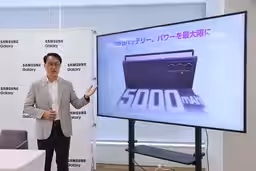
Another significant technical hurdle in developing thinner foldable devices is the battery. Within limited internal space, it was essential to deliver longer usage times and fast charging while maintaining safety and long-term stability. The Galaxy Z Fold8 Ultra manages to uphold a 5,000mAh battery capacity without compromising its slim design, necessitating a complete rethinking of the entire battery system.
The introduction of silicon-carbon negative electrode materials improved energy density and led to advancements in battery performance. The system features various new coatings and materials designed to enhance stability and ion mobility, ensuring the long-lasting reliability of the battery system.
Additionally, both the Galaxy Z Fold8 Ultra and Fold8 introduce 45W super-fast charging, signifying yet another advancement in the foldable series. The charging systems have been carefully optimized for each model's unique battery characteristics, promoting a quicker charging experience while effectively managing heat to ensure stable performance over time.
Rigorous Testing for Reliable Performance
To ensure that users can rely on their devices day after day, Samsung has conducted over 100 types of reliability tests on the final product. These tests expose the devices to various everyday scenarios, from drops and repeated folding/unfolding to pressure, moisture, and foreign material intrusion. The aim is not simply to pass tests but to confirm how the devices perform in real-life situations.
Conclusion
Byung-Duk Yang commented, "My journey with foldable smartphones has been profoundly fulfilling, with this project being the most difficult yet the most revolutionary. Our innovations start with understanding users—their usage patterns and expectations lead to material breakthroughs like the Flex Titanium, contributing to more remarkable user experiences. Samsung is committed to continuing the evolution of foldable technology and setting new industry standards with future innovations."
About Byung-Duk Yang
Byung-Duk Yang has spearheaded advancements in mobile display technology at Samsung Electronics since joining in 2018. He has played a critical role in developing foundational designs for foldable displays, leading to industry-first innovations that set quality benchmarks for durability and reliability.
As Samsung unveils its latest foldable smartphones, users can now experience the pinnacle of innovation in the form of the Samsung Galaxy Z Fold8 Ultra, Fold8, and Flip8, each tailored to meet diverse user needs while setting the stage for the future of foldable technology.




Topics Consumer Technology)
【About Using Articles】
You can freely use the title and article content by linking to the page where the article is posted.
※ Images cannot be used.
【About Links】
Links are free to use.