


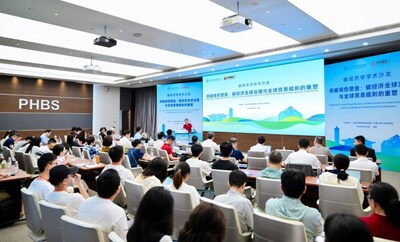

Strengthening Carbon Economy Connections at Shenzhen Carbon Economics Salon
Recent Developments at the Carbon Economics Salon in Shenzhen
On June 16, a significant event took place in Shenzhen, China, focusing on the critical intersection of climate policy and trade in the Asia-Pacific region. Organized by the Peking University HSBC Business School (PHBS) and the Institute for Carbon Neutrality at Peking University (ICN-PKU), the Carbon Economics Salon drew nearly 100 attendees, including scientists, policymakers, and industry representatives. This salon precedes the APEC Ministers of Forestry Meeting scheduled for July 27-28, where green transformation is expected to be the central theme.
The salon, titled "Overcoming Green Barriers in Carbon Economy Governance and Transforming International Trade Rules," addressed three interconnected challenges: unilateral climate-related trade measures, uneven carbon market development, and the growing role of artificial intelligence in managing the carbon economy. These discussions also set the stage for key topics that will be brought up in the upcoming APEC meeting.
In his opening remarks, Piao Shilong, Vice President of Peking University and Dean of ICN-PKU, alongside Hai Wen, Vice Chairman of the Peking University Council and founding Dean of PHBS, stressed the urgent need for an inclusive global carbon emissions management system. Wang Pengfei, the Dean of PHBS and a distinguished Boya Professor at Peking University, voiced the necessity of strengthening carbon pricing mechanisms and market tools.
Highlighting the importance of timely investment in green research and development, 2011 Nobel Laureate Thomas J. Sargent, Honorary Director of the Sargent Institute of Quantitative Economics and Finance at PHBS, noted that uncertainty should drive more proactive efforts in emission reduction and forest protection. Jiang Kejun, a professor and director of a climate change research program at HKUST, described the years 2030 to 2035 as a pivotal period for China’s energy transformation, fueled by rapid growth in renewable energy and electric vehicles. Meanwhile, Wu Dengsheng, a professor at Shenzhen University, presented an overview of research in carbon economy, highlighting China’s strong position in global publications on this topic.
Two roundtable discussions probed the implications of unilateral climate measures on global trade equity and collaboration in carbon markets with countries in the Global South. Zhang Haibin, a distinguished professor at PKU and Associate Dean of ICN-PKU, concluded by reaffirming the significance of ongoing interdisciplinary dialogue. The salon underlined that carbon emissions governance is increasingly shaped by business rules, technologies, and international cooperation.
This event served as a platform for future exchanges between PHBS and ICN-PKU regarding global climate policy management and China’s dual carbon targets. Topics discussed are anticipated to play a vital role in enhancing climate cooperation among APEC economies.
Photograph from the event can be found here.
Topics Policy & Public Interest)

【About Using Articles】
You can freely use the title and article content by linking to the page where the article is posted.
※ Images cannot be used.
【About Links】
Links are free to use.