



Unraveling the Origins of Extinct Plant Populations on Nishinoshima Island
Unraveling the Origins of Extinct Plant Populations on Nishinoshima Island
A research team led by Professor Koji Takayama from Tokyo Metropolitan University and Associate Professor Tomoyuki Nakano from Kyoto University has successfully analyzed the genetic characteristics of Purslane (Portulaca oleracea), a plant that once existed on Nishinoshima, an island within the Ogasawara Islands. Their findings indicate that the plant populations on Nishinoshima originated from other islands within this archipelago. The team also discovered that these populations possessed unique genetic compositions, suggesting a strong influence of founder effects and genetic drift during their establishment process. This groundbreaking study not only clarifies the origin of these plants in an area devastated by volcanic eruptions but also contributes vital information about ecosystem formation on oceanic islands.
Key Points
- - In 2019, before the complete destruction of vegetation caused by volcanic activity, researchers collected Purslane samples from Nishinoshima and compared the genetic data with populations from various regions of Japan and Guam.
- - It was revealed that the Purslane on Nishinoshima is most closely related genetically to the populations found on Chichijima, also within the Ogasawara Islands.
- - On the other hand, the Nishinoshima populations exhibited distinct genetic traits, indicating a possible pattern of establishment that is skewed by a limited number of seeds and natural disruptions.
- - By tracing the founder effects and genetic drift, the study offers critical insights into how initial ecosystems are constructed on islands.
Background of the Research
Nishinoshima is a volcanic oceanic island located approximately 130 km northwest of Chichijima within the Ogasawara archipelago. Since 2013, the island has experienced significant geological changes due to volcanic activity, leading to the total loss of its vegetation. As a result, it has become an extremely isolated environment with almost no surrounding landmasses. This makes it an invaluable natural laboratory for observing the processes through which plants establish and populate. The study utilized Purslane samples collected in 2019—before the complete obliteration by volcanic activity—to investigate the origin and establishment processes of the island’s flora using molecular genetic techniques.
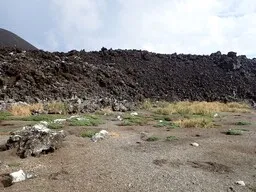
Photo taken in 2019 showing the coastal area of Nishinoshima. Despite the widespread lava flow, patches of vegetation remained near the lava's edge.
Detailed Study Findings
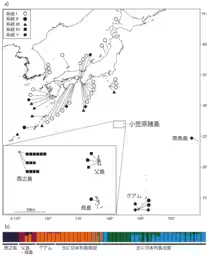
The research involved analyzing 254 specimens from 51 populations, including those of Purslane collected from Nishinoshima in 2019, as well as additional populations from mainland Japan and Guam. The data revealed that the individuals from Nishinoshima shared the same chloroplast genome base sequences as those from Chichijima, establishing a clear genetic lineage difference from other regions. Furthermore, the nuclear genome analysis indicated that while Nishinoshima is closely related to Chichijima, it has developed a unique genetic composition. This genetic independence suggests that the inhalants of extremely limited seed establishment had a significant impact, as did drastic population changes caused by volcanic eruptions and typhoons. Additionally, studies indicate that both Chichijima and Minami-ojima feature two distinct lineages of Purslane, suggesting multiple instances of seed introduction throughout the Ogasawara Islands.
The distribution of chloroplast genome lineages (a) and the genetic structure based on nuclear genome SNPs (b). Nishinoshima contains the same lineage as Chichijima (a), while displaying a distinct genetic composition (b).
Significance and Implications of the Research
This study is pioneering in elucidating the genetic characteristics of Purslane that once thrived on Nishinoshima, where vegetation has been entirely obliterated due to recent volcanic activity. By employing samples from the critical 2019 survey, the research highlights that the plant populations originated from Chichijima and demonstrated unique genetic traits. Thus, it effectively captures the processes behind genetic diversity formation during the early establishment phases of the plants and the influences of founder effects and genetic drift. Although Nishinoshima currently harbors no plant life, understanding how past vegetation formed offers significant insights into the mechanisms of initial ecosystem development on oceanic islands. Given that Nishinoshima is a dynamic environment that is repeatedly reset by volcanic activity, this research provides foundational data for future long-term monitoring of plant re-establishment and recovery processes on the island.
Publication Information
Title: Origin of populations of Portulaca oleracea on Nishinoshima, an active volcanic oceanic island
Authors: Hiroshi Noda, Tomoyuki Nakano, Kazuto Kawakami, Takashi Kamijo, Mari Marutani, Michael Angelo Paragas Fernandez, Koji Takayama*
Equally contributed, Corresponding author.
Published in: Plant Systematics and Evolution (2025)
DOI**: 10.1007/s00606-025-01957-y
Funding Acknowledgments
This study was supported by grants from the Japan Society for the Promotion of Science (JP23K23945, JP23K20303, JP21KK0131), the Environment Restoration and Conservation Agency (JPMEERF20204006), and the Tokyo University-Kyoto University Collaborative Project Eco-Rich Network.
Topics Environment)
【About Using Articles】
You can freely use the title and article content by linking to the page where the article is posted.
※ Images cannot be used.
【About Links】
Links are free to use.