



Revolutionizing AI: From Single Object Recognition to Multi-Object Geometric Understanding
Advancements in AI Geometric Understanding
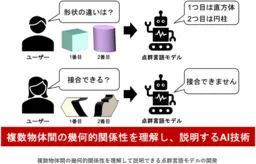
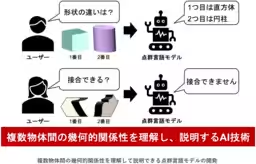
Artificial Intelligence (AI) is rapidly evolving, now moving beyond simple single-object recognition to understanding complex relationships between multiple objects. The National Institute of Advanced Industrial Science and Technology (AIST) has pioneered a groundbreaking point cloud language model capable of interpreting the geometric relations among various components. This advancement holds immense promise for improving efficiency in manufacturing processes, thus benefiting industries reliant on precise object integrations.
Background of the Research
In the manufacturing sector, discerning the geometric relationships between multiple components is crucial. Traditional AI models have typically focused on recognizing and explaining single objects without the capability to interpret the nuanced relationships that exist between multiple objects. As industries increasingly adopt AI, there is a growing demand for systems that can compare shapes, understand connections, and articulate these relationships in human language.
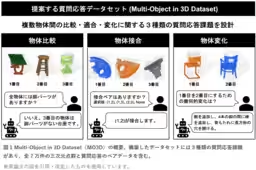
To address this gap, researchers from AIST, including Ryosuke Yamada, Yue Qiu, and research assistant Kohsuke Ide, developed a comprehensive dataset named MO3D. This dataset houses approximately 70,000 high-quality 3D point cloud data samples, each paired with relevant question-answer pairs designed to train AI models to understand and explain geometric relationships.
Development of the Multi-3DLLM Model
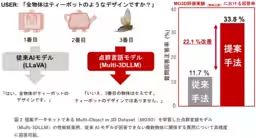
The Multi-3DLLM, a point cloud language model, stands as testament to this research's success. It allows AI to not only compare multiple objects but also generate explanations regarding how different parts connect, as well as outline their shape differences. Evaluations have shown that this new model significantly outperforms previous visual language models, achieving an 1.8 times higher question-answer accuracy rate.
The MO3D dataset's size and complexity set it apart from others, allowing for robust comparisons and assessments of the geometric relationships between parts. The innovation allows users to easily instruct design changes—like increasing a chair's backrest height—by verbal requests to the AI, streamlining the product development process.
Implications for Industries
This research is set to revolutionize design and manufacturing workflows, particularly in how professionals assess and handle parts manufacturing decisions. Automation will enhance consistency and efficiency, reducing the reliance on experts for every judgment call. This will not only speed up production processes but also decrease the likelihood of human error, promoting higher standards of quality in manufacturing outputs.
The development of AI capable of describing overlapping geometric nuances can also support robots in tasks including part sorting, assembly assistance, and shape comparisons—enabling a broader application of AI in manufacturing settings than previously imaginable.
Future Directions
Looking ahead, the team aims to expand the capabilities of the MO3D dataset to include even more complex industrial components and multitier assembly relationships. Plans include working towards models that can handle numerous objects simultaneously while maintaining an understanding of intricate relationships.
Moreover, the researchers are preparing to present their findings at the IEEE/CVF Conference on Computer Vision and Pattern Recognition in 2026, where their work will be showcased to further encourage advancements in this burgeoning field.
For those interested, the MO3D dataset and the Multi-3DLLM model will be publicly available on GitHub. This will ensure the ongoing development of research in AI’s understanding of multi-object geometric relations, further pushing the boundaries of AI technology.
Conclusion
The shift from single-object understanding to a multi-object framework marks a pivotal moment in AI research. The potential of the Multi-3DLLM and the uniqueness of the MO3D dataset can unlock many possibilities in AI applications within various industries, enhancing the design and manufacturing processes for years to come.
Topics Consumer Technology)
【About Using Articles】
You can freely use the title and article content by linking to the page where the article is posted.
※ Images cannot be used.
【About Links】
Links are free to use.