



Exploring the Benefits of Tree Essential Oils in Office Environments: A Collaborative Research Study
Exploring the Benefits of Tree Essential Oils in Office Environments
In a groundbreaking study, At Aroma Co., Ltd., in collaboration with the Forestry Research Institute and A Green Co., Ltd., has investigated the influence of tree essential oils on human psychology and physiology within office environments. As the interest in well-being and productivity rises, utilizing scents in work and living spaces has gained momentum, drawing attention to the potential of natural aromas to create comfortable and functional atmospheres.
The Importance of Tree Essential Oils
Tree essential oils are derived from natural forest resources, each type possessing unique aromatic compounds and characteristics. However, research comparing the effects of various tree essential oils on humans scientifically is still in its early stages. This study aims to highlight differences in these oils and their contributions to both spatial design as well as the creation of new value from forest resources.
The research evaluated 10 types of tree essential oils from Japan and abroad, incorporating impression assessment, brainwave measurements, and aroma component analysis.
Types of Tree Essential Oils Used
For this research, 10 different essential oils were selected, each differing in extraction location and origin, including:
1. Hiba – Wood from Ishikawa (Noto)
2. Tohōmatsu – Branches and leaves from Hokkaido
3. Japanese Cedar (Sugi) – Wood from Kyushu (after drying process)
4. White Cypress – Branches and leaves from Australia
5. Kuromoji – Branches and leaves from Nagano
6. Hinoki – Wood from Nara
7. Kōyamaki – Branches and leaves from Nara and Wakayama
8. Eucalyptus – Branches and leaves from China
9. Hinoki Leaf – Branches and leaves from Nagano
10. Ho Wood – Wood from China
Summary of Research Results
The study revealed distinct characteristics and effects of different tree essential oils, yielding valuable insights into preferred scents in office environments.
Impression Evaluation
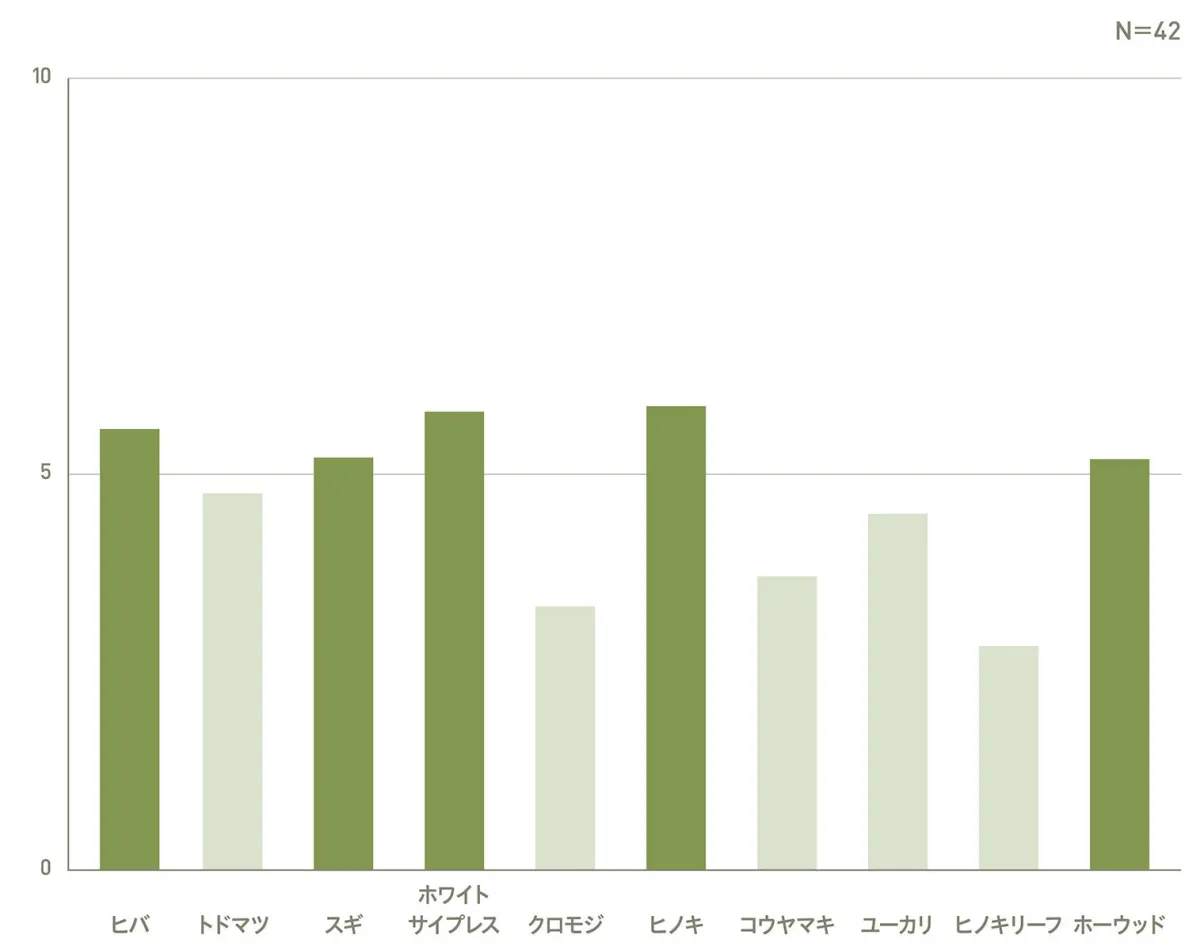
Participants rated each tree essential oil on a scale from “like” to “dislike.” Results indicated that Hinoki, White Cypress, and Hiba were the top-rated oils. A general preference for milder, less overpowering fragrances emerged, signaling a trend towards calming aromas in office settings.
Favorite Fragrance Rankings:
1. Hinoki
2. White Cypress
3. Hiba
4. Sugi
5. Ho Wood
Organizing Characteristics of Tree Essential Oils
Statistical analysis of the impression evaluations identified three distinct axes for tree essential oils: “calmness,” “richness,” and “individuality.” For example, Sugi was classified as primarily “calm,” while Kuromoji showcased notable “individuality.” Hinoki ranked high in both “calmness” and “richness,” with Ho Wood exhibiting strong tendencies across all three axes.
Brainwave Data Exploration
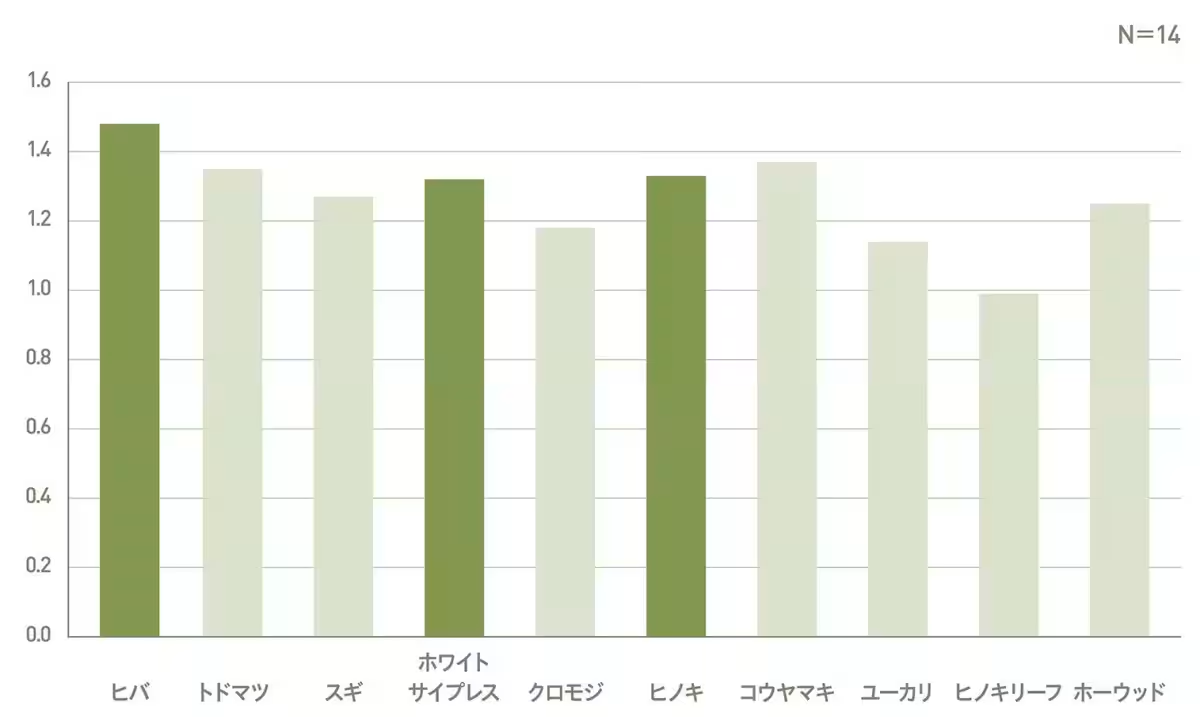
Brainwave testing measured the beta/alpha values of participants, suggesting that 9 out of the 10 tested essential oils indicated possibilities for enhancing focus in office spaces. Specifically, Hinoki, White Cypress, and Hiba correlated with relatively high beta/alpha values, illustrating the potential of these scents for engagement in work environments. However, it should be noted that the participant pool for this segment was 14 individuals, calling for further investigations to substantiate these findings.
Aroma Component Analysis
The component analysis revealed that the essential oils were predominantly comprised of monoterpenes and sesquiterpenes. Interestingly, even closely related oils had differing compositions, suggesting that both the type of tree and the profile of aromatic compounds significantly influence perception of scents.
Future Perspectives
This comprehensive study combining aroma component analysis, impression assessments, and physiological responses has yielded new insights into the characteristics of tree essential oils. At Aroma plans to translate these findings into practical applications for scent design in offices, commercial spaces, and hospitality industries, emphasizing the contribution to enhancing the value of forest resources and creating comfortable atmospheres. Continued collaboration with research institutions aims to deepen the scientific understanding of aromatherapy and its effects on well-being.
Conference Presentation
The results of this study were presented at the 39th Annual Conference on Olfactory and Flavor Environment Sciences by forest researchers Eri Matsubara and Naoyuki Matsui, showcasing the subjective and physiological impacts of tree aromas.
Our Research Partners
- - Forestry Research Institute: Specializes in comprehensive R&D related to forests, forestry, and the wood industry, aiming to create sustainable value through the evaluation of forest components.
- - A Green Co., Ltd.: Focuses on scenting design and crafting scent spaces using natural aromas, actively exploring and producing domestic wood essential oils in innovative ways.
Company Overview of At Aroma
At Aroma stands as a leader in scent design, offering a total approach to developing aroma products and creating olfactory environments. Their services are utilized in over 6,000 locations globally, including hotels and offices, focusing on harnessing the power of natural aromas to elevate sensory experiences.
Official Website: At Aroma
Online Store: At Aroma Store
Social Media:
Topics Consumer Products & Retail)









【About Using Articles】
You can freely use the title and article content by linking to the page where the article is posted.
※ Images cannot be used.
【About Links】
Links are free to use.