



Exciting Seminar on AI Data Center Cooling Technologies Scheduled for September 2025
Seminar Announcement: AI Data Center Cooling Technologies
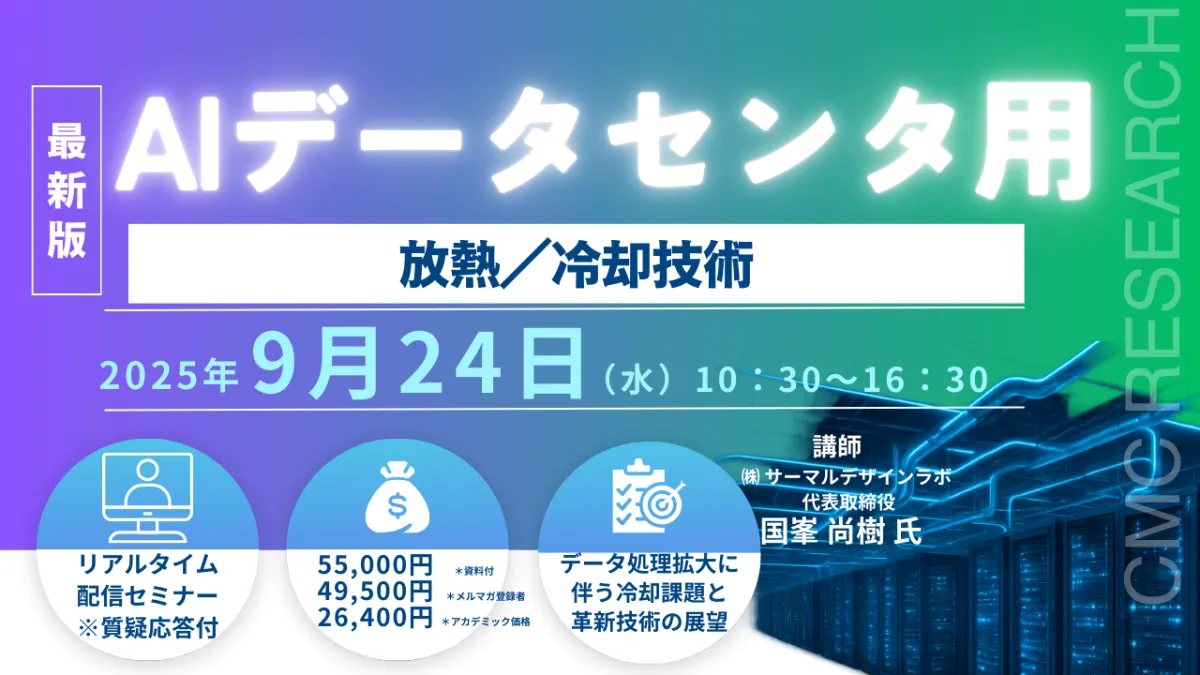
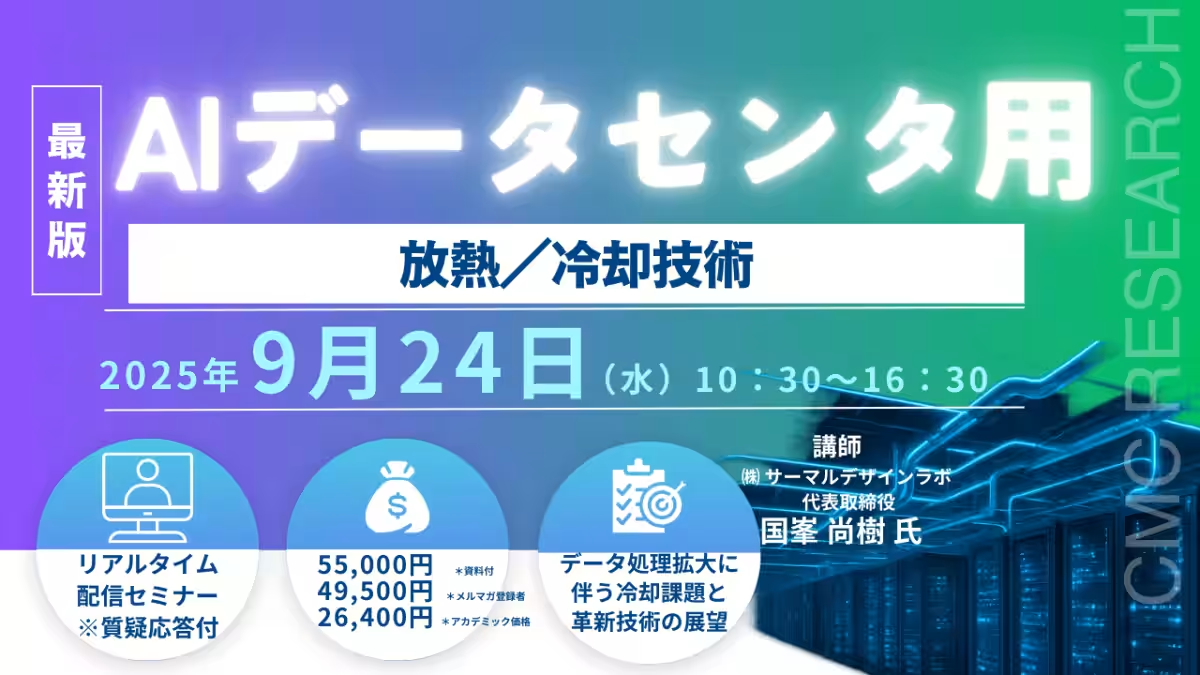
Prepare for an enlightening seminar titled “AI Data Center Cooling Technologies” hosted by CMC Research on September 24, 2025. The event is perfectly timed for professionals aiming to deepen their understanding of cooling solutions as demand for AI capabilities skyrockets.
Seminar Details
- - Date: September 24, 2025
- - Time: 10:30 AM – 4:30 PM (JST)
- - Platform: Zoom (materials included)
- - Instructor: Mr. Naoki Kunimune, CEO of Thermal Design Lab
- - Fees: 55,000 JPY (general), 49,500 JPY (newsletter subscribers), 26,400 JPY (academic members)
This seminar addresses the urgent need for effective cooling solutions in AI data centers, particularly as the heat output of AI servers continues to increase—reaching levels over 1kW due to intensive GPU usage. The evolution from air cooling to more advanced methods including liquid and immersion cooling will be explored extensively.
Learning Outcomes
Participants will gain insights into various topics crucial for effective heat management:
- - Fundamental concepts of thermal conduction
- - Heat dissipation knowledge for design components
- - Practical thermal design strategies for both forced and natural cooling systems
- - Guidelines for heat sink design and more!
Target Audience
This seminar is aimed at:
- - Electronic device designers (including assembly, mechanical, circuit, and PCB design)
- - Developers of thermal dissipation devices and materials
- - Quality assurance and control professionals
Why Attend?
With the rapid advancement of AI applications, especially in data processing, effective cooling has become vital. Traditional web searches consume significantly less power compared to AI search processing, making this seminar increasingly relevant. Participants will familiarize themselves with new cooling techniques, as well as innovations in TIM (Thermal Interface Materials), high-performance heat sinks, and cooling infrastructures needed to accommodate modern AI workloads and data center standards.
Seminar Agenda
The full seminar agenda will cover topics such as:
1. Impact of High-Speed Networks on Data Volume and Power Consumption
- Future trends across sectors such as servers, communications, automotive, and appliances.
- The rising power demands from edge computing driven by AI usage.
2. Essential Heat Transfer Knowledge for Thermal Design
- Mechanisms of heat transfer at both micro and macro levels
3. Effective Cooling Techniques for High-Performance AI Servers
- Recommended cooling methods for GPU heat production.
4. The Role of Cooling Devices in Heat Management
- Evolution and manufacturing diversity of heat sinks and cooling devices.
5. Addressing Heat Challenges in Data Centers
- Current practices toward achieving energy efficiency targets set by regulations.
6. Conduction Cooling for Edge Devices
- An analysis of smartphone and base station structures and their heat dissipation routes.
7. Key Features and Selection Criteria for Thermal Interface Materials (TIM)
- Various types of TIM and how to best choose and evaluate them.
8. Future Challenges Related to Heat Management
- Impacts of new developments such as chiplets and three-dimensional packaging.
Instructor Profile
Mr. Naoki Kunimune holds critical experience in heat design, having served as an engineer at major electronics firms before founding Thermal Design Lab. His extensive knowledge encompasses developing cooling solutions for various electronic devices and authoring several key publications on thermal management.
Don’t miss this opportunity to upgrade your skills and knowledge in a rapidly evolving field!
Visit the CMC Research seminar page to register and explore more upcoming webinars that cater to technology and market trends in electronic components.
Topics Consumer Technology)
【About Using Articles】
You can freely use the title and article content by linking to the page where the article is posted.
※ Images cannot be used.
【About Links】
Links are free to use.