



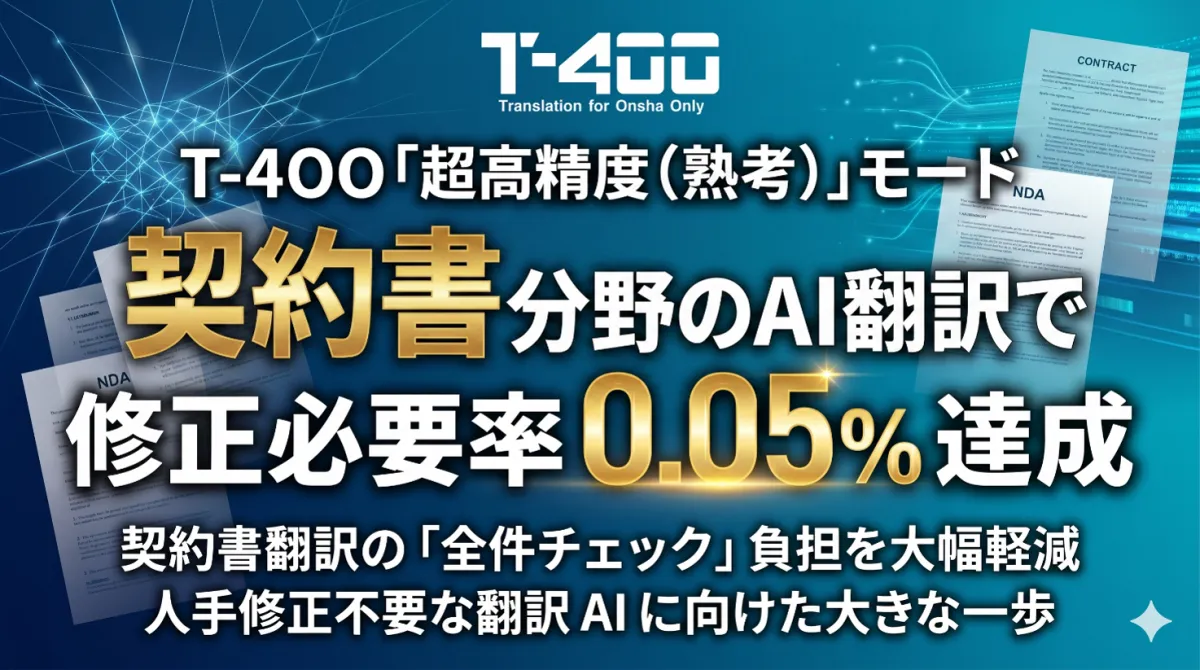
Rosetta Achieves Remarkable Precision in Legal Document Translation with T-400
Rosetta's T-400: A New Era in Legal Document Translation
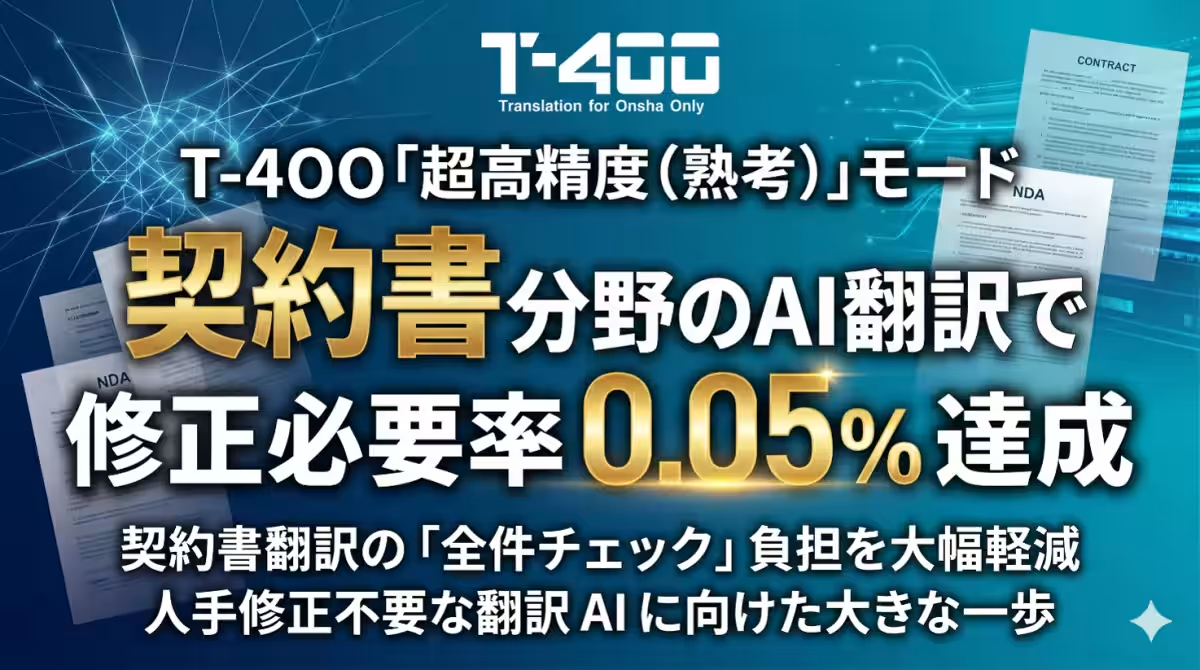
In a significant advancement for the world of translation technology, Rosetta, a subsidiary of Metarial Group and a leader in AI translation services, has successfully achieved a remarkable correction rate of just 0.05% in legal document translations using its latest AI system, T-400. This breakthrough was announced on June 17, 2026, coinciding with the introduction of the AI's new "Ultra Precision (Contemplation)" mode, which utilizes agentic AI to enhance translation accuracy.
The Importance of Accurate Legal Translation
Legal documents such as contracts, non-disclosure agreements, and licenses require the utmost accuracy; even the slightest misinterpretation can lead to significant legal risks and liability. Traditionally, full sentence reviews of both source and translated texts were viewed as essential in ensuring accuracy. However, with T-400's ultra-precise capabilities, users can now streamline their review processes by focusing only on highlighted areas that need verification. This shift represents a substantial reduction in the labor associated with document translation.
What is the "Ultra Precision (Contemplation)" Mode?
The newly introduced mode in T-400, released on April 13, 2026, incorporates advanced AI features that surpass the previous "High Precision" mode in terms of output quality. This system allows the AI to:
- - Identify segments of text that may contain errors and highlight them for easy viewing.
- - Provide alternative translations alongside suggested revisions.
The result is a user-friendly interface where translators can readily see which parts of the translation require their attention, minimizing unnecessary reviews and maximizing efficiency. Additionally, this mode leverages a user-uploaded glossary and previous translation data to further improve accuracy, effectively utilizing internal translation resources built over time.
Validation Results in Legal Documents: 0.05% Correction Rate
Through rigorous internal testing on legal documents handled by corporate legal departments, Rosetta has achieved the impressively low correction rate of 0.05%. This figure matches the success rate seen in the manual and user instruction fields, underscoring T-400's reliability even in high-stakes legal documents. Consequently, legal teams can limit their reviews solely to areas flagged by the system, significantly reducing time spent on audits.
Transformative Changes in Contract Translation
By achieving this level of precision within legal documents, T-400 enables users to experience several transformative changes:
- - Moving from comprehensive review to focused checks on critical segments.
- - Highlighting sections with potential mistranslations provides immediate clarity for reviews.
- - Allows for alignment with internal terminology and past document successes through AI review.
- - Facilitates consistent translations across various documents, benefitting departments like legal, intellectual property, and compliance.
These capabilities pave the way for enhanced quality and efficiency in translation tasks across legal teams worldwide.
Comments from Leadership
Atsunori Shinoda, the project lead for T-400, expressed satisfaction with this achievement. He stated, "Initially, with our April release, we revealed a 0.05% correction rate for user manuals. To announce a similar precision in legal documents is indeed gratifying. The client-firm confidence in our AI, especially in areas as sensitive as legal translation, underscores the effectiveness of our agentic AI quality assessment and suggested revision strategy. We aim to extend these capabilities into other specialized fields, including pharmaceutical and medical documentation, patent texts, and financial reports, to further our vision of creating a translation AI that requires no human correction."
User Feedback
Users like Tatsuya Nakayama, a lawyer at Nakayama International Law Office, shared their excitement about the T-400's Ultra Precision mode. "As a leading international law firm, we frequently handle sensitive translations. We've heavily relied on T-400 for years, and the recent enhancements to the system have significantly elevated our workflow, saving us resources while maintaining high precision. The highlighted errors now guide my reviews, and it's alleviated the need for meticulous checks against the original texts. This ease of use is invaluable in our field."
Future Outlook
As T-400 continues to evolve, Rosetta plans to expand its capabilities and conduct further validation tests across various sectors, ensuring the ongoing development of a translation AI that doesn’t require human revision. This endeavor aligns with their long-term mission to improve translation efficacy by focusing on critical checks instead of exhaustive reviews.
About T-400
T-400, developed by Rosetta, is a state-of-the-art industrial translation AI that uniquely blends high customization for specialized documents with the fluency provided by generative AI. It is tailored to meet the nuanced needs of industries like pharmaceuticals, manufacturing, law, and finance, boasting a reliable translation accuracy that can adapt to specific in-house terminologies without substantial investment in dedicated translation engines.
For more information about T-400, visit Rosetta's website.
In summary, Rosetta's T-400 is redefining the landscape of legal translation, setting a new standard for accuracy and efficiency, ultimately shaping the future of translation technology.
Topics Consumer Technology)
【About Using Articles】
You can freely use the title and article content by linking to the page where the article is posted.
※ Images cannot be used.
【About Links】
Links are free to use.