


Okayama University Establishes New Design Guidelines for Next-Generation Organic Thermoelectric Materials
Introduction
On October 18, 2025, Okayama University announced groundbreaking advancements in the design of organic polymer-based thermoelectric composite materials. These materials are capable of efficiently converting wasted heat into electricity. The research, led by Professor Yasuhiko Hayashi from the Graduate School of Environmental and Life Science, has been a collaborative effort involving researchers from institutions such as Bahir Dar University in Ethiopia, Southern University of Science and Technology in China, and various universities in Singapore. The findings were published in the Journal of Materials Chemistry A on September 5, 2025.
Key Findings
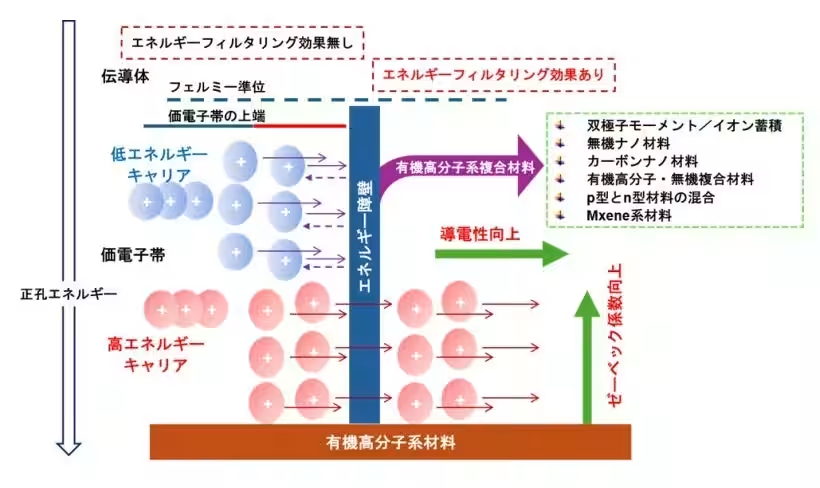
The study provides a systematic overview of mechanisms to efficiently transform waste heat into electrical energy, specifically focusing on the simultaneous improvement of electrical conductivity and the Seebeck coefficient, which indicates the ability to generate voltage from temperature differences. Traditionally, maximizing these two attributes has posed significant challenges due to their trade-off relationship.
By optimizing the interface energy barriers to a range of 0.05-0.1 eV, the research team discovered a way to effectively block low-energy carriers while allowing high-energy carriers to be selectively transported. This achievement was crucial in enhancing the thermal performance of thermoelectric materials.
With the potential to convert low-temperature waste heat (below 150°C) into electricity using lightweight and flexible organic polymer materials, this innovation contributes significantly to the realization of a sustainable and low-carbon society.
Implications for Various Applications
The insights garnered from this research open the door for various applications, including wearable devices, flexible sensors, and self-powered devices that can harvest ambient heat. Lightweight and efficient, these thermoelectric materials can be utilized to recover heat generated in industrial processes and automotive systems, making them particularly beneficial for reducing overall energy consumption and carbon emissions.
A Word from Professor Hayashi
Professor Hayashi emphasized that previous studies primarily focused on empirical optimizations without establishing universal design principles. This research marks a critical step toward creating systematic guidelines for the effective design of thermoelectric materials, leveraging international collaborations to enhance the practical implementation of these technologies.
Conclusion
The findings from Okayama University represent a pivotal advancement in the field of thermoelectric materials. By creating a comprehensive framework for material design, the research serves as a building block for future innovations that can promote energy conservation and sustainable development. As industries increasingly seek efficient ways to harness waste heat, this work could lead new pathways to a greener future. With support from Japan’s Science Promotion Program (JSPS), Professor Hayashi's team is excited about the opportunities ahead to exploit these promising materials in real-world applications.
Further Information
Further details can be found in the published paper, titled "Interface Engineering in Polymer Thermoelectric Composites: Harnessing Energy-Filtering Effects to Overcome the Seebeck-Conductivity Trade-off." For context about the research initiatives at Okayama University, please visit their official website: Okayama University. Hints of collaboration with various academic institutions around the world highlights the university's commitment to addressing global issues through innovative research and sustainable technologies.
References:
- - Journal of Materials Chemistry A, DOI: 10.1039/d5ta05957g
- - Okayama University Research Publications


Topics Consumer Technology)

【About Using Articles】
You can freely use the title and article content by linking to the page where the article is posted.
※ Images cannot be used.
【About Links】
Links are free to use.