



New Voltage-Driven Technology Paves Way for Low-Power MRAM Innovations
Introduction
A recent breakthrough in non-volatile memory technology has emerged from Japan's National Institute of Advanced Industrial Science and Technology (AIST). A team led by Hiroyasu Nakayama and other scientists has developed a novel writing technique for Magnetoresistive RAM (MRAM) based on voltage-driven static magnetization reversal. This innovation allows for stable writing of magnetic information over a broad pulse width range while achieving ultra-low power consumption, revolutionizing the potential of MRAM for future high-capacity applications.
Background on MRAM and the Need for Innovation
MRAM is a type of non-volatile memory that retains data even when the power is off. Unlike volatile memory types, which consume power constantly to maintain data, MRAM stores information through the magnetic state of electrons, making it energy-efficient. Traditional MRAM technologies require significant current for writing, leading to power consumption issues. New developments in voltage-driven MRAM have emerged, which promise lower power usage but come with challenges regarding voltage precision and device variability.
The new technique developed by the AIST team addresses these issues directly, allowing stable operation without the need for high current, ultimately paving the way for expanding MRAM storage capacities.
The Innovation: Voltage-Induced Static Magnetization Reversal Method
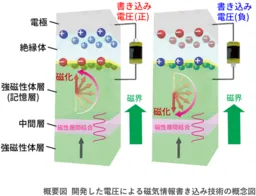
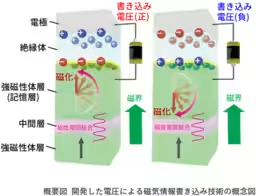
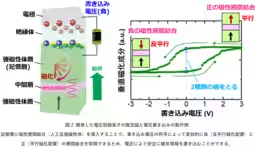
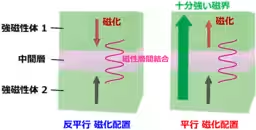
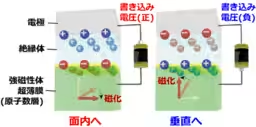
The AIST team has introduced a structure called an artificial antiferromagnet, which consists of a non-magnetic thin film sandwiched between two ferromagnetic films. This innovative design allows the team to control the direction of magnetization through applied voltage. The key discovery is that different signs of the voltage can write magnetic information bidirectionally, thus enhancing stability even as the pulse width of the voltage varies.
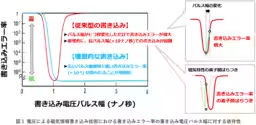
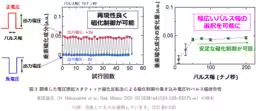
Through rigorous experimentation, the researchers demonstrated that their method allows for broad and stable writing capabilities while consuming minimal power. This efficiency is crucial as the demand for more sustainable and energy-efficient computing solutions grows with advancements in Artificial Intelligence (AI) and the Internet of Things (IoT).
Technical Overview
The new voltage-induced method uses a unique interaction between thin films to control magnetization effectively. In their experiments, researchers observed that voltage application modifies the magnetic interlayer coupling, allowing the artificial antiferromagnet to switch between parallel and antiparallel magnetization states. This level of control is essential for precise data storage solutions.
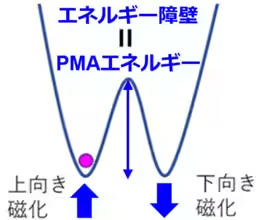
Previous methods, such as voltage-controlled magnetic anisotropy (VCMA), have limitations in writing pulse width, but this new approach significantly expands the possibilities for memory writing durations without compromising stability.
Future Implications and Conclusions
With the results of this research set to be published in Nature Materials in April 2026, the implications for the electronics industry are substantial. By leveraging this voltage-induced process, future MRAM developments can achieve higher densities while maintaining low power requirements, thus enhancing performance across various applications, from consumer electronics to sophisticated computing systems.
The research team plans to continue improving this technology by exploring low-voltage operation and eliminating the need for external magnetic fields. The potential application of these findings could be transformative in advancing non-volatile memory solutions that significantly reduce energy consumption, aligning with the global push for sustainable technology.
References
Nature Materials, DOI: 10.1038/s41563-026-02575-w
Press Release
Topics Consumer Technology)

【About Using Articles】
You can freely use the title and article content by linking to the page where the article is posted.
※ Images cannot be used.
【About Links】
Links are free to use.