



WOTA Unveils Summary Report on Emergency Water Supply Redefinition for Major Disasters
WOTA's Innovative Approach to Emergency Water Supply
WOTA Corporation, headquartered in Chuo-ku, Tokyo, has made significant strides in redefining emergency water supply methods during large-scale disasters. The company recently announced the results of a collaborative research project commissioned by the Ministry of Land, Infrastructure, Transport and Tourism (MLIT) in Japan, which investigates the integrated operation of emergency water purification and supply systems. This research aims to address the pressing needs for living water during disasters, highlighted by the recent experiences faced during the Noto Peninsula Earthquake.
The Challenge of Water Shortages During Disasters
The Noto Peninsula Earthquake in the sixth year of the Reiwa era led to prolonged and widespread water outages, severely impacting the living conditions of evacuees. While emergency supplies secured drinking water, the demand for living water—often 10 to 100 times greater—was insufficient, exposing the weaknesses of traditional emergency water supply systems centered around water trucks. This particularly affected critical needs such as bathing and handwashing, which accounted for about 60% of living water requirements and underscored the need for a reliable supply system to maintain sanitary conditions in evacuation centers.
In response to this dire situation, the Japanese government is ramping up efforts to secure living water. The Cabinet Office has revised disaster response policies to ensure consistent bathing opportunities for evacuees in alignment with Sphere standards. Further, the first mid-term plan for national resilience outlines a goal for every city and town to meet Sphere standard stockpiling requirements by 2030.
However, social consensus on the necessary volume of living water and its procurement methods remains elusive. Existing strategies are still inadequate, prompting the research led by WOTA to explore the effectiveness of using water circulation systems and portable purification devices in emergency supply scenarios.
Summary of Research Findings
The research conducted by WOTA, in partnership with NJS and Metawater, examined how effectively water circulation systems and portable purification units can enhance emergency water supply. Focusing on Suzu City, a model affected by sustained water outages during the earthquake, the study provided quantifiable data confirming that adequate living water can dramatically improve sanitation conditions.
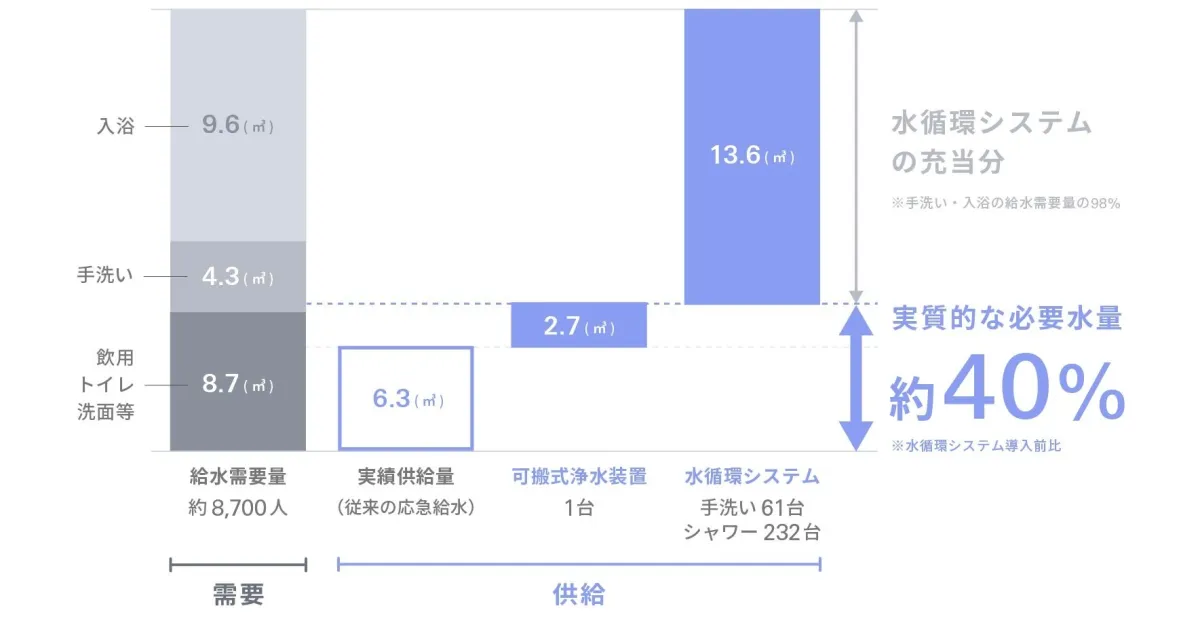
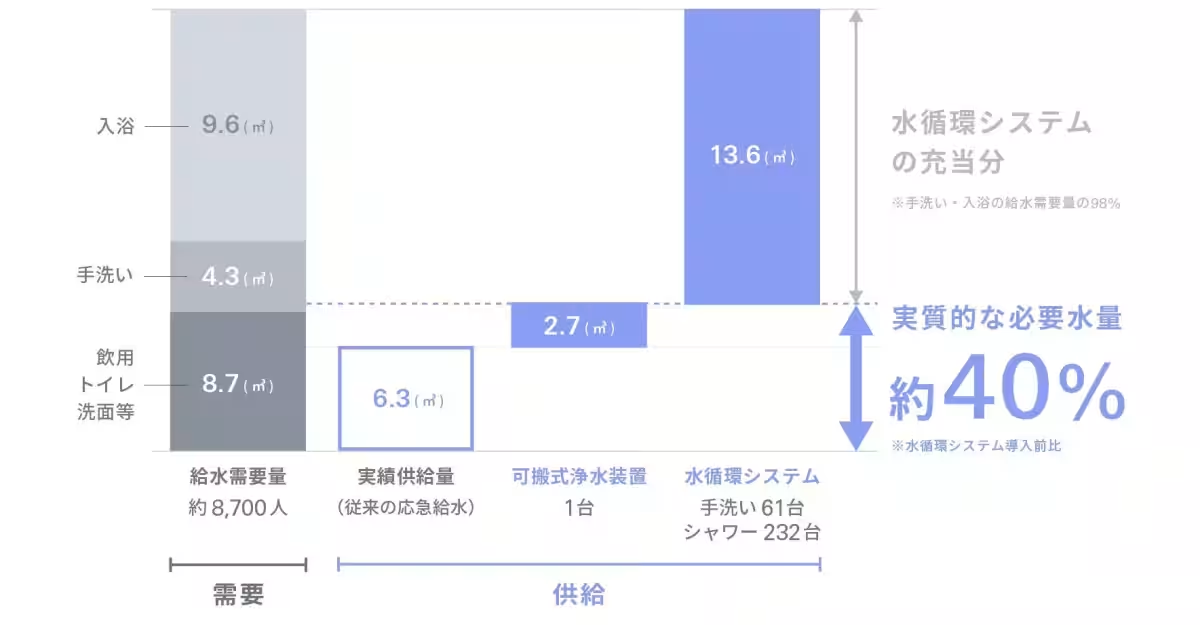
Preliminary estimates indicated that with a sufficient installation of portable purification devices and water circulation systems, it is possible to reduce the requisite supply needed to meet sanitation demands by approximately 40% compared to pre-system implementation. Most importantly, demand for living water—particularly for bathing and handwashing—could see a reduction exceeding 90%, thus significantly contributing to overall water quantity effectiveness during emergencies.
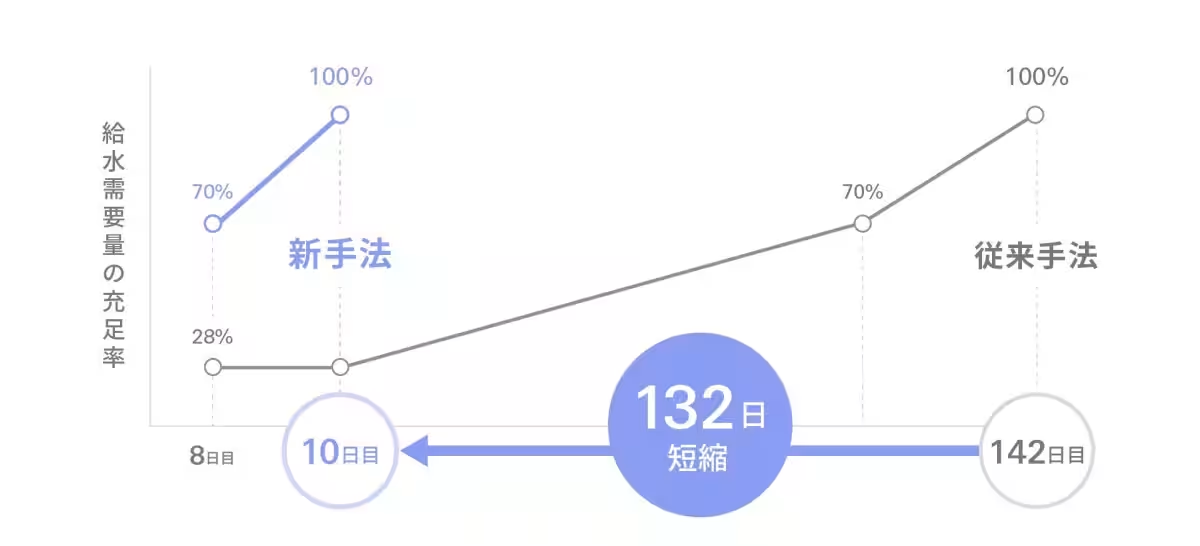
The time needed to meet the water supply needs of evacuees also saw remarkable improvements. Traditional methods required a staggering 142 days post-disaster, while the introduction of water circulation systems reduced this timeframe to just 10 days, representing a substantial 132-day shortening.
The Need for Documented Procedures
Accompanying the report, WOTA has also released a manual for the implementation of such systems in evacuation centers. This manual focuses on practical applications derived from both case studies within the research and WOTA’s previous disaster response experiences. Although not formally evaluated by the A-JUMP Project Evaluation Committee, it prioritizes usability for practitioners contemplating the introduction of water circulation systems in emergency situations.
In conclusion, as water infrastructure faces various risks during disasters, it is vital to visualize the required supply volumes for evacuees and achieve societal agreement on realistic emergency water supply methods. By demystifying the needs for these systems nationwide and standardizing their deployment, WOTA aims to facilitate effective preparation and response to future disaster scenarios. The company believes that continued collaboration with government entities, local authorities, and businesses will strengthen living water supply and hygiene during emergencies, ultimately promoting the widespread adoption of effective disaster water stress countermeasures.
About WOTA Corporation
Founded in 2014, WOTA Corporation is a private enterprise dedicated to solving structural water issues. The company has developed decentralized water circulation systems and self-regulating wastewater treatment technologies to tackle challenges associated with the uneven distribution, depletion, and contamination of water resources across the globe. Their innovation includes a home water circulation system, already implemented in select regions to ensure reliable water access during both everyday and emergency situations.
For more information, visit WOTA Corporation.
Topics Consumer Technology)
【About Using Articles】
You can freely use the title and article content by linking to the page where the article is posted.
※ Images cannot be used.
【About Links】
Links are free to use.